The 9 Best Angle Gauges
Updated by · How we research

Nine digital angle gauges and finders compared for saw setup, trim and metalwork. The Klein 935DAG leads for its tight rating near level and plumb. When users buy our independently chosen editorial picks, we may earn commissions to help fund the Wiki.
The bevel scale printed on most table saws and miter saws is only a rough guide, which is why woodworkers set blades with a digital angle gauge zeroed on the saw table. Most read to a tenth of a degree and are rated within a fifth. Magnetic cubes handle saw setup, while two-arm finders measure corners, trim and steel parts.


Editor's Notes
November 1, 2026, by Ezvid Wiki Editors:
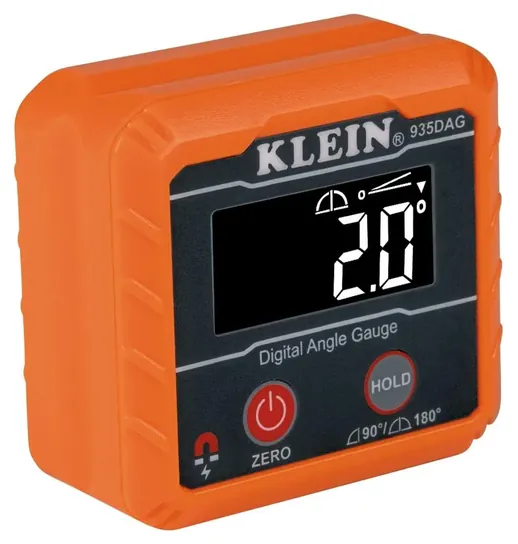
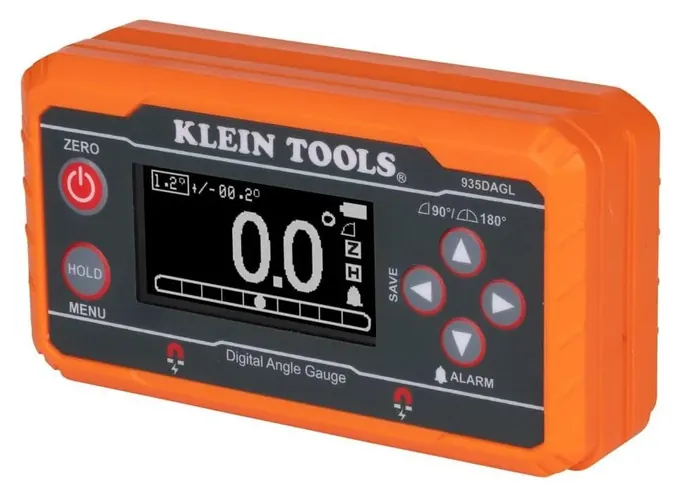
The Klein 935DAG now leads: Klein rates it to a tenth of a degree right at level and plumb, the settings woodworkers make most, and it costs no more than other good cubes. This page covers both tools people mean by angle gauge: magnetic cubes for setting saw blades and two-arm finders for corners and steel.
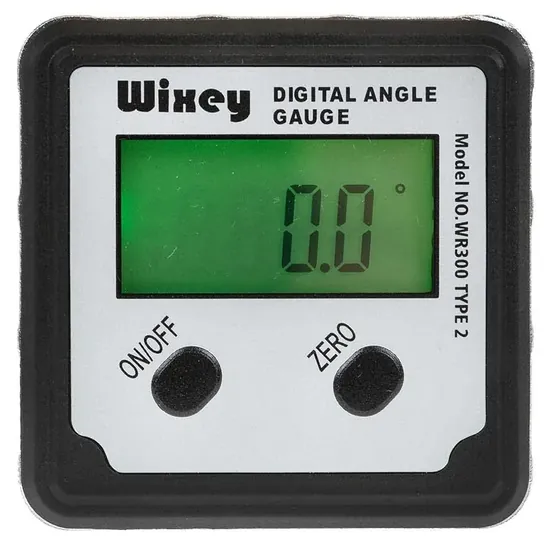
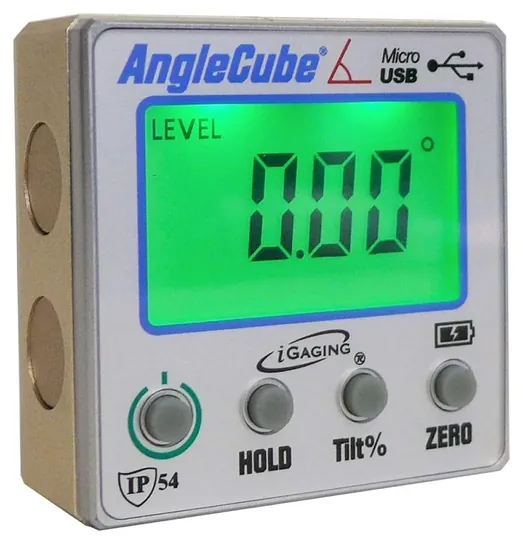
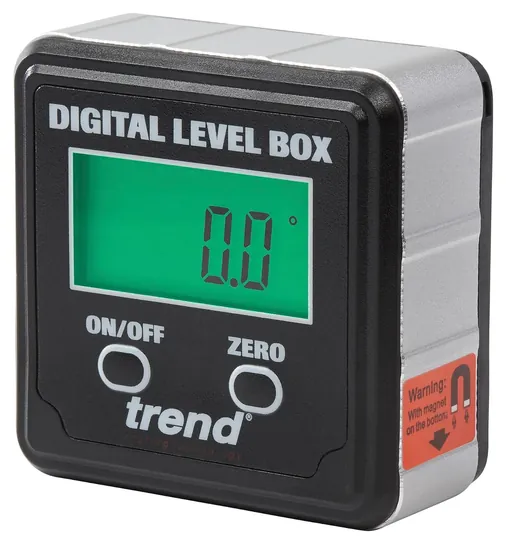
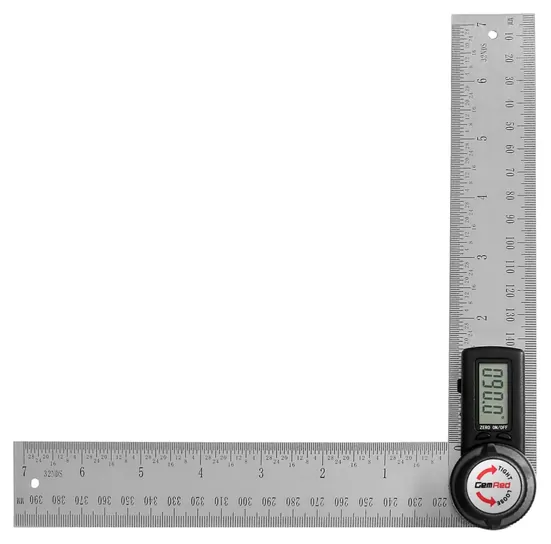
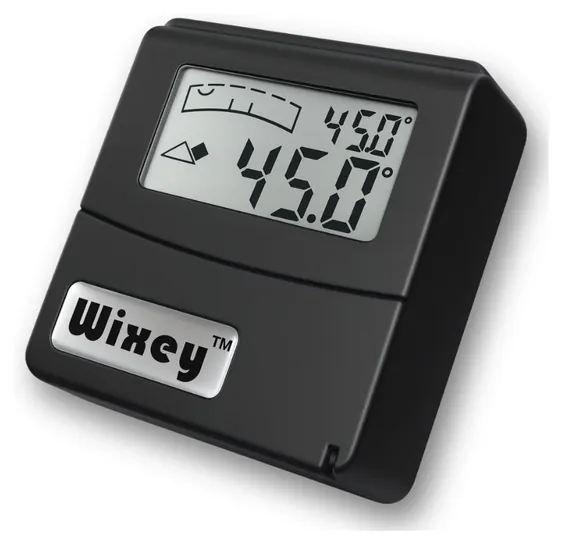
We kept the Wixey WR365, the Bosch GAM 270 MFL and the Fowler, now sold as the Fowler Digi-Level Pro. New are the Wixey WR300 Type 2, the iGaging AngleCube Gen 3, which replaces the original iGaging AngleCube, the Trend Digital Level Box, the GemRed 82305 and the Klein 935DAGL. The Mitutoyo 950-317 is no longer available. The Risepro 82413B, Calculated Industries AccuMaster, Brown Line BLDAG001 and Irwin Tools 1794488 went because we couldn't document them as well as the gauges that replaced them.
The best evidence here is old but solid: Fine Woodworking checked digital gauges against machinist angle plates, and woodworking forums show how the cubes hold up over years of saw setup. However good the gauge, make a test cut before you trust a setting.
Earlier notes
May 11, 2021, by Will Rhoda:
With the exception of the GemRed DEK95, which was unavailable at the time of this writing and removed as a consequence, all of our selections from last round were still available and reviewing well, but we really didn’t feel like they represented the best that the category had to offer, so we had to choose a few to let go of, in order to make room for some new, high-end options. In the end, the tools we decided to omit were the Horusdy 97352, AccuRemote AT203919 and CMT DAG-001.
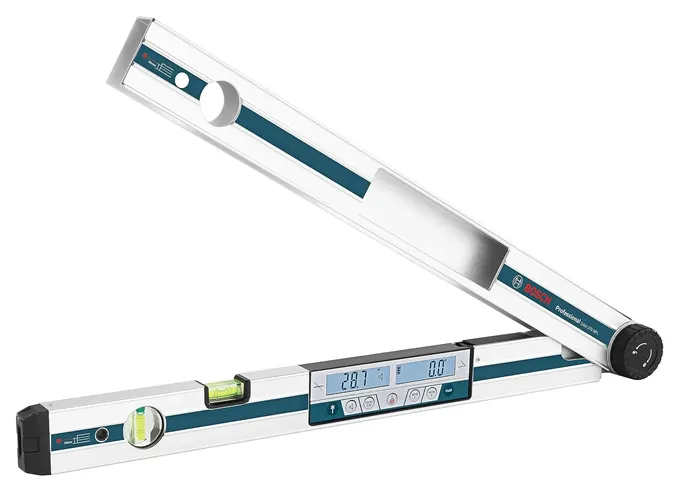
Our most impressive new addition was likely the Bosch GAM 270 MFL, which comes in a zippered carrying case and has an integrated laser that lets you go 100 feet further with your inclinometer readings. Its 17-inch length might help increase the accuracy of its level measurements, when compared to shorter models, and it also makes room on the unit for handy digital displays that let you observe two sets of readings simultaneously, without toggling between modes.
We also added the Japanese-made Mitutoyo 950-317, which costs even more than the GAM 270 MFL, although it is arguably less functional. Nonetheless, we thought it was worth including for the benefit of any professional who’s willing to pay a premium for the peace of mind that comes with a top-shelf measuring instrument.
The Irwin Tools 1794488 is an affordable, analog instrument that we installed near the bottom of our list, to benefit users on a budget, and the Klein Tools 935DAG caught our eye with its 90-degree operating mode, which is an ideal setting for sparkies wrestling with conduit benders.
If you make it the whole way through these rankings without finding an option that appeals to you, then you might find you have better luck with our specialized lists of digital protractors and digital levels.
January 16, 2020, by Rafael Perez:
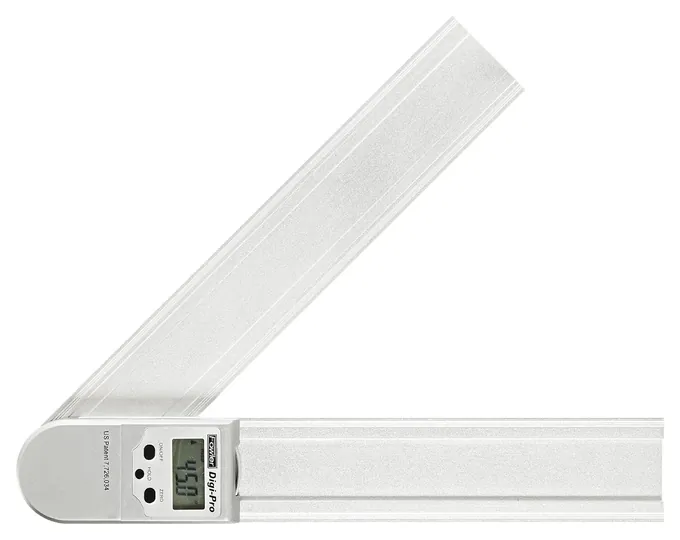
Removed the Capri Tools 20005 because of availability concerns and because it is essentially just a clone of the CMT DAG-001. Added the Fowler Digi-Pro to include more protractor-style models.
The term "angle gauge" is quite ambiguous. Technically anything that reads angles is an angle gauge and there is no single correct referent. For the sake of simplicity we have included level and protractor-style models because they are the most widely used for finding rough angles in construction, woodworking, and metal fabrication. It is difficult and implausible to compare their properties given that they have different functions.
As far as protractor style models, the Fowler Digi-Pro stood out for its relative affordability given that it is quite well-built - it has all-aluminum arms with strong magnets, a heavy detent, and an accurate angle sensor. As far as level-style gauges, the Wixey WR365 offers great movement sensitivity in virtue of its high-quality accelerometer and is portable enough to use when setting circular or table saws.
The accuracy of the AccuRemote AT203919 is adequate for tasks such as leveling studs, transferring rafter angles, and other tasks that many people would use this model for. It's also true that it is not accurate enough for precision work such as machining and the like. Therefore we think it's both true that it is not good for precision work but still good enough to include in the ranking.
The Brown Line BLDAG001 main purpose is to be paired with torque wrenches and ratchets which does not require great accuracy. Its +- 2% accuracy is adequate for that use but we included the negative bullet point to communicate the fact that it won't be accurate enough for use as a general angle gauge. It is an angle gauge and it is accurate enough for its intended use. So that's why we thought that its accuracy should be noted but that the margin of error for its intended use justifies its inclusion.
Special Honors
Starrett Starrett, a Massachusetts toolmaker since 1880, still makes universal bevel protractors with vernier scales that read to 5 minutes of arc, a twelfth of a degree, through a full circle. They need no batteries and suit machinists and inspectors who want a reference to check digital gauges against. starrett.com
Digi-Pas Digi-Pas makes precision machinist levels for leveling machine tools and equipment. Dealers list its two-axis DWL-3500XY with a resolution of 0.001 degree and USB or Bluetooth output, at a price in the thousands, far past woodshop needs. digipas.com
Cube Or Two Arms: Match The Gauge To The Job
Most digital angle gauges are small cubes with a gravity sensor and a magnetic base.
Most digital angle gauges are small cubes with a gravity sensor and a magnetic base. They read tilt, so you zero one on a reference surface, such as a saw table, and it then shows the angle of whatever it sits on relative to that surface. That makes cubes the tool for setting a table saw blade, a miter saw bevel, a jointer fence or a drill press table. Most are rated within 0.2 degree and display 0.1 degree; Wixey and Trend publish those figures, and Klein rates its 935DAG to 0.1 degree within a degree of 0, 90 and 180 (Klein spec via Gerrie).
A two-arm angle finder works differently. Its arms open against two surfaces, so it reads an inside or outside corner, a crown molding wall angle or the angle between two steel parts, with no need to zero first. The GemRed 82305 is a pocket version rated to 0.3 degree. The Bosch GAM 270 MFL adds long arms, a miter calculator and 0.1-degree accuracy for trim carpenters, and the Fowler Digi-Level Pro puts magnets in both blades for metalwork. If you mostly set machines, buy a cube. If you mostly fit trim, buy arms.
Setting A Saw Blade, Step By Step
Unplug the saw first and keep it unplugged while the gauge is on the blade. Clean the table and the blade body: a crumb of sawdust under the gauge throws off the reading. Set the gauge on the table and press zero, then stick it to the flat plate of the blade, clear of the teeth, and tilt the blade until the screen reads your target. This is where a gauge earns its keep, because the bevel scale printed on many saws is only a rough guide.
Check the gauge itself now and then. Zero it on a flat surface, turn it end for end, and look at the reading: if it isn't close to zero, the gauge has an offset. One Sawmill Creek thread describes two units that disagreed by more than a degree. Then make a test cut, as Fine Woodworking advises: two pieces mitered at 45 degrees should close to a square corner. Popular Woodworking's Roger Holmes used a Wixey the same way on a table saw, jointer, miter saw and band saw (Popular Woodworking).
What Accuracy Ratings Mean In Practice
A rating of plus or minus 0.2 degree sounds tiny, and for most work it is. Over a 12-inch cut, 0.2 degree moves the far end about 0.04 inch, a bit more than 1/32 inch. Errors add up in a frame, though: four miters each off by 0.2 degree leave the last joint open by more than a degree. That's why a test cut still matters.
Resolution is not accuracy. A screen that shows 0.05 degree, like the iGaging AngleCube Gen 3, steps in finer increments, but its rated accuracy is still 0.2 degree. For a true 90-degree setting, a good machinist square still beats any digital gauge, according to Fine Woodworking, and a 2007 Fine Woodworking review found a Wixey's readings matched precision angle plates (Fine Woodworking). Woodworkers who need finer than 0.1 degree, such as machinists leveling equipment, move up to precision machinist levels, which cost far more.
How we researched this
We compared 21 angle gauges and finders, read makers' and dealers' spec sheets for the nine picks, used Fine Woodworking's and Popular Woodworking's checks of digital gauges, read owner discussions on woodworking forums, and searched the U.S. Consumer Product Safety Commission's recall records for the major brands.
Sources (7)
Frequently asked questions
What is an angle gauge?
An angle gauge reads the angle of a surface or between two surfaces. Digital cube gauges read tilt against gravity and are used to set saw blades and machine tables. Two-arm angle finders read the angle between two surfaces, such as a wall corner.
Is an angle gauge the same as an angle finder?
The names overlap. Shops usually call the magnetic cubes angle gauges and the two-arm tools angle finders or digital protractors. A digital level uses the same tilt sensor as a cube gauge, often in a longer body.
Is a digital angle gauge accurate enough for miter cuts?
Yes for most woodworking. Typical ratings are within 0.2 degree, and some models are rated to 0.1 degree near 0 and 90. Errors add up across several joints, so make a test cut before a run of frames or boxes.
Can a digital angle gauge replace a square?
Not for a true 90-degree check. Fine Woodworking found that a good machinist square still beats a digital gauge at 90 degrees. Gauges are most useful for bevels and other angles a square can't show.
How do I check whether my angle gauge is accurate?
Zero it on a flat surface, turn it end for end on the same spot and read it again. A reading well away from zero means an offset. Recheck after a drop and replace weak batteries, which can cause odd readings.