The 8 Best Transmission Additives
Updated by · How we research

Match the bottle to the problem: shudder, slipping, CVTs, varnish or leaks. Eight transmission additives compared; Lubegard Instant Shudder Fixx ranks first. When users buy our independently chosen editorial recommendations, we may earn commissions to help fund the Wiki.
Only a few transmission additives are safe in CVTs or dual-clutch gearboxes, and most general ones warn against CVTs. A transmission additive is a small bottle poured into transmission fluid to change how it behaves. Drivers of older cars use them to calm shudder, soften hard or slipping shifts, clean varnish or slow leaks.


From the manual
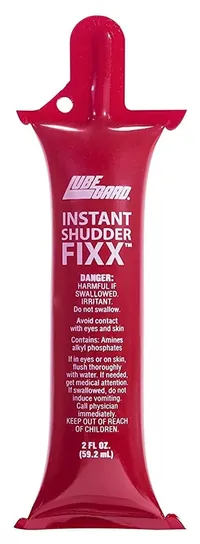
- Classed as a skin and eye irritant; Lubegard calls for protective gloves and a thorough wash after handling. p. 1
- Not flammable, with a flash point above 205 C, but don't store it above 120 F. pp. 4-5
- If the shudder comes back, one more tube may be added; after that, not again until the fluid is fully changed. Lubegard FAQ
- Lubegard calls it a quick fix and points to its ATF Protectant for lasting protection. Lubegard FAQ
Why the Lubegard Instant Shudder Fixx is our top pick
Our pick wins because it's the narrowest fix and the easiest to judge: one tube aimed at torque converter shudder,1 a symptom often traced to the fluid itself. When GM chased light-throttle shudder in its 8-speed automatics, it blamed fluid that absorbs moisture, and its fix was a fluid exchange, not new parts.7 Its maker says the tube is often used as a test, because a shake that stays points to a mechanical fault.4 It empties straight into the fluid through the dipstick tube, in any automatic except CVT, dual-clutch and older Ford Type F units.1
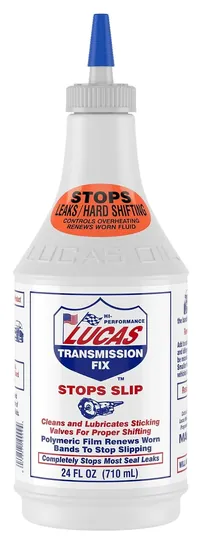
Our runner-up, the Lucas Transmission Fix, works another way. It's a thick oil, 40 centistokes at 100 C,5 that coats worn gears and clutches with a film to calm slip, hesitation and rough shifts.5 It takes more planning: a full 24-ounce bottle, half that in compact cars, and perhaps a second bottle in large or badly worn transmissions.5
The runner-up wins on reach and handling. It may go in manual gearboxes,5 and its safety sheet lists no hazard class,6 while our pick irritates skin and eyes.3 Its own maker calls the tube a quick fix, allows one repeat dose before a full fluid change, and points to its ATF Protectant for lasting care.2
| Lubegard Instant Shudder Fixx | Lucas Transmission Fix | |
|---|---|---|
| Aimed at | Torque converter shudder | Slip, hesitation, rough shifts |
| Dose | One 2 oz tube | 24 oz; 12 oz in compacts |
| Not for | CVT, dual-clutch, Ford Type F | CVT, dual-clutch |
| Manual gearboxes | Not listed | May be used |
| Safety-sheet hazards | Skin and eye irritant | None classified |
Sources
- Lubegard Instant Shudder Fixx 1Product page 2Lubegard FAQ 3Safety data sheet, 2025 (PDF), p. 1 4Lubegard product guide, 2016 (PDF, distributor copy), p. 19
- Lucas Transmission Fix 5Product data sheet, 2024 (PDF, archived), pp. 1, 2 6Safety data sheet, 2025 (PDF), p. 1
- 7GM TechLink: TCC shudder and new Mobil 1 fluid exchange (2019)
From the manual
- One 24 oz bottle goes into existing fluid without draining; compacts take 12 oz, large or badly worn units may need a second. p. 1
- Not recommended for belt-driven CVTs or dual-clutch gearboxes, but it may be used in manual transmissions. p. 1
- Typical viscosity is 40 centistokes at 100 C, which is why it pours so slowly. p. 2
- Lucas says to add it with the engine warm and idling, and one bottle with each fluid change. Lucas UK page
Compare the specs
Swipe the table sideways to see every column.
| Product | CVT use (per maker) | Dose (fl oz) | Safety-sheet warning |
|---|---|---|---|
| 1. Lubegard Instant Shudder Fixx | No | One 2 oz tube | Skin and eye irritant |
| 2. Lucas Transmission Fix | No | 24; 12 in compacts | None classified |
| 3. Lubegard CVT Recharge & Protect | Yes, made for it | 1 per quart | — |
| 4. Hot Shot's Shift Restore | Yes | About 1.5 per quart | None classified |
| 5. Lubegard 60902 ATF Protectant | No | 1 per quart | Skin allergy |
| 6. Sea Foam Trans Tune | Yes, petroleum fluids | 16 per transmission | Highly flammable |
| 7. ATP AT-205 Re-Seal | — | — | Combustible, kidney risk |
| 8. BG ATC Plus | No | 6 or 11 by capacity | None classified |
Makers' own figures. Doses are per quart of total transmission capacity unless noted; BG uses 6 oz up to 8.5 quarts and 11 oz from 8.5 to 14. ATP posts no dose on its own site, and Lubegard publishes no safety sheet for the CVT bottle that we could find. BG's sheet dates from 2016.
Sources
- Lubegard Instant Shudder Fixx page Instant Shudder Fixx safety data sheet (2025) CVT Recharge & Protect page CVT Recharge & Protect data sheet ATF Protectant page ATF Protectant safety data sheet (2025)
- Lucas Oil Transmission Fix data sheet (archived) Transmission Fix safety data sheet
- Hot Shot's Secret Shift Restore page Shift Restore safety data sheet (2023)
- Sea Foam Trans Tune page Trans Tune safety data sheet (2019) Answer on CVT use
- ATP Automotive AT-205 safety data sheet (archived)
- BG Products ATC Plus directions (archived 2025) ATC Plus safety data sheet (2016)
From the manual
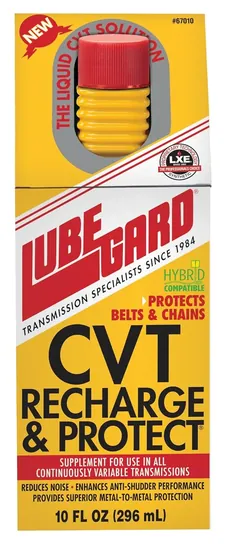
- One 10 oz bottle treats 6 to 10 quarts at 1 oz per quart; never exceed 2 oz per quart or overfill. p. 2
- Shake it before use, and allow up to 150 miles for the full effect. p. 2
- Lubegard advises a fluid and filter change alongside it; it says the filter helps with hesitation. p. 2
- The sheet's only evidence is Lubegard's own wear test on used Honda and Nissan CVT fluid. p. 2
From the manual
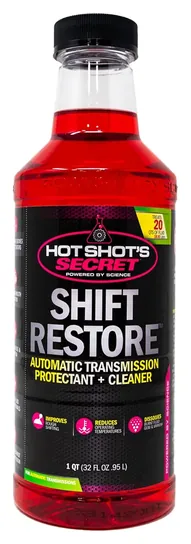
- The chart doses 1.6 oz per quart for friction, or 2.4 oz per quart for added seal protection. pp. 1-2
- Add it at every fluid change to keep the benefit. p. 2
- Hot Shot's says it swells seals 1.5 to 3 percent, then lubricates them. p. 2
- Its 2023 safety data sheet lists no hazard class, with a flash point above 258 C. safety sheet, pp. 1, 4
From the manual
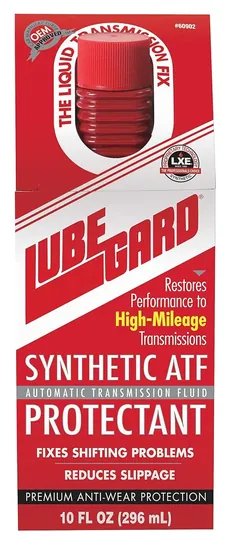
- Classed as a skin sensitizer: it may cause an allergic rash, so wear gloves when pouring. p. 1
- Not for CVT, dual-clutch or 1986-and-older Ford Type F units; it also suits manuals that take ATF. Lubegard product page
- The dose is 1 oz per quart of total capacity, so one 10 oz bottle covers about 10 quarts. Lubegard product page
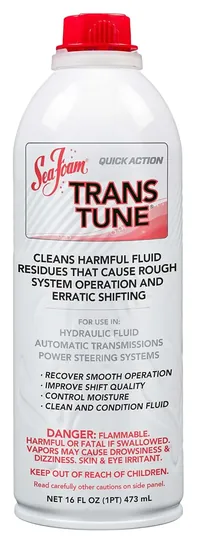
From the manual
- Highly flammable, with a flash point of 55 F; keep it away from sparks, open flame and hot engine parts. pp. 1-2, 5
- Harmful or fatal if swallowed and can enter the lungs; Sea Foam says to store it locked up. p. 2
- Add the 16 oz can without draining unless the level is overfilled; before a fluid change, drive at least 30 miles first. Sea Foam product page
- Sea Foam says it suits CVTs that use petroleum-based fluid, and manual gearboxes too. Sea Foam Q&A
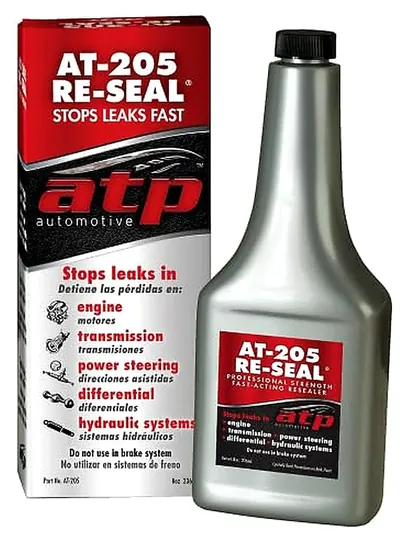
From the manual
- Combustible, flash point 187 F; it may damage kidneys and may be fatal if swallowed and it enters the airways. pp. 2-3
- ATP lists engines, automatic and manual transmissions, power steering, differentials and hydraulics, plus hardened rubber like sunroof seals. ATP release
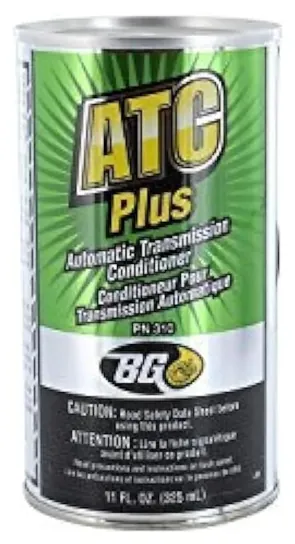
From the manual
- Sized by capacity: 6 oz for up to 8.5 quarts, 11 oz for 8.5 to 14 quarts. BG catalog page
- Not recommended for CVTs, dual-clutch units or Ford Type F. BG catalog page
- BG sells only to licensed shops, and a do-it-yourself buyer doesn't qualify for its lifetime protection plan. BG shop finder
- The 2016 sheet lists no hazard class, with a flash point of 198 C. pp. 1, 4
Editor's Notes
November 4, 2026, by Ezvid Wiki Editors:
We read the makers' data and safety sheets for all eight picks, added a spec table and a section on why the shudder fix is first, and named each bottle's hazards. We corrected the Sea Foam item, which wrongly ruled out manual gearboxes, and noted that BG sells only through repair shops. Two older notes got updates on the renamed Sea Foam and Hot Shot's products.
October 18, 2026, by Ezvid Wiki Editors:
The old list mixed real fixes with products that rest on bold claims, so we rebuilt it around the problem you're trying to solve: shudder, slipping, a CVT, varnish or a slow leak. Lubegard Instant Shudder Fixx stays, now under the Lubegard name instead of Dr. Tranny. Lubegard CVT Recharge & Protect is new, because CVTs are everywhere and most additives warn against them. ATP AT-205 Re-Seal joins for small leaks. We dropped LubeGuard Platinum, Liqui Moly 20040 and Dr. Tranny's Kooler Kleen because of availability concerns, and Prolong and XADO went too, since their metal-treatment claims rest on the makers' word alone. One honest caveat: nobody has published a careful independent test of these products, so think of any bottle as a modest help for a mild problem, not a rebuild in a can.
Earlier notes
February 4, 2021, by Christopher Thomas:
First and foremost, make sure you're getting an additive that is both safe for your transmission and appropriate for whatever specific issue you're having. Aside from that, we haven't made any major changes to this round of recommendations, because by and large, there haven't been any groundbreaking advancements in transmission fluid technology. Take Lucas Transmission Fix, for example, which has been around for a very, very long time and is still the standard by which many others are judged.
To reinforce the point that your use case is the most important factor here, there are also highly versatile options like Sea Foam Hydra Trans Tune that are good for refreshing seals in a range of high-pressure components. [2026 update: Sea Foam now sells it as Trans Tune and pitches it as a varnish cleaner you add to the fluid. It says it won't swell seals and makes no claim to recondition them.] This, and others like Dr. Tranny's Kooler Kleen, aren't so much additives as they are treatments to be used during the flushing process - and that's something that only highly experienced individuals should undertake, due to the risk of stirring up sludge and unintentionally damaging your transmission.
August 20, 2019, by Brett Dvoretz:
Along with the engine and brakes, a well-maintained transmission is one of the most vital aspects of keeping a vehicle in good working order. Unfortunately, it is also one of the most expensive components to fix, so rather than immediately running to the mechanic as soon as you notice a problem, consider trying one of these effective transmission additives first.
If you are experiencing slippage or hesitation during or after changing gears, we recommend you take a look at Lucas LUC10009, Prolong Super Lubricants PSL15000, and Liqui Moly 20040. All of these contain ingredients that can help make shifting smoother and restore some responsiveness. If your transmission isn't slipping, but rather just feeling very rough when shifting or shuddering periodically at slow-to-medium speeds, you'll want to look to LubeGuard Platinum and Dr. Tranny Instant Shudder Fixx.
Additives can do much more than simply make transmissions run smoother. For example, many of the formulas on our list recondition seals, however the best options for stopping minor leaks are Lucas LUC10009 and Liqui Moly 20040. If you need to rid your system of rust and minor surface damage on metal components within the transmission, Xado EX120 Revitalizant and Hot Shot's Secret Restore TSE can both help with that. [2026 update: Hot Shot's product is now called Shift Restore and is sold as a varnish cleaner. Its maker says it prevents rust, not that it repairs worn metal.]
On another note, you shouldn't always wait until experiencing a problem with your transmission before reaching for an additive. Using Lucas ATF Conditioner with a good transmission fluid can go a long way towards preventing the formation of any problems in the future.
Special Honors
Justice Brothers Transmission Line Justice Brothers sells its car-care chemicals through its own distributors, and parts stores such as NAPA carry the line in some regions. Its transmission range includes a Transmission Protectant, an Automatic Transmission Conditioner, a Transmission Cleaner, a Trans Stop-Leak and a Universal CVT Conditioner, so a shop that carries the brand can treat a conventional automatic or a CVT from one line. Ask a local shop or parts store whether it stocks them. justicebrothers.com
Match The Additive To The Problem
Some problems no bottle can fix: burned clutch packs, a failed solenoid or sensor, a broken part, or a big leak.
Transmission additives aren't interchangeable. Each type changes the fluid in a different way, so start with the symptom.
Shudder that feels like driving over rumble strips at a steady, light throttle often comes from the torque converter clutch. A friction modifier such as Lubegard Instant Shudder Fixx changes how the clutch grabs and is the most targeted fix. That shake is often rooted in the fluid itself: when GM traced light-throttle shudder in its 8-speed automatics to fluid that absorbs moisture, its fix was a full fluid exchange, not an additive, after technicians ruled out tire and driveline vibration. Slipping, hesitation and hard shifts on a worn automatic are what thickened stop-slip products like Lucas Transmission Fix aim at; they add body to the fluid and seal conditioners to tired seals. Erratic or sticky shifts can come from varnish on the valve body, which is the job of cleaners such as Sea Foam Trans Tune and Hot Shot's Shift Restore. Slow drips call for a seal conditioner, not a thickener.
Some problems no bottle can fix: burned clutch packs, a failed solenoid or sensor, a broken part, or a big leak. Repair writers at YouCanic report mixed results with Lucas and say it does nothing for electrical faults. If the fluid is dark and smells burned, or a scan tool shows a transmission code, get a diagnosis first.
Check The Transmission Type And Fluid First
Your transmission's fluid spec matters more than any additive. Automakers specify their own fluids, such as Dexron, Mercon, ATF+4, Honda DW-1 and Toyota WS, and CVTs and dual-clutch gearboxes use different fluids again (Wikipedia: automatic transmission fluid). An additive tops up or tweaks that fluid; it doesn't turn the wrong fluid into the right one.
CVTs are the biggest trap. Their steel belt or chain depends on precise friction, and most general additives say not to use them in a CVT. Lucas lists CVTs and dual-clutch units as not recommended for its Transmission Fix, and Lubegard excludes them for Shudder Fixx. For a CVT, use a product made for it: Lubegard CVT Recharge & Protect is dosed at 1 ounce per quart, never more than 2. Hot Shot's and Sea Foam also say their cleaners suit CVTs. Very old Fords that call for Type F fluid are another exception: Lubegard says those units should never get any additive, because they need their clutches to grab hard.
Manual gearboxes usually take gear oil or a dedicated manual transmission fluid, and only some additives allow them. Check the owner's manual, because some automakers, Ford among them, advise against any additive.
Do Additives Work, And How To Add One Safely
The honest answer is: sometimes, a little, for a while. No independent lab has published a careful comparison of these products, and the results you'll find are makers' charts, shop blogs and owner reports. A transmission shop writing at Advanced Transmission says additives can give short-term relief on a worn unit but can't replace repairs, and that the wrong one can cause problems. A fluid and filter service often does more, and Lubegard recommends one alongside its CVT product.
To add one, warm the vehicle, park on level ground and check the level the way the owner's manual says. Use a long, clean funnel down the dipstick tube or fill port, and pour slowly; thick formulas take time. Every bottle raises the level, so drain a little fluid first only if the level is already full. Lubegard warns against overfilling, and Hot Shot's notes that its bottle displaces an equal amount of fluid. Recheck the level after a short drive.
Read the label. Some of these bottles are flammable or harmful if swallowed, so store them away from heat and children, and take used fluid to a recycling site. On warranties, the FTC says a company generally can't void a warranty just because you used another brand's product, but it can deny a claim for damage that product caused.
How we researched this
We compared 22 transmission additives and read the makers' own papers for the eight picks: Lubegard's 2025 safety data sheets for Instant Shudder Fixx and the 60902 ATF Protectant, its CVT Recharge & Protect data sheet and 2016 product guide, Lucas's Transmission Fix data and safety sheets, Hot Shot's Shift Restore data and safety sheets, and the safety data sheets for Sea Foam Trans Tune, ATP AT-205 and BG ATC Plus, along with each maker's directions. YouCanic's repair writers, a transmission shop's advice and GM's TechLink note on converter shudder showed what a bottle can and can't do. A November 2026 search of CPSC and Health Canada recalls found none for these eight; Sea Foam's only one, in Canada in 2011, covered the labels on its Motor Treatment.
Sources (33)
- Lubegard: Instant Shudder Fixx
- Lubegard: Instant Shudder Fixx safety data sheet (2025)
- Lubegard: CVT Recharge & Protect
- Lubegard: CVT Recharge & Protect data sheet (distributor copy)
- Lubegard: Automatic Transmission Fluid Protectant
- Lubegard: ATF Protectant safety data sheet (2025)
- Lubegard: FAQ
- Lubegard: 2016 product guide (distributor copy)
- Lucas Oil: Transmission Fix
- Lucas Oil UK: Transmission Fix directions
- Lucas Oil: Transmission Fix data sheet (2024, archived)
- Lucas Oil: Transmission Fix safety data sheet (2025)
- Hot Shot's Secret: Shift Restore
- Hot Shot's Secret: Shift Restore technical data sheet (2020)
- Hot Shot's Secret: Shift Restore safety data sheet (2023)
- Sea Foam: Trans Tune
- Sea Foam: Trans Tune safety data sheet (2019)
- Sea Foam: Trans Tune in a CVT
- Sea Foam: Trans Tune in a manual transmission
- ATP Automotive: AT-205 Re-Seal uses
- ATP Automotive: AT-205 safety data sheet (archived)
- BG Products: ATC Plus directions (archived 2025)
- BG Products: ATC Plus safety data sheet (2016)
- BG Products: where to buy BG products
- GM TechLink: TCC shudder and new fluid exchange (2019)
- YouCanic: Does Lucas Transmission Fix work?
- Advanced Transmission: Do transmission additives work?
- Wikipedia: Automatic transmission fluid
- FTC: Businessperson's Guide to Federal Warranty Law
- Justice Brothers: transmission and drive train products
- IMCA: Justice Brothers sponsor news (retail outlets)
- Health Canada: 2011 Sea Foam Motor Treatment recall
- CPSC SaferProducts
Frequently asked questions
Do transmission additives really work?
Sometimes, for mild problems. A friction modifier can calm torque converter shudder, and a conditioner or thickener may ease slipping or hard shifts on a worn unit. No independent lab has published a careful test, and additives can't fix broken parts, burned clutches or electrical faults.
Can an additive fix a slipping transmission?
Only mild slipping, and often only for a while. Check the fluid level first, since low fluid is a common cause. If the fluid smells burned or the slip is getting worse, see a transmission shop.
Can I put a transmission additive in a CVT?
Only one whose maker says it's safe there, such as Lubegard CVT Recharge & Protect, which is made for CVTs. Hot Shot's and Sea Foam also list CVT use for their cleaners. Most general additives, including Lucas Transmission Fix and Lubegard Instant Shudder Fixx, say not to use them in a CVT or dual-clutch transmission.
Will a transmission additive void my warranty?
Under federal law, a warranty generally can't require one brand of fluid or additive. But a carmaker can deny a claim if it shows the additive caused the damage, and some owner's manuals warn against additives.
How much additive should I add?
Follow the label and your fluid capacity. Lubegard CVT Recharge & Protect calls for 1 ounce per quart, Hot Shot's Shift Restore about 1.5 ounces per quart, and Sea Foam Trans Tune one full can. Never leave the transmission overfilled.
Is there an additive for a manual transmission?
Several. Lucas rates its Transmission Fix for light-duty manuals, Sea Foam and ATP say their bottles suit manual gearboxes, and Lubegard's ATF Protectant works in manuals that take ATF. Most manual gearboxes use gear oil or a specific manual transmission fluid, so check the owner's manual before adding anything.