The 7 Best EMF Detectors
Updated by · How we research

Seven EMF meters compared on magnetic, electric and radio readings, range and published accuracy. The Trifield TF2 leads for checking wiring and Wi-Fi at home. When users buy our independently chosen editorial choices, we may earn commissions to help fund the Wiki.
Household fields come in three kinds: magnetic fields from current, electric fields from live wires and radio waves from Wi-Fi and phones, and a meter only sees the kinds it was built for. These handheld readers help homeowners, renters and curious ghost hunters find hot spots. A reading shows how strong a field is, not whether it causes harm.


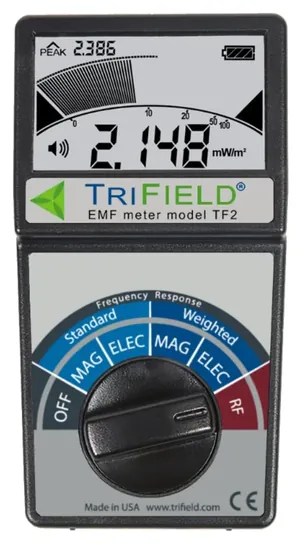
From the manual
- The backlight and sound buttons sit inside the battery compartment, not on the front. p. 3
- A refrigerator or washer door reading above 50 V/m can mean the appliance isn't grounded, which AlphaLab calls a shock hazard. p. 4
- Phone and Wi-Fi bursts show in the small peak number, held for three seconds; a smart meter pulses only about once a minute. p. 5
- The warranty is one year from purchase, and AlphaLab takes calls about readings on weekdays. pp. 5-6
Why the Trifield TF2 is our top pick
The TF2 carries tighter published accuracy ratings than our runner-up, the GQ EMF-390, for all three kinds of field. The gap is widest on radio: its maker rates our pick's sensor within 20% at 1 GHz,1 while the runner-up's is rated within 10 dB,3 a spread of about ten times either way in power. The magnetic and electric ratings are closer: 4% and 5% for our pick,1 5% and 10% for the runner-up.3
It is also simpler to read well. A knob picks Standard or Weighted for magnetic and electric fields; the weighted setting leans on frequencies above 60 Hz, which AlphaLab says drive more current in the body, and it advises reading both.2 The quick start gives quiet-home benchmarks, such as under 3 mG on standard magnetic and under 50 V/m electric,2 so a first reading has context. A 9-volt battery you can swap anywhere lasts more than 20 hours with the backlight off.1
The GQ is the better tool for some jobs. It reaches 10 GHz against our pick's 6 GHz,1,3 and it logs all three readings every second for about a day.3 For an overnight record of a bedroom, buy the GQ; for a dependable walk-through survey of wiring, appliances and Wi-Fi, the TF2 is the safer choice.
| Trifield TF2 | GQ EMF-390 | |
|---|---|---|
| Radio accuracy rating | ±20% at 1 GHz | ±10 dB |
| Radio range | 20 MHz to 6 GHz | 10 MHz to 10 GHz |
| Weighted mode | Magnetic and electric | Not listed |
| Data logging | None; 3-second peak hold | Every second, about 24 h |
| Power | 9 V battery, over 20 h | Rechargeable, about 24 h |
Sources
- Trifield TF2 1Specifications, AlphaLab 2Quick start guide and FAQ v1.9.5 (PDF), pp. 3–4, 4
- GQ EMF-390 3User guide, Rev 1.94 (PDF), pp. 5, 6, 21
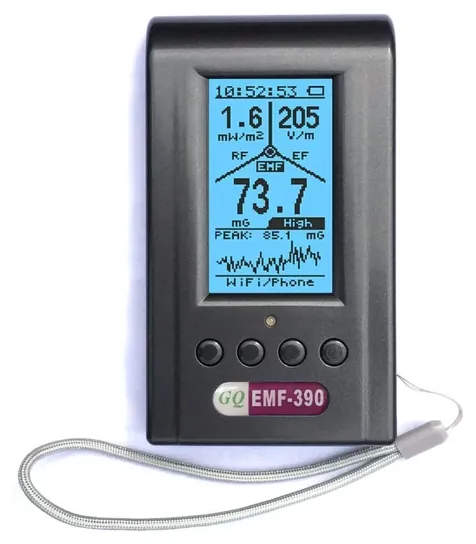
From the manual
- Set the date and time first: every logged reading is stamped with them, and a factory reset erases the whole history. pp. 14-15
- It can shut down before the battery gauge reads empty, so charge it fully before first use and before a long log. pp. 7-8
- The spectrum view covers set bands up to 2.5 GHz; above that, it reports only total radio power, up to 10 GHz. p. 27
- Free software exports logs as a spreadsheet file; GQ's download page also has a Mac version, and newer Windows needs no driver. pp. 5, 28
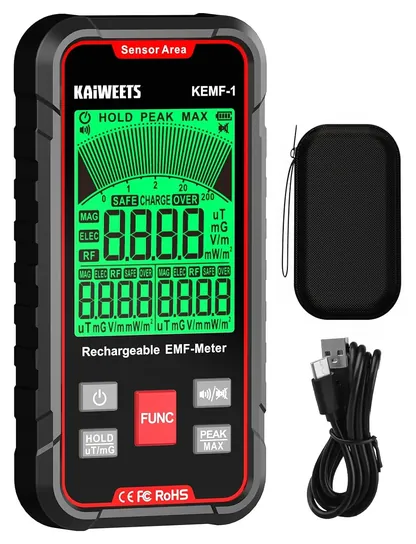
From the manual
- It switches off after about 15 minutes; holding HOLD while powering on cancels that, but only until the next start. p. 4
- The backlight turns orange from 1.2 mG and red at 4 mG on the magnetic reading, with a beep unless muted. pp. 6-7
- Kaiweets calls the readings a reference only and suggests an expert or another meter when accuracy matters. p. 9
- The warranty runs three years. p. 46
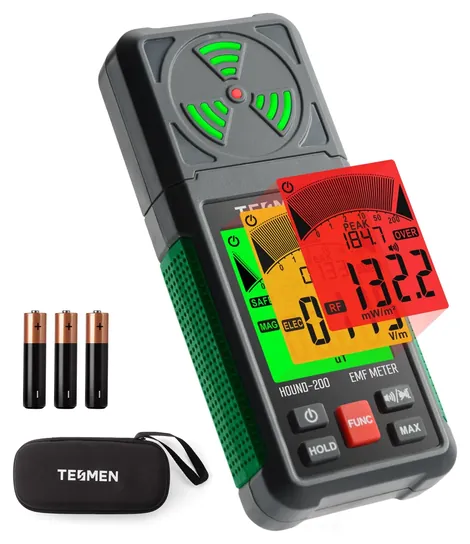
From the manual
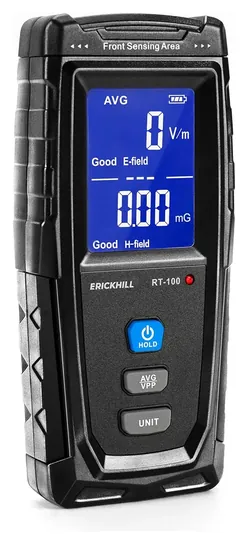
- It stops measuring while it charges, so it can't watch a room on USB power. p. 6
- A long press on the average/peak button silences the buzzer; otherwise it sounds at 40 V/m or 4 mG. pp. 6, 8
- A blank reading means the field is below what it can detect, not that the meter has failed. p. 5
Editor's Notes
November 5, 2026, by Ezvid Wiki Editors:
We read the manuals for the Trifield TF2, GQ EMF-390, Kaiweets KEMF-1 and Erickhill RT-100, added notes from them under each of those picks, and explained why the TF2 leads. We corrected several claims: GQ and Kaiweets do publish accuracy figures, GQ's software also runs on a Mac, the GQ's spectrum view stops at 2.5 GHz, and the Kaiweets radio sensor stops at 3.5 GHz. We also named the EMF consultant the guide quotes.
October 26, 2026, by Ezvid Wiki Editors:
The Trifield TF2 stays on top because AlphaLab publishes how accurate each of its sensors is; among the budget picks, only Kaiweets prints similar figures in the documents we could find. The GQ EMF-390 stays too, for readers who want to see Wi-Fi and phone signals in detail.
Six old picks are gone. The Meterk Tester, KKmoon AS1392 and Tacklife Meter have disappeared from sale, while the Cornet ED-88T, Acoustimeter AM11 and Cambridge Labs Rechargeable are unavailable. The Acoustimeter is still sold by its maker, so it moves to special honors.
The new picks cover a budget all-in-one meter, one on AAA cells, one that can stay on all day, a simpler meter for wiring worries and a cheap LED meter for ghost hunts. We leaned on the sensor specs AlphaLab and GQ publish, the World Health Organization's guideline levels for household fields, and an EMF consultant's write-up on why weighted meters read higher than flat ones. The budget meters' accuracy claims are their sellers' own, so treat their numbers as rough.
Earlier notes
December 19, 2020, by Kaivaan Kermani:
While all fields measured by EMF meters lie on the same spectrum, these devices measure the power of these fields, and not just their presence, and as the power or intensity of these fields is measured in different units – magnetic intensity is measured in microtesla or milligauss, for instance, whereas RF intensity is often expressed in decibel-milliwatts – it can cost more to build multiple layers of detection capabilities into an EMF tester. Models that include radio frequency testing typically cost the most, which is why it can be helpful to know what you want to measure beforehand. I’ve added the Acoustimeter AM11 which is arguably the best RF-only tester on the market, while the Trifield TF2 is arguably the best ‘all-around’ tester. I’ve also updated the Cornet ED-78S to the ED-88T – the latter model adds a faster sampling rate, among other tweaks.
November 16, 2019, by Kaivaan Kermani:
Removed some of the outdated models like the Sonic Technology Electrosensor and Lutron 822-A, and added newer devices like the Cambridge Labs Rechargeable and KKmoon AS1392. A particular favorite of mine is the newly added and rather versatile GQ EMF-390 for its detailed and rather data-populated display modes, as well as its RF power spectrum.
The K2 BL has aged quite well and is still a very user-friendly model with a simple interface - and it’s good on reliability and durability measures too. Conversely, the Technology Alternatives Cell Sensor hasn’t fared as well for its slight lack of sophistication and accuracy which may not have been the case in the EMF market in 2007 when it was first released. However, it’s very cheap and it’s still a great introductory model and option for your kids and teenagers who may not require such high levels of reading accuracy.
And yes, the Alternative Tech International Ghost Meter may still be a good choice for your paranormal adventures, though we question its capabilities with regards to more practical tasks.
Special Honors
Safe and Sound Pro II Safe Living Technologies' Safe and Sound Pro II is a dedicated RF meter for people who want more trust in their Wi-Fi and cell readings. The maker says it reads from about 200 MHz to 8 GHz, with accuracy certified by a third-party lab. It measures radio waves only, so pair it with a magnetic meter for wiring. safelivingtechnologies.com
EMFields Acoustimeter AM11 The Acoustimeter AM11 from British maker EMFields is an RF meter that shows both peak and average levels and plays the signal as sound, so you can hear the difference between Wi-Fi, phones and smart meters. It reads 200 MHz to 8 GHz, and the maker offers a five-year return-to-base warranty. It doesn't read magnetic or electric fields. emfields-solutions.com
Which Fields Does Your Meter Need To See?
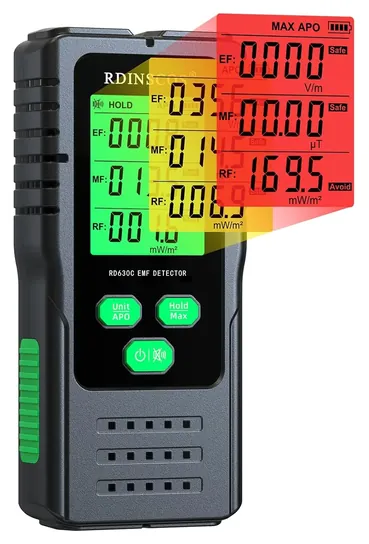
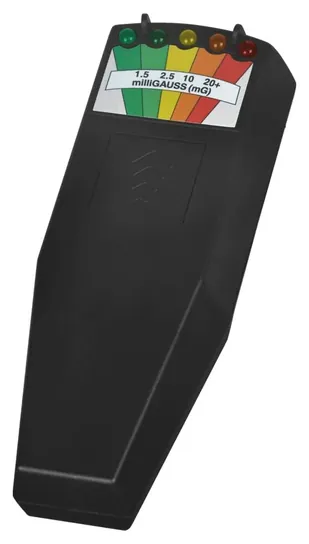
The Erickhill RT-100 and the AceFox LED meter have no RF sensor, so they won't react to a router at all.
Start with what worries you. Power lines, breaker panels, wiring in a wall and appliance motors make low-frequency magnetic fields, measured in milligauss (mG) or microtesla. Live cords and wiring make electric fields, measured in volts per meter, and they're there even when a lamp is switched off but still plugged in. Wi-Fi routers, phones, cell towers, smart meters and microwave ovens give off radio-frequency (RF) waves. The World Health Organization explains all three and gives typical household levels.
A meter only reads the fields it has sensors for. The Erickhill RT-100 and the AceFox LED meter have no RF sensor, so they won't react to a router at all. RF range matters too. The Trifield TF2 reads RF from 20 MHz to 6 GHz, and the GQ EMF-390 goes to 10 GHz. The Kaiweets KEMF-1 and the Tesmen Hound-200 stop at 3.5 GHz, which misses the 5 and 6 GHz Wi-Fi bands.
Watch for sensor axes as well. A three-axis magnetic sensor reads the same no matter how you hold it. A single-axis sensor, like the TF2's RF and electric sensors, has to be turned slowly until the number peaks.
What The Numbers Mean
A meter tells you how strong a field is, not whether it's harmful. The WHO cites a general-public guideline for power-frequency magnetic fields of 100 microtesla at 50 Hz, or 83 microtesla at the 60 Hz used in North America, which is about 830 mG. It notes that at about a foot away, most household appliances measure more than 100 times lower than that (WHO).
The 4 mG alarm built into many budget meters isn't a legal limit, and it sits far below the WHO figure, so expect it to sound near a refrigerator, a laptop charger or a fuse box. The National Cancer Institute sums up the evidence that keeps people cautious: the International Agency for Research on Cancer lists low-frequency magnetic fields as a possible carcinogen, based on limited evidence, and a European review linked daily averages above 3 to 4 mG to childhood leukemia without finding any mechanism. IARC gave cell phone use the same label in 2011. Most studies haven't found that household levels cause cancer.
RF units trip people up. The TF2 reads in milliwatts per square meter, while some meters use microwatts per square meter or nanowatts per square centimeter, and these differ by factors of 100 to 1,000. Check the unit on the screen before comparing. None of these meters detects radioactivity; that takes a Geiger counter.
How To Take A Useful Reading
Two meters rarely agree, even on the same spot. Some weight higher frequencies more heavily. Joel-Anthony Gray, who runs the Dallas consultancy ScanTech and lists more than 22 years as an EMF consultant, explains in an undated post on his firm's site how an older weighted Trifield, the analog 100XE, can show about 6 mG where a flat-response meter shows 3, because harmonics on the wiring count extra. Neither meter is broken; they're measuring differently.
RF readings are looser still. Even specialist RF meters such as the Safe and Sound Pro II and the Acoustimeter AM11 quote accuracy of plus or minus 6 decibels, which is about a factor of four in power. So use a home meter to find sources and compare rooms, not to prove an exact number.
For a fair survey, turn on the appliance you're checking, since a magnetic field only exists while current flows. Put your own phone in airplane mode so it doesn't swamp the RF reading. Hold the meter at the same height and distance each time, take several readings, and write down the low, typical and peak values. Then move away: field strength falls off quickly with distance, which is usually the simplest fix.
How we researched this
We compared 13 EMF meters and read AlphaLab's TF2 quick start guide and FAQ, GQ's EMF-390 user guide (revision 1.94), the Kaiweets KEMF-1 manual and the Erickhill RT-100 manual, plus the maker spec pages for the TF2, EMF-390, Tesmen Hound-200 and RT-100. RDINSCOS and AceFox publish no manual or maker page we could find, so those two entries rest on seller descriptions. The World Health Organization's field guidance, the National Cancer Institute's fact sheets and Dallas consultant Joel-Anthony Gray's notes on weighted meters shaped the buyer's guide. A November 2026 search of U.S. CPSC and Health Canada recall records found no recalls for any of the seven brands.
Sources (18)
- Trifield: TF2 EMF meter
- GQ Electronics: EMF-390
- AlphaLab: TriField TF2 quick start guide and FAQ (PDF)
- GQ Electronics: EMF-360V2/380V2/390 user guide, Rev 1.94 (PDF)
- GQ Electronics: software and user guide downloads
- Kaiweets: KEMF-1 user manual (PDF)
- Tesmen: Hound-200 EMF meter
- Erickhill: RT-100 EMF meter
- Erickhill: RT-100 user manual (PDF)
- World Health Organization: Radiation, electromagnetic fields
- National Cancer Institute: Electromagnetic fields and cancer
- National Cancer Institute: Cell phones and cancer risk
- ScanTech Technical Consulting (Joel-Anthony Gray): EMF meter frequency weighting
- Safe Living Technologies: Safe and Sound Pro II
- EMFields: Acoustimeter AM11
- EMF Guide: best radio frequency meters
- U.S. Consumer Product Safety Commission recalls
- Health Canada: recalls and safety alerts
Frequently asked questions
What does an EMF meter measure?
It measures the strength of fields around electrical things: magnetic fields from current, electric fields from live wiring and, on many models, radio waves from Wi-Fi, phones and smart meters. It shows how strong a field is where you hold it. It can't tell you whether that level affects your health.
What milligauss level is dangerous?
No harm from long-term, low-level household exposure has been confirmed. The WHO cites a public guideline of 100 microtesla at 50 Hz, about 830 mG at the 60 Hz used in North America. Most homes read a few mG or less away from appliances. The 4 mG alarm on budget meters is a precautionary setting, not a limit.
Trifield TF2 or GQ EMF-390: which should I buy?
Get the Trifield TF2 if you want dependable numbers for wiring, appliances and Wi-Fi, with a tighter radio accuracy rating and a simple knob instead of menus. Get the GQ EMF-390 if you care most about radio signals, want a spectrum display for common bands or need to log readings over time.
Do cheap EMF meters work?
They're fine for finding sources, like a breaker panel or a router, and for comparing rooms. Some publish no accuracy figure at all, and two cheap meters can read quite differently on the same spot, so treat their numbers as rough.
Can an EMF meter detect ghosts?
It detects fields from wiring, appliances and radios. A spike in an old house usually means a hidden wire, a bad connection or a phone nearby, so check for those first.
Does an EMF meter detect radiation from radioactive materials?
No. EMF meters read non-ionizing fields. Radioactivity needs a Geiger counter or another ionizing-radiation detector.