The 10 Best TV Antenna Amplifiers
Updated by · How we research

TV antenna preamps and distribution amps for weak or split signals, compared on gain, noise figure, filters and setup. The Winegard Boost XT LNA-200 leads. When users buy our independently chosen editorial selections, we may earn commissions to help fund the Wiki.
Too much gain near a tower makes reception worse, and no amplifier can fix a poorly aimed or undersized antenna. An amp only strengthens an over-the-air signal on its way to the TV. That helps rural viewers, homes with long cable runs and setups that split one antenna to several sets, and it does the most good mounted at the antenna.


From the manual
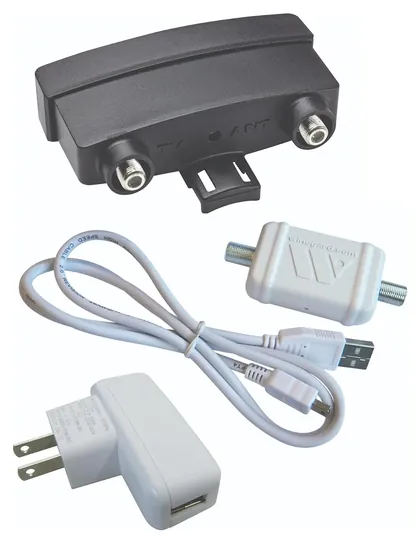
- Never run a cable from the inserter's ANT/AMP port to the TV; Winegard warns that hookup overloads and damages the inserter. p. 1
- The power inserter is indoor-only and must stay dry. Antenna, mast and coax aren't in the box. p. 1
- Feeding a splitter for several TVs? Power the USB cable from the wall adapter, not the TV's USB port. p. 1
- One-year warranty for the original buyer only; Winegard must approve a return first, and wind, lightning or ice damage isn't covered. p. 2
Why the Winegard Boost XT LNA-200 is our top pick
For distant stations on a long cable run, our pick publishes a 1 dB typical noise figure, the measure of how much hiss an amp adds, with 18 dB of gain.1 Solid Signal calls about 2 dB good on UHF and says that with digital signals, noise figure often matters more than gain.7 Our runner-up, the Televes TForce 560383, promises only "very low noise" and gives no figure to compare.4
That fixed 18 dB also roughly covers 100 feet of RG6 plus a four-way splitter, by Solid Signal's loss figures,7 and the amp runs on five volts sent up the coax from a USB adapter in the box.1 Its weak spot is cell filtering: a Winegard help article claims a 4G/5G filter,3 but the printed spec sheet and the product page don't list one,1,2 so a home near a cell site may need a separate filter.
The TForce is the better buy where stations arrive at very different strengths. It adjusts its own gain on each band, up to 31 dB on UHF,4,5 lists a 5G filter for signals above 608 MHz,4 and can power an amplified antenna, which our pick isn't made to work with.4,2 Both list a one-year warranty, the TForce's through Televes' US store.1,6
| Winegard Boost XT LNA-200 | Televes TForce 560383 | |
|---|---|---|
| Noise figure | 1 dB typical | Not published |
| Gain | 18 dB, fixed | Up to 31 dB UHF, automatic |
| Cell filter | Claimed in a help article only | 5G, on the spec sheet |
| Amplified antennas | Not supported | A switch can power one |
| Warranty | 1 year, return needs pre-approval | 1 year (Televes US store) |
Sources
- Winegard Boost XT LNA-200 1Instructions and warranty, part 2452296 (PDF), pp. 1–2, 2 2Product page and specifications 3Help center article
- Televes TForce 560383 4Product sheet (PDF), pp. 1, 2 5Product page and specifications 6US store warranty FAQ
- 7Solid Signal: choosing the right TV antenna amplifier
From the manual
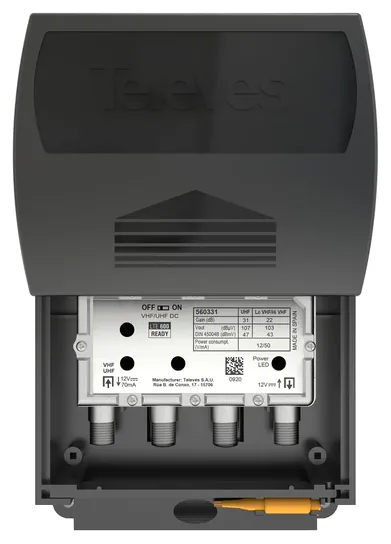
- Nothing to set: gain adjusts itself on each band, including when stations come from more than one direction. pp. 3-4
- A switch sends power up the input to run an amplified antenna or another preamp; a passive antenna doesn't need it. p. 2
- The included power supply has two outputs, so a second TV can be fed from it. p. 1
- With separate VHF-only and UHF-only antennas in fringe areas, Televes says to join them with a diplexer before the amp. p. 4
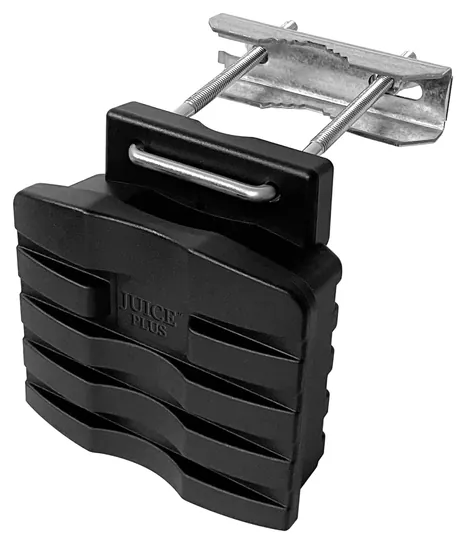
From the manual
- The box holds two 3-foot cables; the long run from the preamp down to the power inserter is sold separately. p. 1
- Slide the front panel up and tilt the preamp out to connect cables, then close the restraint arm and panel to seal it. p. 1
- Ground the antenna system under National Electrical Code Article 810, and keep the mast away from power lines. p. 1
- The 90-day warranty covers parts only, not removal or reinstallation, and needs proof of purchase from an authorized dealer. p. 2
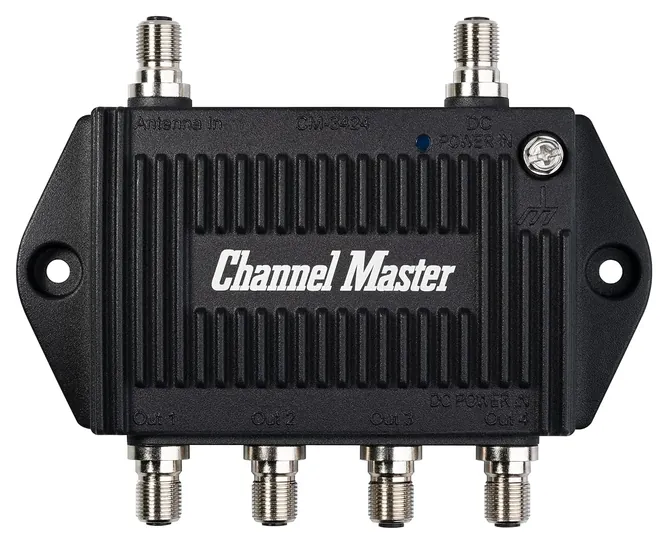
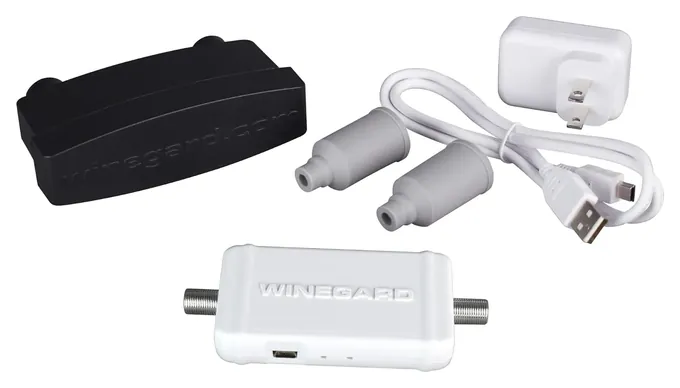
From the manual
- Winegard says to aim with a buddy: one person turns the antenna, the other watches the app. Readings refresh every 6 to 12 seconds. pp. 1-2
- The app needs a Winegard account, and the email must be verified before you can log in. p. 1
- While aiming, the signal meter needs power outside (outlet or power bank), and the phone must stay within 30 feet. pp. 1-2
- Close to a tower, the app can switch the amplifier off so it doesn't overpower a strong channel. p. 2
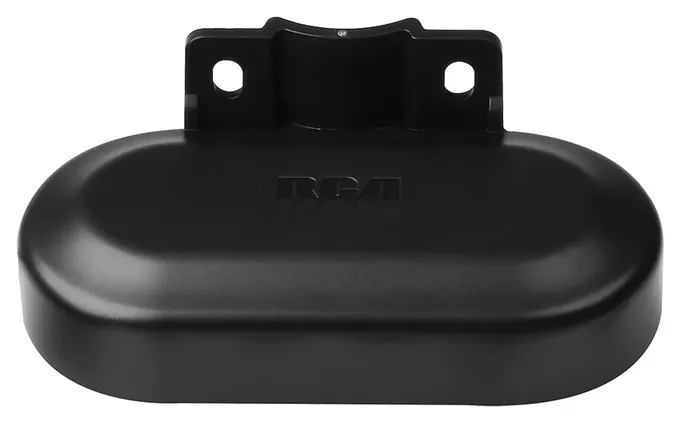
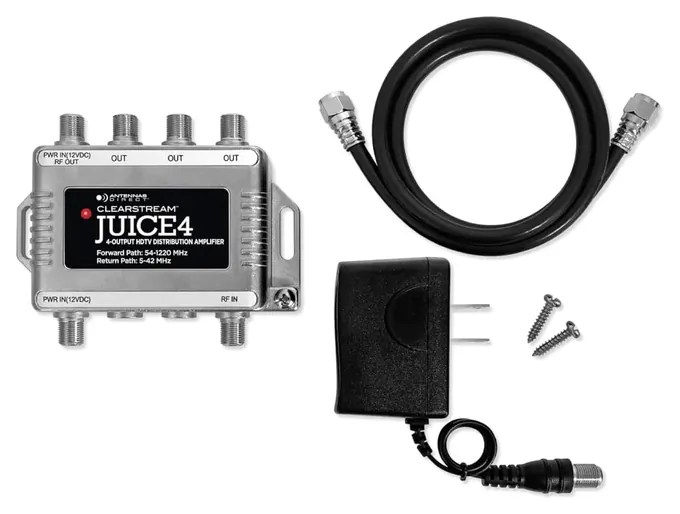
From the manual
- There's no power switch: it turns on when the supply is plugged in, so connect every cable first. p. 1
- Outdoors only under an eave, out of direct rain; the power supply is for indoor use only. p. 1
- Mount it centrally to reach every TV, and ground it through the supplied screw with copper wire. p. 1
- It passes cable TV signals as well as antenna channels, with gain listed up to 1,220 MHz. p. 1
Editor's Notes
November 4, 2026, by Ezvid Wiki Editors:
We read the maker documents for the top five picks and the JUICE4, added a section on why the LNA-200 leads and notes from those documents under five picks, and corrected three entries that said no gain or noise figure was published. We also dropped cell-filter and mounting claims no maker source backs, fixed the JUICE Plus kit description, and added 2026 updates to the 2019 and 2020 notes where they conflict with today's list.
October 16, 2026, by Ezvid Wiki Editors:
The Winegard Boost XT LNA-200 publishes a 1 dB noise figure in its own spec sheet, and it sits at the antenna, where an amplifier does the most good. That earns it the lead. Most of the 2020 list was gone. The Skywalker Signature Series SKY38323, Philips Outdoor, Channel Master CM-7778HD Amplify+, GE Booster, Winegard LNA-100 and EEEkit 108901 are all currently unavailable. We dropped the Pingbingding Outdoor too, because its listed specs didn't add up and we found little else about it. The Antop Low-Noise listing disappeared, but the same 602B model is still sold, so it stays as the Antop Smart Boost 602B.
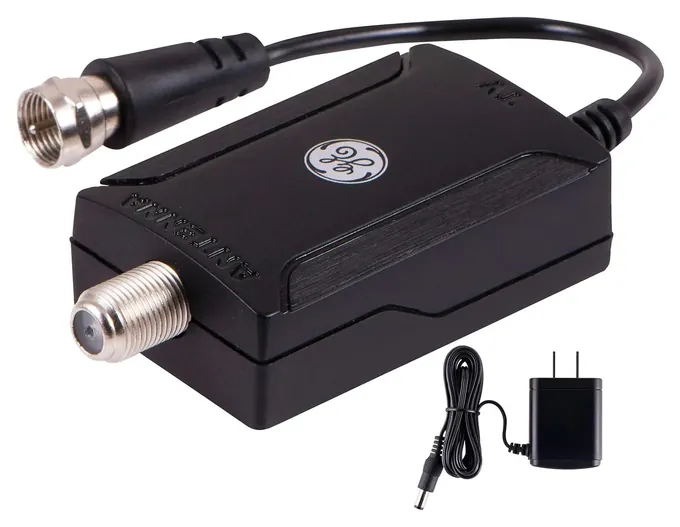
The GE 42178 stays as the cheap inline option.
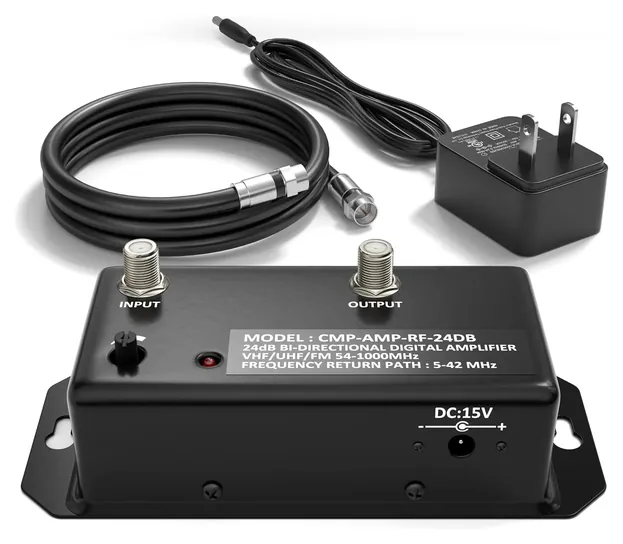
New are two preamps with extras, the Televes TForce 560383 with automatic gain and the Winegard Boost XT Pro BT-1000 with a signal meter, plus a complete kit in the Antennas Direct JUICE Plus and a budget preamp in the RCA AMP2450E. For homes with several TVs, we added two distribution amps, the Channel Master CM-3424 and the Antennas Direct JUICE4, and for indoor setups, the Cimple Co CMP-AMP-RF-24DB-KIT.
One honest warning: an amplifier can't make a poorly aimed or undersized antenna better, and too much gain near a tower makes things worse. The buyer's guide explains how to tell whether you need one. We also found no independent lab tests of these amps, so maker spec sheets, owner reports and recall checks carry the weight, with gain and noise figures where makers publish them, and each entry says when a fact comes only from the seller.
Earlier notes
November 13, 2020, by Kaivaan Kermani:
As stated by our previous editor, there are two types of amplifiers, and prior to my update, this list had a healthy mix of both distribution amplifiers and preamplifiers. However, I suspect that if you’re looking for an antenna amplifier, you are almost certainly going to be needing a preamplifier and not a distribution amplifier, so I’ve taken this opportunity to remove all distribution amplifiers from this list, and introduce some high-quality preamplifiers in their place. [2026 update: the current list includes distribution and inline amps again, for homes that feed several TVs from one antenna.]
A Preamplifier vs. A Distribution Amplifier
To quickly reiterate what the previous editors note has already expressed in some detail, A preamplifier is basically a low-noise amplifier, and it’s designed to amplify the signal while reducing the signal-to-noise ratio. A layman’s way of saying this is that, it amplifies all the ‘good parts’ of the signal, while trying to reduce the ‘bad parts’ – the noise, distortion, fuzziness, etc. – that typically accompany longer transmission distances, or come as a result of weather and other forms of interference. When shopping for a preamplifier, look for the words ‘low-noise’. [2026 update: every amplifier boosts the signal and the noise together and adds a little noise of its own; a low-noise preamp simply adds very little, which is why it belongs at the antenna.]
On the other hand, a distribution amplifier amplifies everything equally – the signal as well as the noise. A distribution amplifier is typically what you’d look for when you have a cable television setup, and I’ve included some excellent distribution amplifiers in our selection of the best cable amplifiers – though, do look for a passive return amplifier, and not an active return one.
Do You Need Both?
You may need both a distribution and low-noise amplifier, in which case, you’ll want to connect the preamplifier first – closest to your antenna - followed by the distribution amplifier. Also, you can’t use an amplifier if you have an active antenna – which is basically just a passive (regular) antenna that already has an amplifier. [2026 update: some preamps, such as the Televes TForce on this list, can send power to an amplified antenna.]
Models That Have Remained
I’ve left in a couple of units like the Skywalker Signature Series SKY38323 – which has a variable gain – as well as the EEEkit 108901 and Channel Master CM-7778HD Amplify+. Channel Master also makes some of the best and most hardy distribution amplifiers.
New Entries To The List
Many of these newer options that I’ve added like the Antop Low-Noise and Pingbingding Outdoor have built-in 4G LTE filters, in order to mitigate interference from cell phone towers, since 4G operates on the same VHF/UHF frequency band as many FM radio and TV channels. [2026 update: cell service took over frequencies that once carried upper UHF TV channels; FM radio has its own band, which some amps block with an FM trap.] It’s likely that something similar will happen with 5G in the near future.
I know that it’s already happening in the UK, and across Europe, with UHF channels using the 700MHz frequency band being reassigned to new frequencies in order to make way for 5G, but, like with the 4G filters, many aerials in the future will undoubtedly come with built-in 5G filters in order to attenuate those specific frequency bands. You can also install your own bandpass filter. [2026 update: makers now build 5G filters into amplifiers, including several on this list.]
February 21, 2019, by Brett Dvoretz:
Picking out the right TV antenna amplifier for your needs can be tricky, mostly because companies market a variety of different types of products as antenna amplifiers. For example, it is not often to find distribution amplifiers sold as antenna amplifiers, even though they have two very different functions. Adding to the confusion is the fact that some people who may think they need an antenna amplifier, actually need a distribution amplifier and vice versa, which is why we included both styles on this list.
To put it simply, if you need to make your amplifier more powerful because it is having trouble picking up a single, perhaps because the broadcast towers are too far from your house, you need an antenna amplifier. These are generally connected as close to the antenna as possible. Since they increase the strength of your antenna, they also help ensure your television is getting sent a strong signal. On the other hand, distribution amplifiers are designed to be used with antennas that are able to pick up signals from the broadcast towers, but boost that signal so that you can send it through far runs of cable or split it to multiple outputs without causing loss of quality.
Antenna amplifiers should increase the number of channels your antenna receives, though this isn't always the case. Sometimes they just make channels you are receiving come in more clearly or eliminate periodic dropouts. Distribution amplifiers won't increase the number of channels your antenna receives, though because of the way they boost the signal coming from the antenna, they may allow your television to display channels that were previously too weak, so in a roundabout way, they too could potentially increase the number of viewable channels. If your antenna is having trouble picking up signals, then your best options are the Channel Master CM-7778HD Amplify+, Winegard LNA-200 Boost XT, EEEkit 108901, and Winegard LNA-100 Boost.
Your choice will be partly dictated by whether your are working with an indoor or outdoor antenna. If your antenna is picking up signals well, but you want to ensure that you won't lose transmission due to splittage or extended cable runs, then you should consider the Channel Master CM3414, PCT MA24PN, PCT MA22PN, PCT MA28PN, Skywalker Signature Series SKY38323, and RadioShack Inline. [2026 update: of the models named here, only the Winegard LNA-200 remains on the current list.]
Special Honors
RabbitEars.info Signal Search Map RabbitEars.info is a free database of U.S. TV stations. Its Signal Search Map takes an address and lists the stations you might receive, with their channels, direction and expected signal strength. It's the quickest way to learn whether you need VHF coverage, a preamp, or just a better-aimed antenna before buying an amplifier. rabbitears.info
Do You Need An Amplifier At All?
It can't add antenna gain, and it can't fix a signal that's blocked by hills or bounced around by buildings.
An amplifier doesn't make an antenna hear farther. It can't add antenna gain, and it can't fix a signal that's blocked by hills or bounced around by buildings. What it does is make up for losses after the antenna, in the coax and in splitters, so a signal that reached the antenna doesn't fade below what the TV's tuner can decode. Cord Cutting Report makes the same distinction between an antenna's built-in gain and an external amp.
Start with the antenna. Look up your address on a free station map such as RabbitEars.info to see how far the towers are, which direction they lie and whether any stations broadcast on VHF, which needs an antenna and amplifier that cover that band. Aim the antenna, rescan the TV, and add an amp only if channels you should get are still missing or breaking up.
More gain isn't always better. Near a tower, an amp can overload the tuner and cause the same pixelation it's meant to cure. Jim Kimble, who founded and edits The Cord Cutting Report and has tested and written about TV gear since 2016, describes trials in the woods of southern Maine: a FOX station about 40 miles away stayed shaky until he swapped a standard amp for an adjustable preamp, turned the gain down and rescanned. Use the lowest gain that gives a stable picture, and rescan after every change.
Preamp Or Distribution Amp: Do The Math
Two kinds of products are sold as antenna amplifiers. A preamp mounts at the antenna and is powered through the coax by a small inserter indoors. Because it boosts the signal before the cable run, it helps the most with weak signals and long runs. A distribution amp usually sits indoors or in an attic, and replaces a splitter, making up the loss of feeding several TVs. Inline boosters that sit by the TV work like a small distribution amp. Many homes with far-off stations and several TVs need a preamp at the mast and a distribution amp after it.
The numbers help. According to Solid Signal, RG6 coax loses roughly 6 to 8 dB per 100 feet and RG59 about 10 dB. A two-way splitter costs about 4 dB per line, three-way and four-way splitters about 8 dB, and an eight-way splitter 14 to 15 dB. Add up your losses and pick gain that roughly matches them. Solid Signal's example: with only 15 dB of loss, a 30 dB amp can overdrive the tuner.
Noise figure matters as much as gain. It measures how much hiss an amp adds, and Solid Signal calls about 2 dB good on UHF and 4 to 6 dB high. Winegard lists 1 dB for the LNA-200 and the BT-1000, Channel Master under 2 dB for the CM-3424, and Antennas Direct 3 to 4.5 dB for the JUICE Plus. Many cheaper boosters publish neither figure. Automatic gain control, as on the Televes TForce, sets the level for you when stations arrive at very different strengths.
Cell Signal Filters, Power And Safe Installation
Since the broadcast spectrum repack, cell carriers use frequencies just above the TV band, from about 608 MHz up. A strong LTE or 5G signal from a nearby cell site can swamp a preamp and knock out channels. Several amplifiers on this list state that they include a cell filter, and the best place for it is ahead of the amplifier stage, as Antennas Direct does on the JUICE Plus. If an amp without one, such as a distribution amp, keeps dropping out, a separate filter such as the Winegard 5G-FLTR can go between the antenna and the amp.
A preamp's power inserter sends DC up the coax, so connect it in the right order: the inserter goes indoors on the line from the antenna, with its powered port facing the amp and its TV port going to the TV or splitter. Don't put that DC on a cable or satellite line. Channel Master and most other makers design these amps for antenna signals only. The JUICE4 is one of the few that also passes cable TV.
Outdoors, the antenna and mast are the risk, not the low-voltage amp. Keep any mast well away from power lines, ground the mast and coax as the National Electrical Code requires, and seal outdoor connectors against water. A search of the U.S. Consumer Product Safety Commission's and Health Canada's recall databases in November 2026 found no recalls of these amplifiers (CPSC, Health Canada).
How we researched this
This list started from 20 TV antenna amplifiers, preamps and distribution amps, 12 of them screened in depth. We read Winegard's LNA-200 instruction and warranty sheet and its Boost XT Pro quick start guide, Televes' 560383 product sheet, and Antennas Direct's JUICE Plus and JUICE4 quick-start guides, plus the maker spec pages for the Channel Master CM-3424, the Cimple Co amp and the GE 42178; RCA and Antop publish no spec page we could reach, so those entries rest on listing details. Solid Signal's figures for cable and splitter loss set the yardstick for gain and noise figure, and searches of the CPSC and Health Canada recall databases on November 4, 2026 turned up no recalls for any of these amplifiers.
Sources (21)
- Winegard: Boost XT LNA-200 support article
- Winegard: Boost XT outdoor amplifier
- Winegard: Boost XT LNA-200 instructions and warranty (PDF)
- Winegard: Boost XT Pro BT-1000
- Winegard: Boost XT Pro quick start guide (PDF)
- Winegard: LTE/5G filter 5G-FLTR
- Televes: 560383 product sheet (PDF)
- Televes: 560383 product page
- Antennas Direct: antenna amplifiers
- Antennas Direct: JUICE Plus specifications
- Antennas Direct: JUICE Plus quick start (PDF)
- Antennas Direct: JUICE4 quick start (PDF)
- Channel Master: TV Antenna Booster 4 (CM-3424)
- The Cimple Co: 24 dB distribution amplifier
- Jasco: GE antenna amplifier 42178
- Solid Signal: choosing the right TV antenna amplifier
- Cord Cutting Report: how TV antenna amplifiers work
- Tablo community: amplifier recommendations
- RabbitEars.info
- CPSC recalls
- Health Canada recalls and safety alerts
Frequently asked questions
Do TV antenna amplifiers really work?
Sometimes. An amplifier makes up for signal lost in long cables and splitters. It can't add antenna gain, fix a blocked signal or replace a poorly aimed antenna. Aim the antenna first, rescan, and add an amp only if channels are still missing.
What's the difference between a preamp and a signal booster?
A preamp mounts at the antenna and boosts the signal before the cable run, which helps most with weak signals. An inline booster or distribution amp sits indoors near the TV or splitter and makes up for cable and splitter loss.
What is the best TV antenna amplifier for rural areas?
A low-noise mast-mounted preamp, such as the Winegard Boost XT LNA-200, which lists 18 dB of gain and a 1 dB noise figure. If some stations are strong and others weak, an automatic-gain model like the Televes TForce 560383 is the safer choice.
Can an amplifier make my reception worse?
Yes. Too much gain near a broadcast tower can overload the TV's tuner and cause pixelation or lost channels. Use the lowest gain that gives a stable picture, and rescan after each change.
Does an antenna amplifier work with cable or satellite TV?
Most don't. Antenna amplifiers are designed for over-the-air signals, and a preamp's power inserter shouldn't go on a cable or satellite line. The Antennas Direct JUICE4 distribution amp is an exception that also passes cable signals.
Do I need an LTE or 5G filter?
If you live near a cell site or lose specific channels at random, probably. Cell signals now sit just above the TV band. Several amps on this list state one built in, and a separate filter can go ahead of an amp that doesn't.