The 8 Best Surgical Loupes
Updated by · How we research

Ready-made flip-up and through-the-lens loupes for students, hygienists and lab work, compared on power, reach and light. The Songzi Optics Titanium leads. When users buy our independently chosen editorial recommendations, we may earn commissions to help fund the Wiki.
Most surgeons and dentists never buy loupes off the shelf. Makers such as Designs for Vision, Orascoptic and SurgiTel measure each wearer and build a custom pair, at many times the cost of anything here. The ready-made sets on this list suit students, assistants, hygienists, lab techs and anyone who wants to try magnification before paying for a fitted pair.


Editor's Notes
November 5, 2026, by Ezvid Wiki Editors:
We found no manual we could read for any of these eight picks, so this pass checked each claim against Practicon's and Vision Aid's own pages, the sellers' listings and the custom makers' guides. We replaced the consumer recall line with a search of the FDA's device recall records, corrected who took part in the posture study, and dropped an unconfirmed three-year warranty and some unconfirmed box contents. The buyer's guide now adds an ergonomics specialist's view on flip-up versus through-the-lens loupes and a study on headlight filters.
October 23, 2026, by Ezvid Wiki Editors:
The Songzi Optics Titanium moves to the top because it's the one ready-made pair here that lets you choose both the magnification and the working distance, and it brings its own headlight. The Careshine Dental Binocular is gone because it's no longer sold, and the Qooltek Headband Magnifier can't be found anymore. We cut the Songzi Optics Goggle Frames, SuperElight DY-101 and Purple Violet DY-104 because each repeated a pair that's still here.
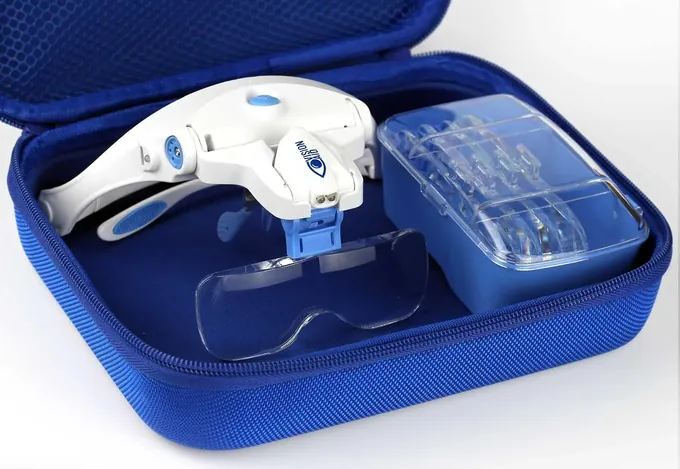
New are the Practicon TTL Easy Size, for a through-the-lens style without a custom wait, the Smedent D-2.5RR for students, the Dental Power TDN01 kit, the SKTECH SK-119 for neck strain, the NSKI 008 Belt-Clip and the Vision Aid Expert Edition for hobby work. The NSKI DY-110 stays for glasses wearers.
Our evidence was the optical figures in the makers' and sellers' listings (field of view, depth of field and working distance), the fitting guides that custom loupe makers and a surgeon publish, and what owners report about blur, fit and broken frames. If you operate for a living, get measured for a custom pair. These sets are for learning, assisting and close work.
Earlier notes
February 4, 2021, by Will Rhoda:
We decided on removing the Songzi Optics Sport Frames, recognizing that the company already had significant representation on our list – via the Songzi Optics Goggle Frames and Songzi Optics Titanium Frames –and noticing that this model was suffering from some availability issues. We also ended up eliminating the Tuop Two-Way-Adjustment Goggle Frames due to the very few user reviews they had being quite mediocre.
Our new additions this time around are the Careshine Dental Binocular — which feature a sturdy, two-strap harness to help ensure they stay securely in place; and the Qooltek Headband Magnifier — which are essentially a set of glasses with interchangeable magnifying lenses. Although this option might not technically qualify for this category, we thought it was worth including at the bottom of our list, as a budget-friendly option that – depending on their intended use – may well prove serviceable for some users.
June 3, 2019, by Will Rhoda:
Well past the apparent parameters of their titular description, surgical loupes are used by a variety of professionals – inside and outside the medical world. In the field of dentistry, perception of them as an essential instrument only seems to be increasing, and many jewellers, horologists and technologists find their use to be extremely beneficial.
While there doesn't appear to be much resistance to the idea that through-the-lens style loupes, comprised of prismatic lens systems and prescribed by a qualified optometrist, tend to provide a superior user experience, their price can be prohibitively expensive for students, and many professionals. [2026 update: on posture, an ergonomics specialist warns that most TTL loupes can't angle down far enough and favors vertically adjustable flip-ups; see the buyer's guide.]
With this in mind, this Wiki focuses on flip-up style loupes, that endeavour to compensate for their shortcomings, in terms of the fine-tuned precision operation a prescribed pair of loupes might offer, with the flexibility of their adjustable designs, and price points that can come in upwards of 90% cheaper.
However, it should be mentioned that most the offerings presented by this Wiki cannot accommodate prescription lenses, and that for users who regularly require glasses or contacts – as well as professionals who can afford to splurge – the notion of purchasing a pair of prescription loupes might well be worth your consideration. If this is a route you're considering, some standout brand names in this arena include Oroscoptic, Vision by Design and SheerVision. [2026 update: the first two makers are spelled Orascoptic and Designs for Vision.]
Special Honors
Designs for Vision Designs for Vision builds custom through-the-lens loupes to each wearer's pupil spacing, with the prescription built into both the lens and the telescope. It also makes wide-field panoramic models and LED headlights to match. designsforvision.com
Orascoptic Orascoptic custom-builds loupes from 2.5x to 6.5x using a digital measurement of the wearer's face, including variable-zoom models and angled optics meant to improve posture. orascoptic.com
SurgiTel SurgiTel makes custom-tailored loupes and LED headlights, sells caps that let one pair work at more than one working distance, and publishes a clear guide to choosing magnification, working distance and light. surgitel.com
Flip-Up, Through-The-Lens Or Clip-On
The Practicon TTL Easy Size is a halfway step: a TTL-style frame with four lens pairs that you choose by measuring the distance between your pupils.
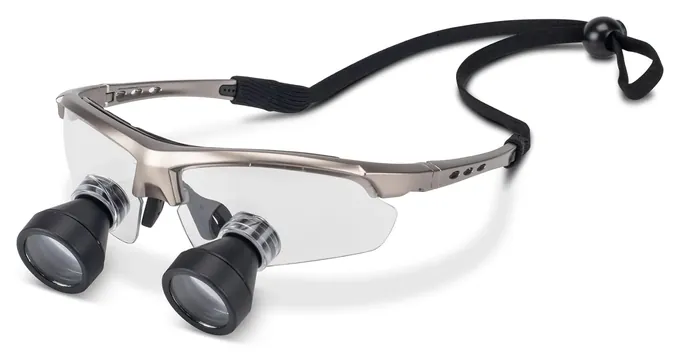
Loupes come in two main builds. Through-the-lens (TTL) loupes have the magnifiers set into the lenses of a safety frame, close to the eye. Designs for Vision, which says it pioneered the style, credits it with the widest view and the lightest weight (maker page). But the frame is built to your measurements, so it can't be shared, and it takes weeks to arrive: ILLUCO quotes three to four weeks after measuring (ILLUCO). Flip-up loupes hang the magnifiers on a hinge in front of the frame. They adjust to most faces, lift out of the way when you talk to a patient and can be passed to a classmate, but they sit farther from the eye.
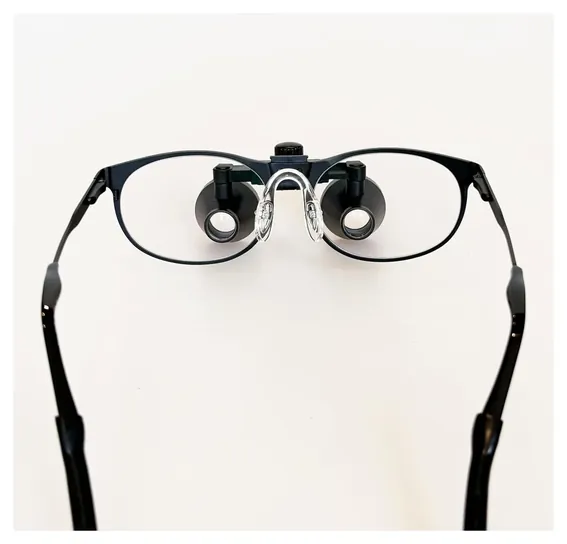
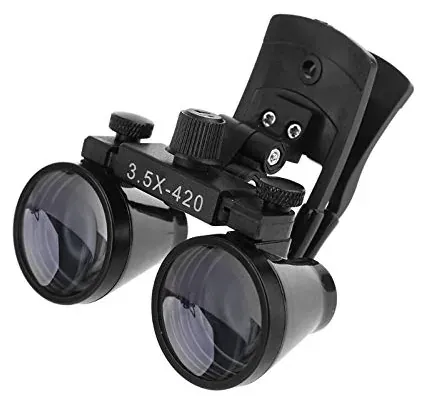
Almost every pair on this list is a flip-up. The Practicon TTL Easy Size is a halfway step: a TTL-style frame with four lens pairs that you choose by measuring the distance between your pupils. Clip-on blocks such as the NSKI DY-110 attach to glasses you already own, which is the cheapest route for anyone who needs a prescription.
The brands surgeons buy are a different market. Orascoptic builds each pair from a digital measurement of the wearer's face and offers powers from 2.5x to 6.5x (Orascoptic). ILLUCO, one of the lower-priced custom makers, lists TTL pairs from $1,395 and a 3.0x flip-up at $635 (ILLUCO). If you operate or do procedures every day, a fitted pair is worth the money. The sets here are for students, assistants, hygienists, lab work and trying magnification first.
Magnification And Working Distance
More power is not always better. Each step up narrows the field of view, shrinks the depth of field and adds weight, and the image moves more with every small head movement. Headmirror's guide for ear, nose and throat residents calls 2.5x enough for most cases and warns that high power can make anyone prone to motion sickness queasy at first (Headmirror). One custom seller's specialty chart puts dental work at 2.5x to 3.5x, orthopedics at 2.5x to 3.0x and cardiac surgery at 3.5x to 4.5x (LoupeDirect). SurgiTel calls 2.5x to 4.5x ideal for general surgery and points 5.5x and up at specialized procedures (SurgiTel). Beginners do best starting at 2.5x.
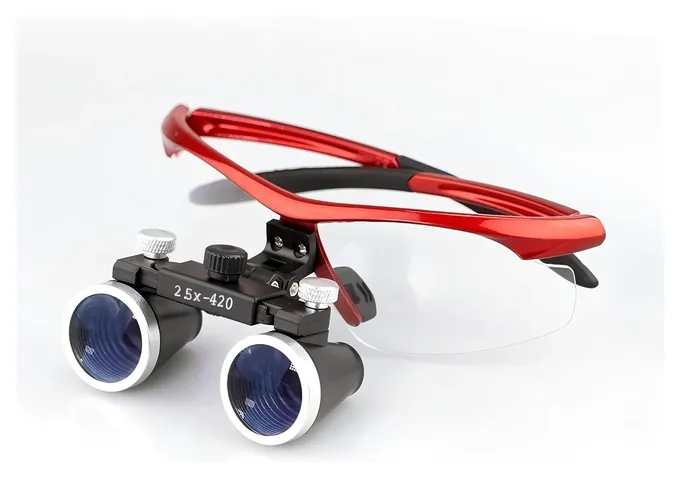
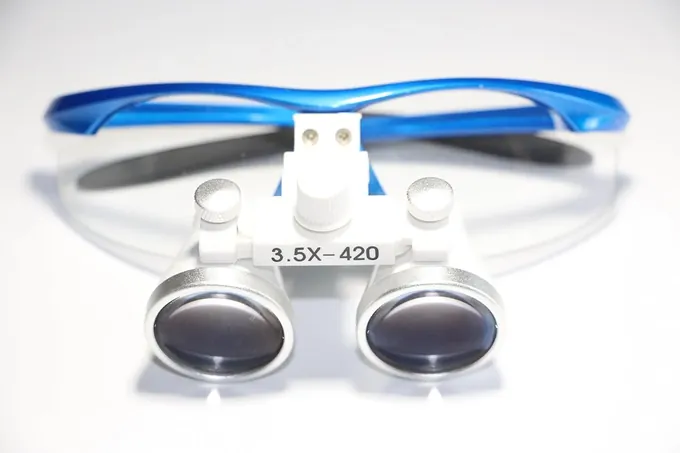
Working distance is the gap from your eyes to the work when you sit or stand in your normal posture. Loupes are only sharp within a band around that distance, so a pair set too short makes you hunch. SurgiTel says working distances typically run 18 to 20 inches, and LoupeDirect puts dental work at about 340 to 450 millimeters. To find yours, take your usual working position and have someone measure from your eyes to the work. Many budget pairs are sold as 420 millimeters, which suits a seated dental chair, but some of the same listings give a different range in the fine print, so check before you buy. Taller people and anyone who stands to work may need a longer pair, which is why the Songzi Optics Titanium is sold in four ranges.
Light, Fit And Your Neck
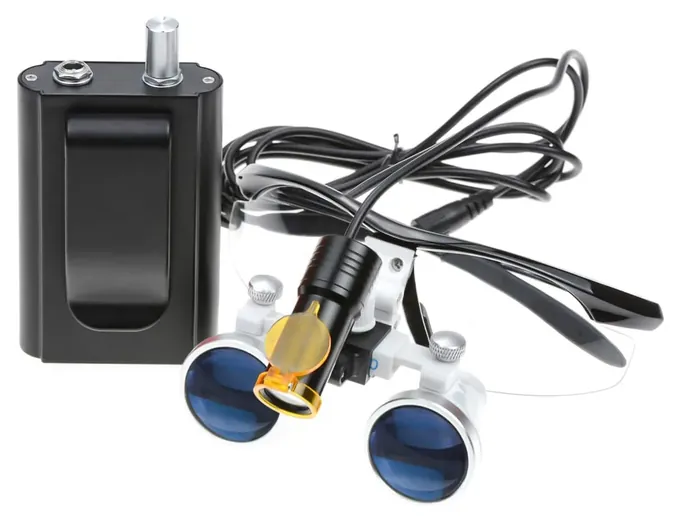
Magnification dims the view, so many users add a headlight. A light mounted on the bridge shines along your line of sight and leaves no shadow from your own hands. Custom makers sell small lights with long run times; SurgiTel's mini LED runs up to 12 hours, for example. Budget kits bundle a simpler lamp and battery box. Dental users should look for an orange filter: in a 2022 lab study, ordinary white headlights shortened the working time of light-cured fillings, and orange filters prevented that (Journal of Clinical and Experimental Dentistry).
Fit causes most complaints: sore ears, a sore nose bridge, slipping and fogging. A retaining strap stops slipping, and taping the top edge of a mask cuts fogging (Headmirror). Flip-up barrels also need setting for the distance between your pupils and for the viewing angle, and a pair that's slightly off can cause eye strain.
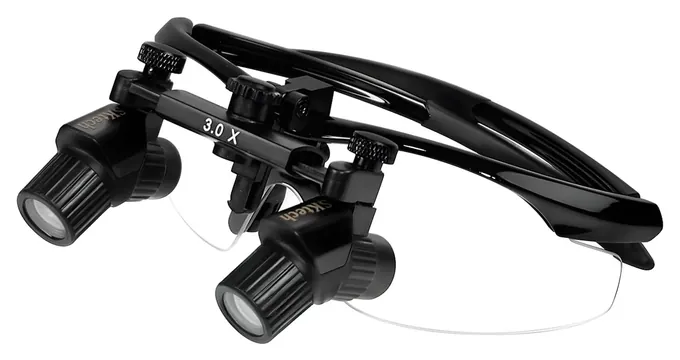
Posture is the other reason people buy loupes. A small 2025 study of 10 postgraduate periodontology trainees found better head, neck, shoulder and trunk posture when they cleaned teeth wearing prismatic loupes than without them (Scientific Reports). The angle of the optics matters too. Bethany Valachi, a physical therapist and certified ergonomics assessment specialist who taught ergonomics at OHSU's School of Dentistry, wrote in Dental Products Report in October 2016 that TTL loupes typically can't angle down more than about 30 degrees, and that vertically adjustable flip-ups were the only type she had seen consistently keep wearers in a safe head posture (Dental Products Report, PDF). Angled, or declined, optics such as the SKTECH SK-119 aim for the same thing by letting you look down at the work without bending your neck. Ordinary loupes are not laser eye protection; laser-rated models are a separate kind. Loupes are medical devices, and the FDA's recall records list none for any brand here; the loupe recalls on file are Kerr's laser-safety loupes in 2012 and the nickel nose pads on some Orascoptic custom pairs in 2025 (FDA).
How we researched this
Nineteen loupes and head magnifiers were weighed for this list, and eight made it. No manual for any of the eight could be found and read, so the details come from Practicon's TTL Easy Size page, Vision Aid's own store page for the Expert Edition and sellers' listings for the other six, which is why every Songzi, Smedent, Dental Power, SKTECH and NSKI figure is the seller's own. The buying advice draws on SurgiTel's, LoupeDirect's and ILLUCO's guidance for custom loupes, Headmirror's guide for surgical residents, Bethany Valachi's ergonomics column and two dental studies on posture and headlight filters. Because loupes are medical devices, the recall check used the FDA's device recall records on November 5, 2026: no recall for any brand here, and only two loupe recalls in all, Kerr's laser-safety loupes in 2012 and Orascoptic nose pads in 2025.
Sources (16)
- Headmirror: Guide to loupes
- LoupeDirect: Best surgical loupes for cardio vs dental vs ortho
- SurgiTel: Choosing surgical loupes and LED headlights for residents
- Orascoptic: Loupes
- ILLUCO
- Designs for Vision
- Practicon: TTL Easy Size 2.5X loupes
- Designs for Vision: Custom surgical loupes (through-the-lens)
- Designs for Vision: Panoramic loupes
- ILLUCO: TTL Galilean and prismatic loupes
- Scientific Reports (2025): dental loupes and posture in periodontal therapy
- Journal of Clinical and Experimental Dentistry (2022): headlight spectrum and composite working time
- Bethany Valachi, PT, MS, CEAS, Dental Products Report (October 2016): Are dental loupes improving or worsening your neck health?
- FDA medical device recalls: Orascoptic custom loupes, Z-2440-2025
- FDA medical device recalls: Kerr Laser Loupes, Z-0414-2013
- Vision Aid: Expert Edition magnifying headset
Frequently asked questions
What magnification should surgical loupes have?
Most people start at 2.5x, which a guide for ear, nose and throat residents calls enough for most cases. Dental work often uses 2.5x to 3.5x and cardiac surgery 3.5x to 4.5x. Higher power narrows the view and can feel unsteady at first.
Which loupe brands do surgeons use?
Most buy custom pairs from specialist makers; Headmirror's guide for surgical residents lists Designs for Vision, Keeler, SurgiTel, Zeiss, Orascoptic and SheerVision. They're measured for each wearer and sold direct or through dealers, not off the shelf.
How much do surgical loupes cost?
Custom pairs usually cost from several hundred dollars for a flip-up to well over a thousand for TTL; ILLUCO lists TTL pairs from $1,395. Ready-made flip-ups cost far less but aren't fitted to your face.
Should I get flip-up or through-the-lens loupes?
TTL loupes sit closer to the eye, which makers say gives a wider view and less weight, but they're built to your measurements and can't be shared, and an ergonomics specialist warns most can't angle down far enough for a safe neck posture. Flip-ups adjust to most faces, lift out of the way and suit students or shared use.
Can I wear loupes with prescription glasses?
Yes. Clip-on loupes attach to your own glasses, some TTL-style frames take a prescription insert, and custom makers build your prescription into the lenses. Many flip-up kits are too snug to wear over glasses.
Do I need a headlight with my loupes?
It helps. Magnification dims the view, and a light on the bridge removes shadows from your hands. Dental users should pick a light with an amber filter so it doesn't cure fillings early.