The 8 Best Chain Hoists
Updated by · How we research

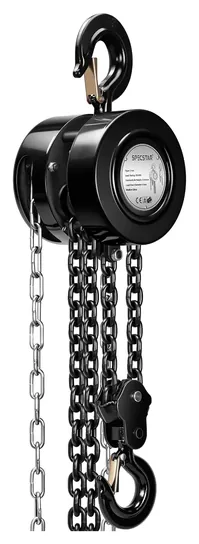
Hand chain, lever and electric hoists compared on rating, brake, chain and lift. The SpecStar VH829 leads with a two-ton rating at a budget price. When users buy our independently chosen editorial picks, we may earn commissions to help fund the Wiki.
The number stamped on a chain hoist is its working load limit, not a target to approach, and the hoist is only as safe as the beam, tripod or gantry it hangs from. This list is for home mechanics, farmers and small shops lifting engines, logs and machinery, from budget imports to trade-brand tools.


Editor's Notes
October 23, 2026, by Ezvid Wiki Editors:
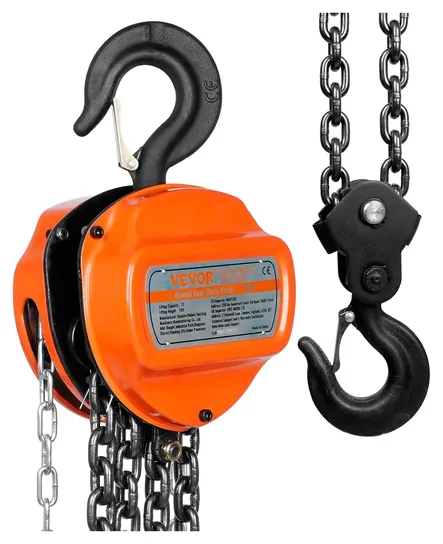
The SpecStar VH829 keeps its place on top: it is still sold, still carries a two-ton rating at a budget price, and nothing newer beat it on paper. Most of the old list was gone. The Torin TR9000, Neiko 02182A, Mophorn electric and XtremepowerUS lever block are no longer sold, and the Black Bull CHOI1 had no current offer. We dropped the Harrington LX because a quarter-ton rating is too small for most of you. New are the VEVOR 2-Ton Hand Hoist, the VEVOR 1.5-Ton Lever Hoist, the VEVOR H10 Electric, the Glorousamc HL0609, the JET S90-100-10 and the Amarite Mini Come-Along, while the Columbus McKinnon 603 Mini stays as the trade pick for tight spots. We compared rated loads, brake designs, chain grades and lift heights against the ASME hoist standards, and the federal recall database showed no chain hoist recalls for any brand here.
Earlier notes
May 20, 2021, by Christopher Thomas:
Eliminated an electric model from Strongway that's no longer available. Our new top recommendation is the SpecStar Manual, which comes with a capacity up to five tons and operates as smoothly as anything else on the market. We still like the Mophorn Electric as an electric option, although the button takes some extra attention as it many users find it sticks a lot. The Neiko 02182A and Black Bull CHOI1 are other great budget-friendly models, and if you're willing to make a larger investment, the XtremepowerUS Lever Block is built to last virtually forever.
February 12, 2020, by Will Rhoda:
During this round of updates, we eliminated the Vevor 3-ton due to availability issues, and added two motorized options to our rankings. The Mophorn Electric benefits from its notably-low, 750-watt draw, which is modest enough for it to plug into most existing circuits without tripping a breaker, but the five-feet cord for its remote is a bit short. On the other hand, the Strongway 72642, by virtue of its 1400-watt draw, demands a designated 15-amp circuit, but the 20-feet cord for its remote is much less limiting than the Mophorn's.
A few things to pick up on in this category:
Weight Capacity: Pick one that exceeds your workshop’s needs. While most options in this category are rated to lift a ton, some offerings – like the Harrington LX, which is available in both 500- and 1,000-pound models, and the Columbus McKinnon 603 Mini, which can lift up to a half ton – do fall short of the benchmark. Other hoists – like the Torin TR9000 Series, which is available in weight capacities up to five tons – can lift considerably more.
Reach: This consideration is especially relevant to users outfitting shops with high ceilings, who would ideally like to mount the hoist to an I-beam. While the Black Bull CHOI1 and Neiko 02182A are both rated to lift a ton, the Black Bull has a limiting eight-feet lift capacity, and the Neiko can hoist items as high as 15 feet, making it conducive to machine shops that need to have high ceilings to accommodate their equipment and overhead doors. The XtremepowerUS Lever Block does even better than the Neiko in this respect, boasting a 20-feet lift capacity.
Safety: Needless to say, heavy lifting is dangerous business. Unsafe equipment and unsafe equipment usage in this pursuit can lead to strained lower backs, crushed fingers and, in extreme situations, even death. Look for selections like the Torin TR9000 Series and Neiko 02182A that feature built-in, mechanical load brakes to help keep you and your staff safe. The Mophorn Electric and Strongway 72642 are also outfitted with limit switches to prevent the over-traveling of their chains.
Special Honors
Harrington Hoists Harrington makes hand chain, lever and electric hoists for industry, sold through distributors rather than general retailers. Its LX lever hoist and CB hand chain hoist are common choices for crews who need certified, serviceable gear with parts support, at trade prices well above the budget picks. harringtonhoists.com
Hand Chain, Lever Or Electric
It is slower over a long lift, because each stroke moves the load only a little.
A chain hoist turns a small pull into a big lift through a gear train and a toothed wheel that grips the load chain. When you stop, a mechanical brake holds the load. Wikipedia's hoist article covers the basic types: manual, electric, air and hydraulic, with chain or wire rope.
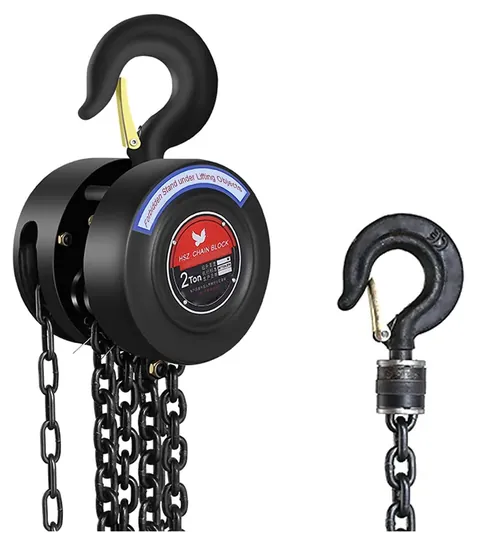
A hand chain hoist hangs from a beam and lifts straight up as you pull a loop of hand chain. It is the quickest type to rig and the easiest on your arms for a long lift, which makes it the usual choice for pulling engines and loading machinery. A one-ton or two-ton model covers almost every home and farm job.
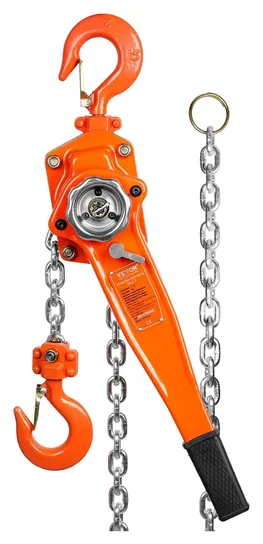
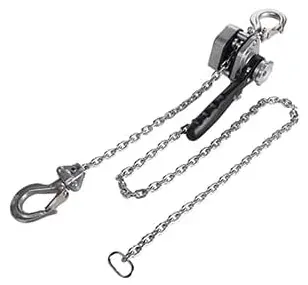
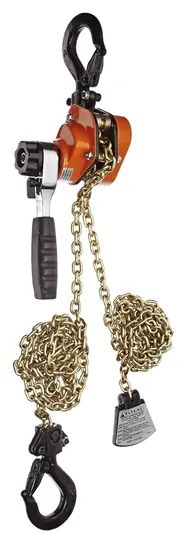
A lever hoist, often called a come-along, does the same work with a ratchet handle. It lifts, pulls and tensions at any angle, so it suits fence work, tree jobs, winching and tight spaces where a hand chain would hang in the way. It is slower over a long lift, because each stroke moves the load only a little. Lever hoists are covered by their own standard, ASME B30.21.
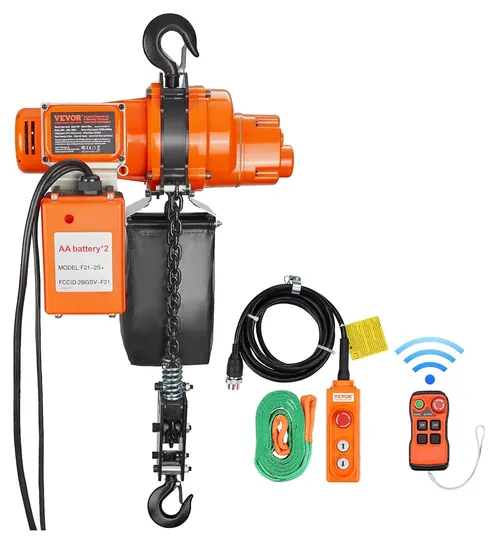
An electric chain hoist trades effort for weight and wiring. You get a pendant or remote and a steady lift speed, but you need the right voltage, a beam strong enough for the hoist itself, and rest breaks, since the motor has a duty limit. It makes sense when you lift often, not once a season.
Capacity, Lift Height And Headroom
The rated load is a working limit, not a test target. A one-ton hoist is meant to lift up to one ton smoothly, with no jerking or dropping. Shock loads, such as a load that slips and catches, can put several times the static weight on the chain and hooks. If your heaviest lift is close to the rating, buy the next size up. A two-ton hand chain hoist costs only a little more and takes a bit more chain pulling for the same lift.
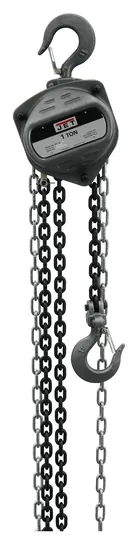
Check the lift, not just the chain length. SpecStar sells its VH829 with 10 feet of chain but rates the useful lift at about 8.5 feet, because some chain stays inside the hoist and the hooks take up room. Long-lift versions exist, such as a 20-foot version of the JET S90, if you are lifting from a pit or a loft.
Headroom matters in a garage. Add the hoist's closed hook-to-hook length, the height of the load, your slings or chains, and a few inches of clearance. If that sum is close to your beam height, a compact lever hoist or a low-headroom model is the answer.
The hoist is only as strong as what holds it. A ceiling joist, a garage door track or a tree limb is not a rated anchor. Use a steel beam, a beam clamp or trolley, an A-frame gantry or a tripod rated above the load.
Safe Rigging And Inspection
In U.S. workplaces, hoists fall under OSHA's overhead crane rule, 29 CFR 1910.179, and under ASME B30.16 for overhead hoists. Home users aren't bound by them, but the same habits prevent injuries.
Before each use, look at the hooks, the latches, the chain and the brake. A hook with an opened throat or a twist has been overloaded, and it should be retired, not bent back. The chain should run straight with no kinks, gouges or stretched links. With a light load, lift a few inches, stop, and make sure the brake holds without creeping.
Keep the load centered under the hoist, and never side-pull with a hand chain hoist. Never stand or reach under a raised load, and never lift a person: these hoists aren't rated for it. Lower the load onto stands or blocks before you work on it.
New budget hoists can arrive with tangled chain or a sticky hook latch, so run the chain through its full travel and test the latch before the first real lift. Keep the rating plate legible, and store the hoist dry with a light coat of oil on the chain.
How we researched this
We compared 16 chain, lever and electric hoists, including the eight on the old list, using the makers' rated loads, chain grades, brake designs and lift heights, plus owner feedback patterns. We checked the ASME hoist standards and searched the CPSC recall database for every brand, and found no chain hoist recalls. Updated October 23, 2026 by Ezvid Wiki Editors.
Frequently asked questions
Can a one-ton chain hoist lift a car engine?
Usually yes. Most car engines with a transmission weigh well under a ton, but hang the hoist from a rated beam or gantry, not a joist, and avoid jerking the load.
What is the difference between a chain hoist and a come-along?
A hand chain hoist lifts straight up with a pulled chain. A come-along, or lever hoist, uses a ratchet handle and can pull or lift at any angle, but more slowly.
Is an electric chain hoist worth it?
Only if you lift often or high. It saves effort and time, but it is heavy, needs the right power and a strong support, and has a duty limit.
Can I lift a person with a chain hoist?
No. Standard chain and lever hoists are not rated for lifting people. Use equipment built for personnel lifting.
How often should I inspect a chain hoist?
Look over the hooks, latches, chain and brake before each use, and retire any hook that has opened or twisted.