The 9 Best Voice Amplifiers
Updated by · How we research

Wired, wireless and clip-on voice amplifiers for teachers and guides, compared on battery, mic type and volume. The Zoweetek Original, with two mics, leads. When users buy our independently chosen editorial recommendations, we may earn commissions to help fund the Wiki.
Teachers have a high rate of voice disorders, and the National Institute on Deafness and Other Communication Disorders says a light mic and speaker can help in classrooms. These belt-worn kits suit teachers, tour guides, coaches and anyone with a soft voice. They are speech tools, not singing amps, and the wattage on the box is a claim, not a loudness test.


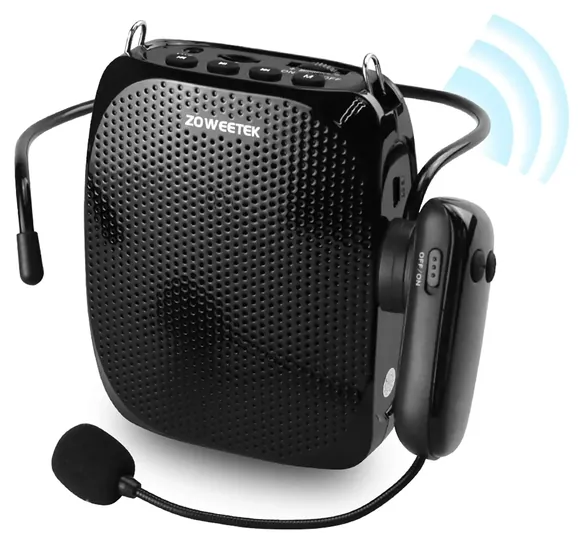
Why the Zoweetek Original is our top pick
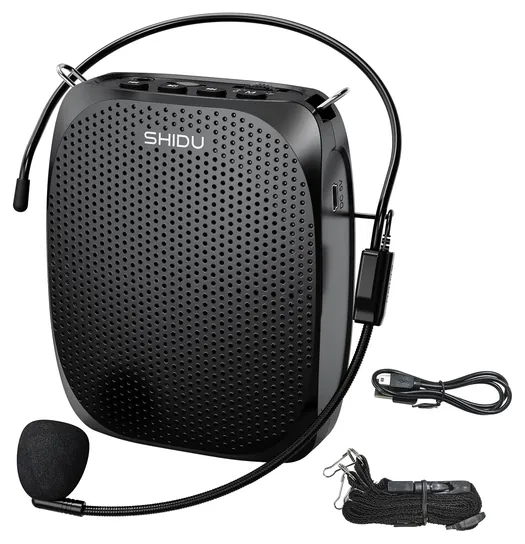
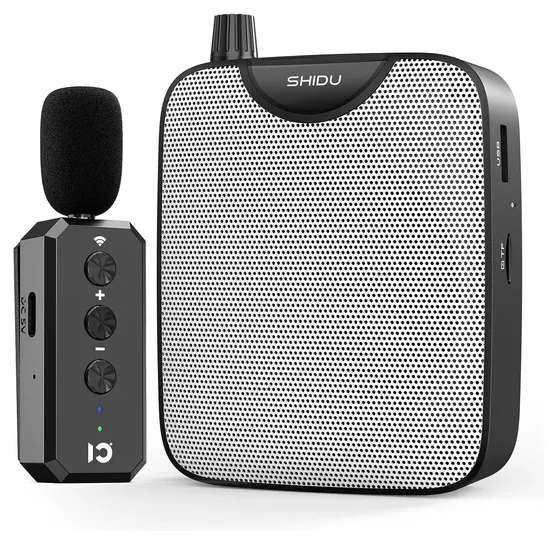
Our pick and the runner-up carry the same class of speaker, so the deciding difference is the mic. Both are rated at 10 watts and 8 to 12 hours of talking per charge,1,4 but our pick adds a wireless UHF headset with a claimed range of 30 to 35 meters to the corded one.1,2 The runner-up, the Shidu S258, sits in its maker's wired range and ships with a single corded headset.3,4
That second mic earns the top spot. On a normal day the wireless headset lets a teacher walk the room or face the board with no cable to the belt. Its battery is the weak point: the listing gives it about 3 to 5 hours,2 well short of the speaker's. When it runs flat, the corded headset plugs into the same speaker and the lesson carries on, a fallback that wireless-only kits lack.
The runner-up costs less and is the better buy for anyone who stays near the front of the room, since a cord never needs charging or pairing. For a teacher who wants to move around without betting the day on a second battery, our pick covers both cases.
| Zoweetek Original | Shidu S258 | |
|---|---|---|
| Mics in the box | Wired and wireless headsets | Wired headset |
| Wireless range | 30-35 m (UHF) | None, corded |
| Rated output | 10 W | 10 W |
| Talk time per charge | 8-12 h | 8-12 h |
| Mic battery | 3-5 h (wireless) | None needed |
Sources
From the manual
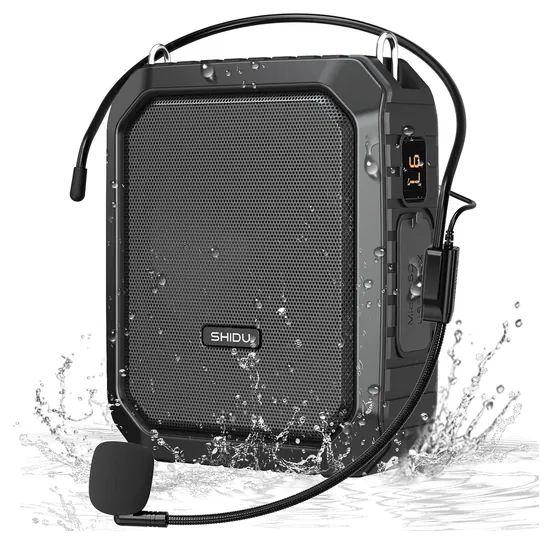
- The manual lists an IPX5 water rating, yet its cautions say to keep the unit dry and out of the rain. Features; Caution
- Everything stops while it charges, and Shidu says to unplug the charger as soon as the battery is full. Charge the speaker
- With a USB stick or memory card inserted, the REC key records the wired mic; the USB slot can also charge a phone. How to Use
- A unit that stops responding resets with a 10-second press; a USB stick is not included, but an AUX cord is. Troubleshooting; UBC guide, p. 3
Editor's Notes
November 5, 2026, by Ezvid Wiki Editors:
We read Shidu's SD-M800 manual and WinBridge's spec sheets, rewrote the methodology, and added a section on why the Zoweetek Original leads the Shidu S258. We corrected battery claims for the Shidu M800, S258 and WinBridge WB002, softened the M800's rain claim to match its manual, and credited the museum educator quoted in the guide by name. Two older notes got short 2026 updates where they no longer match the list.
October 23, 2026, by Ezvid Wiki Editors:
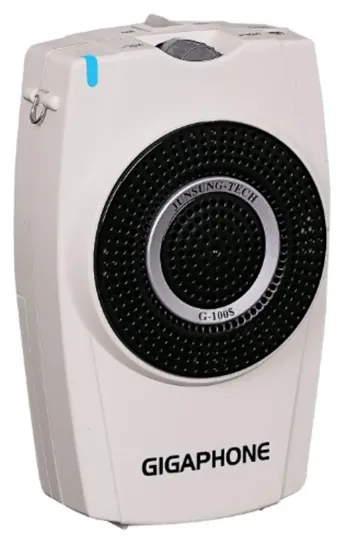
The Zoweetek Original moves to the top because it puts a wired and a wireless headset in one inexpensive box, so a flat mic battery never ends a lesson. The Shidu S258 stays as the budget pick, and the Gigaphone G100S and VoiceBooster MR-AK38 stay too. The wireless Shidu M800 has become hard to find, so we now list the wired, splash-resistant Shidu M800 in its place.
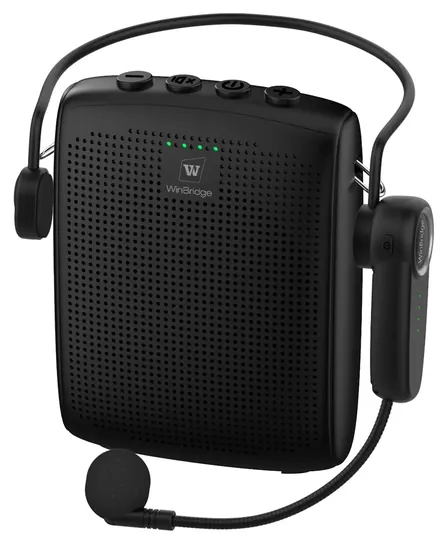
Five older picks are gone. The WinBridge S92, Archeer PA System and DuaFire Portable DF-A are no longer sold, the WinBridge WB711 is listed only at an absurd price, and the Maono AU-C03 is a podcast microphone that never belonged here. New picks cover a wireless headset (WinBridge WB002), two clip-on mics for people who hate headsets (WinBridge WB005 and Shidu M500 35W), and a two-mic speaker for gyms and events (WinBridge S97).
For evidence we leaned on each maker's battery, mic and power figures, a museum educators' thread comparing units for outdoor tours, the NIDCD's advice on teachers' voices, and patterns in owner reports on durability and squeal. No brand here has a recall on file with the Consumer Product Safety Commission.
Earlier notes
September 30, 2020, by Daniel Imperiale:
Among the few changes we made to this ranking, we upgraded the Maono AU-C01 to the Maono AU-C03, which lacks its predecessors LCD readout, but has much more comprehensive and intuitive controls for both speaking needs and music playback. We also added the Gigaphone G100, which bests the rest of the category in just about every aspect, most notably in power, where it reaches 30 watts. [2026 update: the current list includes units with higher power ratings, the 35-watt Shidu M500 and the 60-watt WinBridge S97.]
It is important to note, however, that that Gigaphone model isn't wireless. In our opinion, wireless connectivity shouldn't be a deal breaker unless you're combining your speaking duties with some activity that requires the completely unencumbered use of your arms. It's also true that most people prefer to wear these speakers in one way or another, whether it be around their neck as is possible with the Shidu M800 Wireless, or clipped to their belt or waistband. The only problem with this is that if you turn your back on your audience, say, to write on a whiteboard, you will no longer be facing them. For this reason, a wireless option like the WinBridge S92 might be the best choice for a variety of teachers.
July 30, 2019, by Daniel Imperiale:
A few of the items on our previous list had to be removed due to issues around their availability, most notably the Maono AU-C03 and the Hisonic HS388. We did find some great replacements for those older models, however, the most exciting of which landed in our number one spot. That's the Shidu Portable 18-Watt, which is a rugged, waterproof option that you can take with you just about anywhere. It's particularly good for tour guides who might get caught in the rain. [2026 update: the Shidu on today's list, the M800, is the wired version, and although it carries an IPX5 water rating, its manual says to keep it out of the rain.] It also happens to boast a wireless connection between its headset microphone and speaker unit, all combining to make it one of the loudest, most versatile selections on the market. On the flip side, our list's biggest loser can be none other than the WinBridge WB711, whose wireless pairing issues sent it all the way down to number ten.
Special Honors
Hamilton Buhl Amp-Up Hamilton Buhl, an education audio supplier, sells its Amp-Up voice amplifiers alongside classroom PA and assistive listening systems. The Amp-Up Personal UHF kit pairs a belt speaker with a wireless mic and offers up to 40 channels, so several teachers on one hallway can each use a wireless mic without crossing signals. A wired version, the PA-25, comes with a headworn mic and no radio link to manage. hamiltonbuhl.com
Wired, Wireless Or Clip-On
Feedback squeal happens when the mic hears its own speaker.
The mic decides more about daily life with a voice amplifier than the speaker does. A wired headset plugs into the belt pack, needs no battery and never drops out, which is why it's the cheapest and most dependable setup. The trade-off is the cord: turn away to write on a whiteboard and the speaker turns with you, or you're tethered to it.
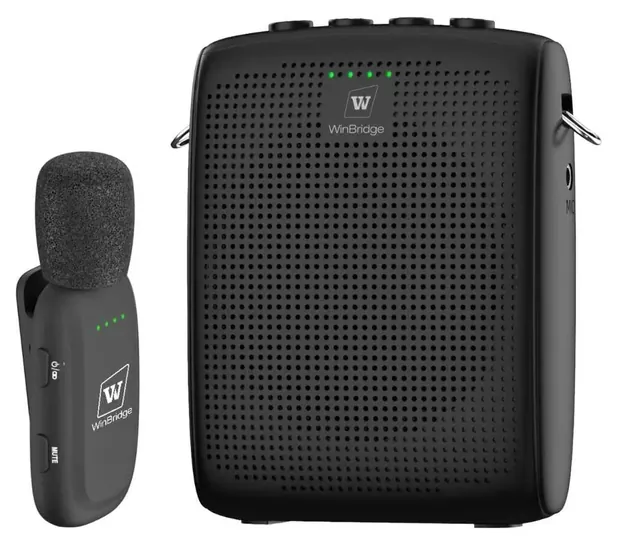
Wireless headsets free you to walk the room, but they add a second battery. Wireless mics on these kits run from about 3 to 5 hours on the Zoweetek Original's headset to more than 10 on the WinBridge WB005's clip-on, so charge both pieces every night. Clip-on (lavalier) mics are the comfort pick for anyone who dislikes a headset. A clip-on sits farther from the mouth, though, so it needs more gain and squeals more easily.
Feedback squeal happens when the mic hears its own speaker. Keep the speaker below and away from the mic, point the mic away from the grille, and turn the volume down before you turn the mic toward the speaker. Shidu's M800 manual puts a number on it: keep the mic more than 60 centimeters (about two feet) from the speaker.
Watts, Batteries And How Loud Is Enough
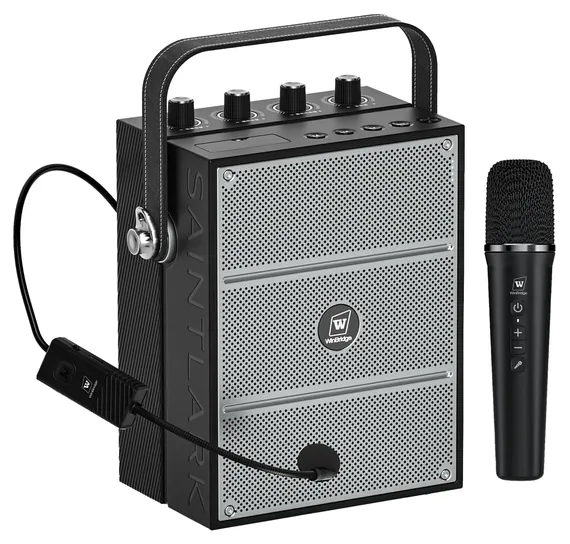
The watt rating on these units is a power figure from the maker, not a measured loudness, and coverage claims of 10,000 square feet or more are marketing. As a rule of thumb, a 10 to 15 watt belt unit fills a classroom of 30 to 50 people. Step up to 18 to 35 watts for outdoor tours, gyms and lecture halls, and to a 60-watt box like the WinBridge S97 only for events, fitness classes or two speakers at once.
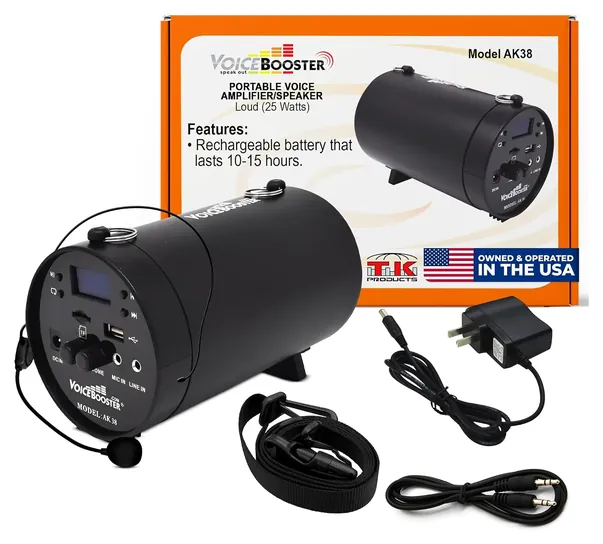
More power means a bigger battery and more weight. In a July 2023 American Alliance of Museums forum thread, Miriam Machado, director of education at Florida International University's Frost Art Museum, wrote that the Shidu amplifiers her museum bought "have been working well for outdoor sculpture park tours." Another member pointed out that the 18-watt Shidu she linked weighs about 1.4 pounds, and that power and weight rise together. Belt units claim roughly 7 to 16 hours per charge and take 2 to 6 hours to recharge. They run on built-in lithium batteries, so charge with the supplied cable and don't leave them in a hot car. Batteries also age: VoiceBooster rates the MR-AK38's for two to three years and sells replacements.
Louder isn't kinder. Long exposure above 85 decibels can damage hearing, according to NIOSH and the NIDCD, and a speaker strapped to your hip is closer to the front row than to the back. Set the volume so the back row can hear without straining, and no higher.
Protecting The Voice You're Amplifying
An amplifier helps most when it's used before the voice is hurting. The NIDCD counts teachers among the people who demand the most of their voices, notes that they have a high rate of voice disorders, and suggests a lightweight microphone and amplifier-speaker for classrooms, exhibit areas and exercise rooms. It also says talking too loudly and too softly can both strain the voice.
That means the goal is your normal speaking voice, not a whisper into the mic. Pair the amplifier with the NIDCD's other habits: drink water, rest your voice between classes, and give it a break when you're sick.
For people with a weak voice from age or illness, a personal amplifier works the same way. A wired headset is the simplest choice, since there is only one battery to charge and nothing to pair. If the voice stays hoarse, raspy or tired, the NIDCD advises seeing a doctor, often an ear, nose and throat specialist.
How we researched this
We compared 21 voice amplifiers, from pocket-size belt units to speaker boxes with two mics. We read Shidu's SD-M800 user manual and a University of British Columbia quick guide to the same unit, WinBridge's partner-catalogue spec sheets for the WB002, WB005 and S97, and the maker spec pages for the Zoweetek S615 and VoiceBooster MR-AK38, and noted where WinBridge's own run-time figures disagree. The NIDCD's voice-care advice, NIOSH's noise limits and a museum educators' forum thread shaped the buying guide. Searches of the CPSC recall database and Health Canada's recall list in November 2026 found no recalls for Zoweetek, Shidu, WinBridge, Gigaphone or VoiceBooster.
Sources (19)
- NIDCD: Taking care of your voice
- NIDCD: Noise-induced hearing loss
- NIOSH: About noise and hearing loss
- American Alliance of Museums forum: voice amplifier recommendations
- Hamilton Buhl: voice amplification
- WinBridge store
- Zoweetek
- VoiceBooster
- Mis Clases Locas: best voice amplifier for teachers
- CPSC SaferProducts.gov
- Shidu: SD-M800 user manual (Manuals+)
- University of British Columbia: Shidu SD-M800 quick guide (PDF)
- WinBridge partner catalogue: WB002, WB005 and S97 spec sheets (PDF)
- Zoweetek: S615 voice amplifier spec page
- WinBridge: WB002 product page
- WinBridge: WB005 product page
- WinBridge: S97 product page
- VoiceBooster: MR-AK38 product page
- Health Canada: recalls and safety alerts
Frequently asked questions
What is the best voice amplifier for teachers?
For most classrooms, a 10 to 15 watt belt unit with a headset is enough. Pick wired for reliability and the lowest price, or a wireless headset or clip-on mic if you move around the room a lot.
Can a voice amplifier play music?
Most can. The Zoweetek Original, Shidu S258, Shidu M800 and VoiceBooster MR-AK38 play music from a memory card or USB stick, and the WinBridge and Shidu M500 kits stream from a phone over Bluetooth. The MR-AK38 adds an FM radio.
Can two people use one voice amplifier?
Only with a second mic that works at the same time. The WinBridge S97 is built for its two wireless mics to work at once. The Zoweetek Original also ships two headsets, one wired and one wireless, but its maker doesn't say both can run together. Single-mic belt units are for one speaker.
Why does my voice amplifier squeal?
That's feedback: the mic is picking up its own speaker. Point the mic away from the speaker grille, keep the speaker lower than the mic, and lower the volume. Headsets squeal less than clip-on mics because they sit closer to the mouth.
Is a voice amplifier good for singing?
Not really. These are tuned for speech and are small. For vocals on stage, look at a PA speaker or a karaoke system with a proper vocal mic.
Do voice amplifiers help older adults with weak voices?
Yes, the same belt units work for a soft voice from age or illness. A wired headset model is the simplest, with one battery to charge and no pairing.