The 6 Best Spray Foam Insulation Kits
Updated by · How we research

For DIY rim joists and crawl spaces: six two-tank, open-cell, can and injection kits, compared by R-value, yield and safety. The Froth-Pak 630 tops the list. When users buy our independently chosen editorial picks, we may earn commissions to help fund the Wiki.
Past a few hundred square feet, a contractor's quote is worth getting before a DIY spray foam kit. Below that, a kit lets a homeowner insulate and air-seal rim joists, crawl spaces and garage walls without a crew. Two-component kits mix foam from two pressurized tanks, can kits use aerosol cans on a gun, and safety gear matters with both.


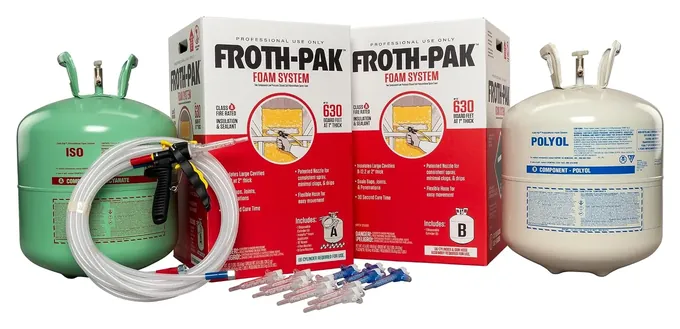
From the manual
- Labeled for professional use only; users of the insulation kits must complete DuPont's safety certification training and quiz before spraying. pp. 1, 3
- Store the tanks indoors at 75 to 85 F for at least a day before spraying, or the foam can suffer and yield drops. p. 8
- Spraying needs at least 10 air changes an hour, kept up for an hour afterward; anyone entering sooner needs a respirator. p. 4
- Use an opened kit within 30 days: moisture in the air reacts with the A side and can ruin the gun and hoses. p. 6
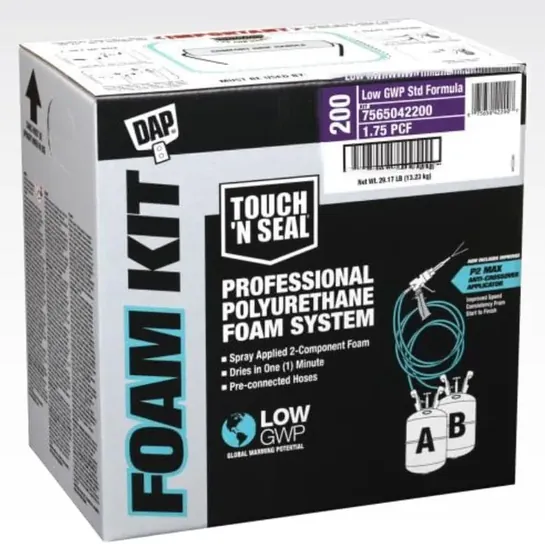
From the manual
- Check three temperatures: chemicals 70 to 90 F, room air 60 to 90 F, and the surface 60 to 90 F. p. 2
- Unopened kits keep 18 months; store them upright below 90 F to protect that shelf life. pp. 2, 3
- The foam is tack-free in 30 to 60 seconds, cuttable in about five minutes and fully cured in about an hour. p. 3
- DAP gives a limited one-year warranty, and the setup steps come on instructions packed inside the box. pp. 2, 3
Compare the specs
Swipe the table sideways to see every column.
| Product | Foam type | Rated yield (board ft) | R-value per inch | ASTM E84 fire class |
|---|---|---|---|---|
| 1. Froth-Pak 630 | Closed cell, two tanks | 630 | 6.2 aged | Class A |
| 2. DAP Touch 'n Seal 200 | Closed cell, two tanks | 200 | 6.4 aged, 7.17 initial | Class A, 5/350 at 2 in |
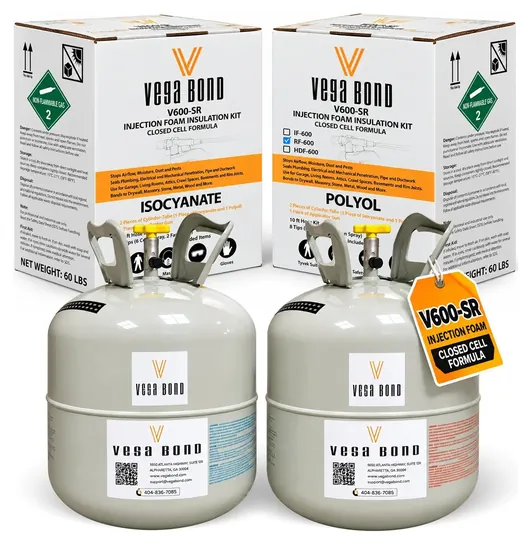
| 3. Vega Bond V600 | Closed cell, two tanks | 600 | 7, maker claim | Class A, maker claim |
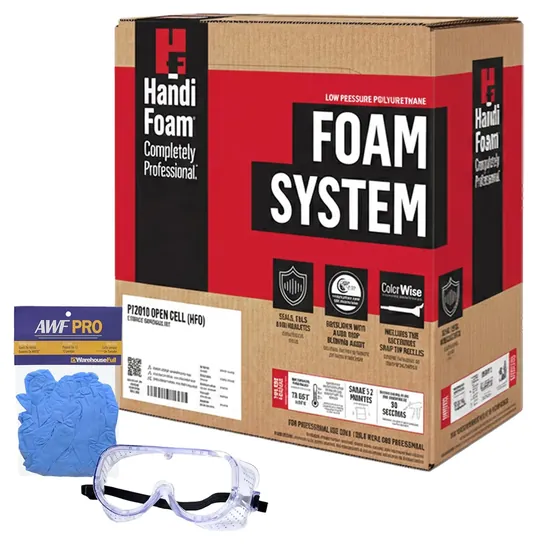
| 4. Handi-Foam HFO 500 | Open cell, two tanks | 500 | 4.4 aged, 6.1 initial | Class B, 65/450 at 4 in |
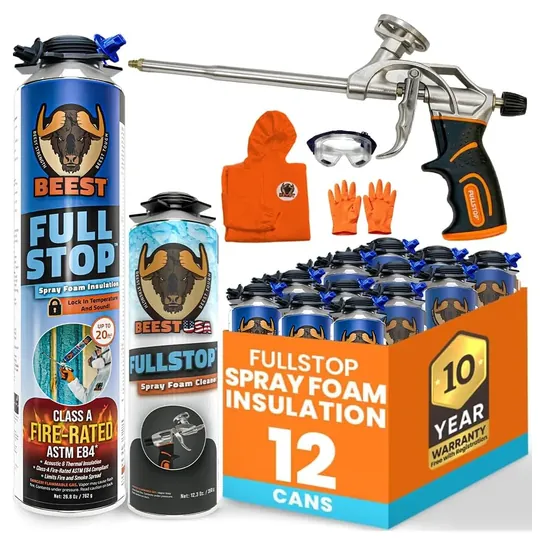
| 5. BEEST FullStop | Foam cans on a gun | — | 4.12, maker figure | Class A, flame spread 0 |
| 6. Vega Bond V600 SLR | Closed cell, slow rise | 600 | About 7, maker claim | Class A, maker claim |
Yield is each maker's theoretical figure at 1 inch under ideal conditions; real coverage runs lower. Aged R-values, measured after curing for months, sit below initial ones; Vega Bond and BEEST don't say which they quote. Fire figures are ASTM E84 flame spread and smoke developed. DAP's come from its standard 1.75 PCF kit data sheet, and BEEST doesn't publish a yield for this 12-can kit.
Sources
- DuPont Froth-Pak Product information sheet (PDF) 630 foam system page
- DAP Touch 'n Seal 1.75 PCF data sheet, June 2026 (PDF)
- Vega Bond V600 fast-rise kit page V600 slow-rise kit page
- HandiFoam HFO Open Cell data sheet TD064 (PDF)
- BEEST FullStop foam cans page
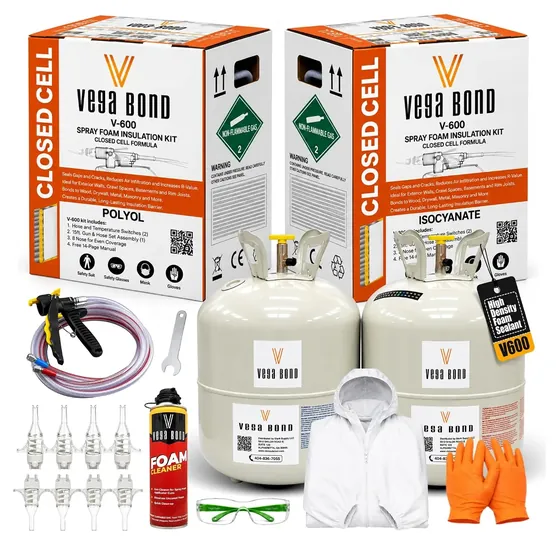
From the manual
- Marked for professional use only; ICP recommends certified respiratory protection or a powered air-purifying respirator. p. 1
- Kits stored below 70 F need one to two days to warm to 70 to 85 F before spraying. p. 4
- Once you release the trigger, restart within 30 seconds or fit a new nozzle, or chemical can leak and ruin the gun. p. 3
- Use a kit within 30 days of first spraying, and dispense a little foam every three days to keep the hoses flowing. pp. 4, 6
HandiFoam two-component disposable kit operating instructions (PDF)
Editor's Notes
November 5, 2026, by Ezvid Wiki Editors:
We read DuPont's Froth-Pak manual, DAP's June 2026 data sheet and HandiFoam's kit instructions and data sheet, then added a spec table and notes from those documents. We corrected the HandiFoam kit's fire rating, which is Class B, BEEST's warranty, which reaches ten years only if registered, and the old line that DuPont didn't list the 630. We also noted that DuPont and ICP label their kits for professional use and added the code's rim-joist exception to the guide.
October 19, 2026, by Ezvid Wiki Editors:
Almost every kit from the 2021 page was gone, marked up or unshippable. The Touch n' Seal Two Component, Touch n' Seal 120 BF, Dow Froth Pak 120, Froth Pak 650 and Fomo Products P40540 are gone. The Dow Froth Pak 620 now sells only at a wild markup, the Handi-Foam E84 costs twice what a similar kit does, and the Industrial Products Seal Spray can't be shipped.
The new list leads with the Froth-Pak 630, DuPont's large two-tank kit. The DAP Touch 'n Seal 200 handles small jobs, the Handi-Foam HFO 500 covers open cell, and the BEEST FullStop is there for people who only need to fill gaps. We also added the Vega Bond V600 SLR, because a lot of readers want to insulate walls without tearing them open.
We couldn't find a lab test of any DIY spray foam kit. We leaned on makers' data sheets, the CPSC and EPA safety guidance, building-code summaries, expert answers and owner reports. One honest point kept coming up: past a few hundred square feet, a contractor's quote is worth getting first.
Earlier notes
March 19, 2021, by Chris Gillespie:
Spray foam has a number of properties that make it a versatile and indispensable building material. Not only does it insulate homes, thus reducing heating costs, but it also reduces noise transfer and helps to control moisture while improving the structural integrity. The types of foam listed in this ranking can be broken down into three basic types, closed-cell used for wall insulation, which traps gasses inside and provides a vapor barrier, closed-cell used for roofs, which is denser and therefore more expensive, and open-cell, which traps air inside and is used for gap filling, however, open-cell foam is not impervious to water and should not be used outside.
In this latest update, we added several kits to the ranking to cover all of the application requirements aforementioned. The Touch n' Seal 120 BF was added as a repair kit for roof structures and, as such, has high insulation properties and is resistant to thermal movement. The Touch n' Seal Two Component and the Dow Froth Pak 620 are both ideal for wall insulation, with the latter becoming tack-free almost instantly after application, and completely dry in just one minute. The Handi-Foam E84, the Dow Froth Pak 120, and the Fomo Products P40540 are all smaller kits that are better suited to filling gaps and crevices than full wall insulation, however, it should be noted that once opened most of these kits have a 30-day shelf life, therefore, pre-planning can prevent unnecessary wastage. For very small jobs, the Industrial Products Seal Spray may be a better option, as it comes in individual canisters, each covering approximately 25 board feet.
December 10, 2018, by Brett Dvoretz:
When it comes to spray foam insulation kits, we believe most consumers would agree that the most important thing is how effective the product is at reducing thermal loss and lowering your energy bill. For that reason, this property was our main focus. After that, we wanted to make sure to include kits of varying sizes.
Special Honors
TruTeam TruTeam, the installation arm of TopBuild, has branches across the country that install spray foam and other insulation. Getting a quote makes sense once a project runs past a few hundred square feet, where several kits often cost about as much as a professional crew with proper equipment and training. truteam.com
Tiger Foam Tiger Foam sells two-component kits directly rather than through big retailers, including a 200-board-foot kit with a 9.5-foot hose, a 600-board-foot kit with a 15-foot hose, a slow-rise formula for closed walls and an open-cell kit. Its site also posts coverage estimating help and safety data sheets. tigerfoam.com
Sizing A Kit: Board Feet, Thickness And Waste
That's why kits suit rim joists, a crawl-space wall, a shed or a few problem spots.
Kits are sold by the board foot, a piece of foam 12 by 12 inches and 1 inch thick. To size a job, multiply the area in square feet by the thickness you want in inches. A 600-board-foot kit covers about 600 square feet at 1 inch, 300 at 2 inches or 200 at 3 inches. That rating is theoretical: DAP's 2026 data sheet for Touch 'n Seal gives yield under ideal conditions, and cold tanks, thick passes and wasted nozzles all cut it. DuPont's Froth-Pak manual says to estimate 10 percent more foam than the job needs, and spraying thicker than planned, an easy mistake on a first job, uses it up faster.
Thickness sets the R-value. Closed-cell foam runs about R-6 to R-7 per inch, so 2 inches lands near R-12 to R-14. Spread over 180 square feet, a 600-board-foot kit gives about 3.3 inches, or roughly R-20.
That's why kits suit rim joists, a crawl-space wall, a shed or a few problem spots. Owners on the Garage Journal forum describe needing four large kits for one 28-by-32-foot building and saving little over a contractor. For a whole house, get a quote before buying several kits.
Two Tanks Or Cans, Closed Cell Or Open
A two-component kit holds an A tank (isocyanate) and a B tank (polyol resin) joined by hoses to a gun, and the foam mixes in the nozzle. The EPA's overview of spray foam product types calls these low-pressure kits, separate from the high-pressure rigs contractors run from a truck. They make real insulation and an air barrier in one pass.
One-component cans cure with moisture from the air. They're simpler, but the foam sets up softer and less dense than two-part foam. Bill Wichers, a Green Building Advisor Expert Member who says he has used lots of Froth-Pak kits, wrote in October 2023 that the canned foam he tried "didn't seem to go as far as claimed" and that he wouldn't use it "for a large area like an entire wall or a ceiling." Some inspectors also want an R-value printed on the product.
Closed-cell foam is dense, about 1.75 to 2 pounds per cubic foot, and blocks both air and water vapor, which makes it the usual pick for rim joists, crawl spaces, basements and metal buildings. Open-cell foam is about half a pound per cubic foot, gives roughly R-3.5 to R-4.5 per inch and soaks up sound, but it lets vapor through, so cold-climate walls need a vapor retarder. Slow-rise injection foam is a third type, made to flow into closed wall cavities before it expands.
Safety, Weather And Building Code
The A side contains isocyanates, which can trigger asthma and skin allergies. The CPSC's spray foam fact sheet says homeowners need the same precautions as professionals, that people with asthma or prior sensitivity should consider another product, and that occupants should vacate for at least 24 hours. DuPont and ICP allow re-entry an hour after spraying with proper ventilation, and both label their kits for professional use. Plan on a fitted half-face respirator with organic vapor cartridges and particulate filters, sealed goggles, nitrile gloves and a coverall, plus fans that push air out of the space. The paper masks packed in some kits are not enough.
Temperature makes or breaks the job. DAP wants the chemicals at 70 to 90 degrees Fahrenheit and surfaces at 60 to 90 degrees. Cold tanks are the usual cause of crumbly, off-color foam and short yield, so warm them indoors for a day or two before a winter job. Spray thin passes rather than one thick layer, since thick foam can overheat as it cures. Unopened kits keep 12 to 24 months depending on the maker, and an opened kit should be used up within about 30 days, so check the date code and plan the work in one stretch.
Foam is combustible. Under the International Residential Code, foam inside living space needs a thermal barrier such as half-inch drywall, and attics and crawl spaces entered only for service need an ignition barrier, as Penn State's housing research center explains. Rim joists are the main exception: foam up to 3 1/4 inches thick may stay bare there if it meets the code's density and smoke limits and has a flame spread index of 25 or less, the Class A range. Class B foam doesn't qualify. Foam exposed outdoors needs a UV coating. Ask your building department about permits before you start.
How we researched this
We compared about 20 two-tank and can kits, including every product from the 2021 version of this page. For the six picks we read DuPont's Froth-Pak kit operating manual and product information sheet, DAP's June 2026 Touch 'n Seal 1.75 PCF data sheet, ICP's HandiFoam open-cell data sheet and disposable-kit operating instructions, Vega Bond's fast-rise and slow-rise kit pages, and BEEST's FullStop page and warranty policy. The CPSC fact sheet, the EPA's guide to spray foam types, Penn State's summary of the code's barrier rules and Green Building Advisor's expert threads shaped the buying guide. Searches of CPSC and Health Canada recall notices found no recalls for DuPont Froth-Pak, DAP Touch 'n Seal, HandiFoam, Vega Bond or BEEST FullStop.
Sources (20)
- ICC-ES: report listing ESR-3228
- DAP: Touch 'n Seal low GWP 1.75 PCF standard spray foam technical data sheet (June 2026)
- CPSC: spray polyurethane foam insulation, health and safety recommendations for consumers
- EPA: spray polyurethane foam product types
- Penn State PHRC: IRC spray foam thermal and ignition barriers
- Green Building Advisor: DIY closed-cell spray foam in a can, is it legit?
- Green Building Advisor: suppliers for spray foam insulation kits
- Garage Journal: spray foam options
- Tiger Foam: two-component spray foam kits
- CPSC recalls
- DuPont: Froth-Pak foam insulation and sealant kits operating manual (rev. 09/2025)
- DuPont: Froth-Pak foam system product information sheet
- DuPont: Froth-Pak 630 foam system
- ICP: HandiFoam HFO Open Cell technical data sheet TD064
- ICP: HandiFoam two-component disposable kit operating instructions A16600
- Vega Bond: V600 closed-cell fast-rise kit
- Vega Bond: V600 slow-rise injection foam kit
- BEEST: FullStop foam insulation cans
- BEEST: warranty policy
- Health Canada: recalls and safety alerts
Frequently asked questions
Can I install spray foam insulation myself?
Low-pressure two-component kits and foam cans are sold to homeowners, though DuPont and ICP label their kits for professional use. The CPSC says the same precautions as professionals apply: a fitted respirator, goggles, gloves, ventilation and an empty house for at least 24 hours. People with asthma or chemical sensitivities should consider other insulation.
How much does a 600 board foot kit cover?
About 600 square feet at 1 inch, 300 square feet at 2 inches or 200 at 3 inches. Kits sold as 600, 620, 630 or 650 board feet are the same class. Real yield is often lower: DuPont advises estimating 10 percent extra, and a first job often uses more.
Is closed cell or open cell spray foam better?
Closed cell gives about R-6 to R-7 per inch and blocks air and water vapor, so it suits rim joists, crawl spaces, basements and metal buildings. Open cell is softer and damps sound better, but it gives about R-4 per inch and needs a vapor retarder in cold climates.
Is canned spray foam as good as a two-tank kit?
Not for large areas. Can foam sets up softer and less dense than two-part foam and often yields less than its label. It works for gaps, patches and small walls. Two-tank kits build thickness quickly and make a continuous air barrier.
Can I use a spray foam kit in cold weather?
Only if you warm the tanks. DAP calls for chemicals at 70 to 90 degrees Fahrenheit and surfaces of at least 60 degrees. Store the kit indoors for a day or two first and heat the work area if you can. Cold chemicals make weak foam and cut yield.
Does spray foam need to be covered?
Usually, yes. Building codes require a thermal barrier such as half-inch drywall over foam in living spaces and an ignition barrier in attics and crawl spaces. Rim joists can stay bare under foam up to 3 1/4 inches thick that meets the code's fire limits. Foam left outdoors needs a UV coating. Check with your local building department.