The 10 Best Speaker Selectors
Updated by · How we research

Speaker switch boxes for two to twelve rooms, compared on amp protection, volume in each room and source switching. The Monoprice SSVC-4.1 leads for most homes. When users buy our independently chosen editorial choices, we may earn commissions to help fund the Wiki.
A speaker selector adds no power. It only routes one amplifier to more rooms, and every pair you switch on lowers the load the amp sees, so four ordinary pairs can drag it near two ohms, below what most receivers accept. These boxes suit anyone running a stereo to a patio, kitchen or office without buying another amp.


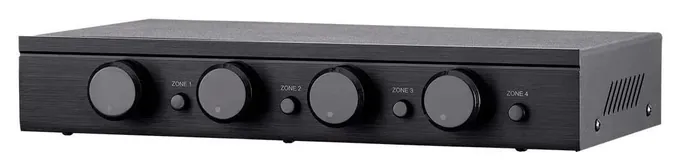
From the manual
- Set levels with the amp at minimum and every room knob at maximum, raise the amp to its loudest clean level, then turn rooms down. p. 2
- If your receiver has A and B speaker outputs, wire the selector to the A outputs. p. 2
- The connector blocks pull out for wiring; check each for stray strands before pushing it back in. p. 2
- Rated for 100 watts a channel continuous and 200 peak, with isolated grounds for bridged or floating-ground amps. p. 1
Why the Monoprice SSVC-4.1 is our top pick
It protects the amp with nothing to set. Its maker's guide says the amp never sees less than 5 ohms with four 4-ohm pairs playing, or 6 ohms with 8-ohm pairs.1 Our runner-up, the OSD Audio SSVC6D, guards the amp with jumpers inside the case, one set per room, left at 4X from the factory; changing them means taking the cover off.2 A dealer warns those jumpers must be set correctly to avoid overloading the receiver.4
On the basics the two match. Both give every room its own on/off button and volume knob, and both keep the left and right grounds apart, so bridged amps are safe.1,2 Our pick's terminal blocks take wire as thick as 12 gauge, while the runner-up stops at 14.1,3 Its power rating is also plain, 100 watts a channel continuous,1 while the runner-up's maker says amps up to 300 watts and a dealer says 100 watts a channel at 8 ohms.3,4
The runner-up wins on reach: six rooms instead of four, and a front switch for a second amp or receiver.3 If you own two sources or need more than four rooms, buy it. For one receiver and up to four rooms, our pick is the simpler box to set up safely.
| Monoprice SSVC-4.1 | OSD Audio SSVC6D | |
|---|---|---|
| Amp protection | Automatic, nothing to set | Jumpers inside the case |
| Rooms | 4 | 6 |
| Amp inputs | 1 | 2, front A/B switch |
| Thickest wire | 12 gauge | 14 gauge |
| Rated amp power | 100 W a channel | 300 W maker, 100 W dealer |
Sources
- Monoprice SSVC-4.1 1Quick install guide (PDF), p. 1
- OSD Audio SSVC6D 2User manual, online copy, pp. 3, 6 3Product page and specs
- 4Crutchfield: OSD SSVC6D details
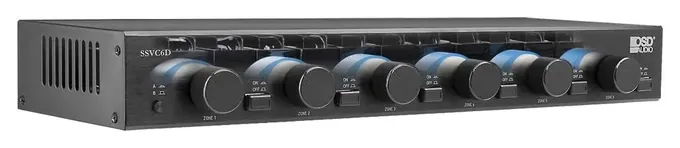
From the manual
- A knob turned fully down mutes the room but leaves it connected; OSD says to switch the room off with its button instead. p. 6
- Protection jumpers sit inside, one set per room, factory set to 4X; changing them means removing the cover, and OSD offers phone help. p. 6
- The connectors unplug for wiring. Plug them back without shifting over a pin. p. 5
- OSD suggests 16-gauge stranded wire, 14-gauge past 50 feet, and fire-rated in-wall cable inside walls. p. 5
Compare the specs
Swipe the table sideways to see every column.
| Product | Speaker pairs (pairs) | Amp inputs (amps) | Room controls | Amp protection | Rated amp power (W per channel) |
|---|---|---|---|---|---|
| 1. Monoprice SSVC-4.1 | 4 | 1 | Button + volume knob | Automatic, resistors | 100 (200 peak) |
| 2. OSD Audio SSVC6D | 6 | 2 | Button + 12-step knob | Autoformers, inside jumpers | 300 maker; 100 dealer |
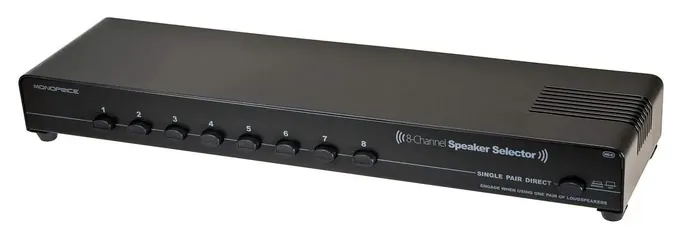
| 3. Monoprice 108230 | 8 | — | On/off switch | 5-ohm floor, can turn off | 100; 200 protection off |
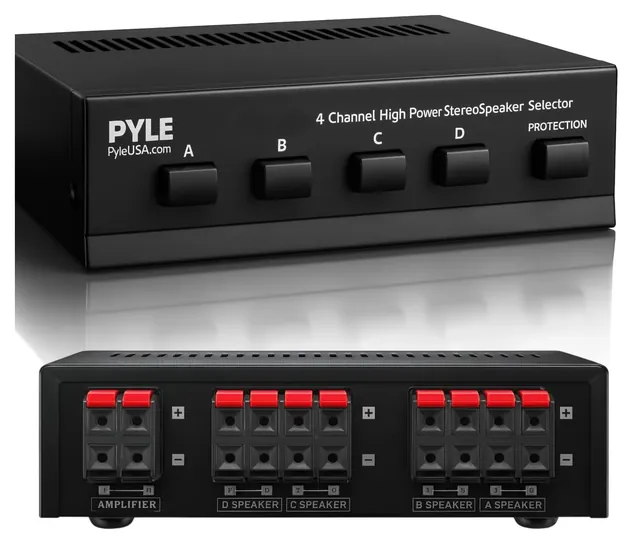
| 4. Pyle PSS4 | 4 | 1 | Push button | Protection button | 100 (guide says 50) |
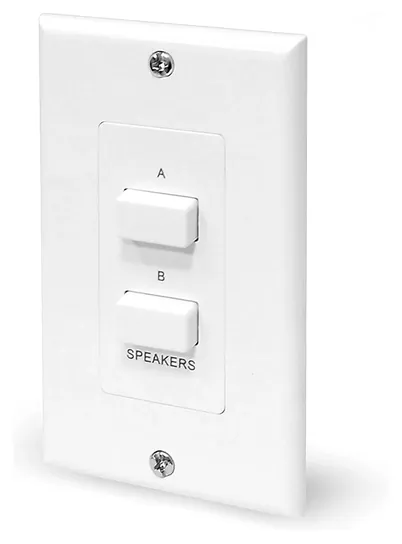
| 5. Pyle PVCS2 | 2 | 1 | A and B buttons | None described | 120, basis not stated |
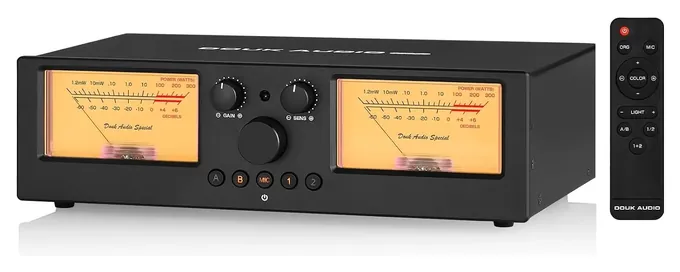
| 6. Douk Audio VU3 Pro | 2 | 2 | Remote control | No-load resistors | 350 |
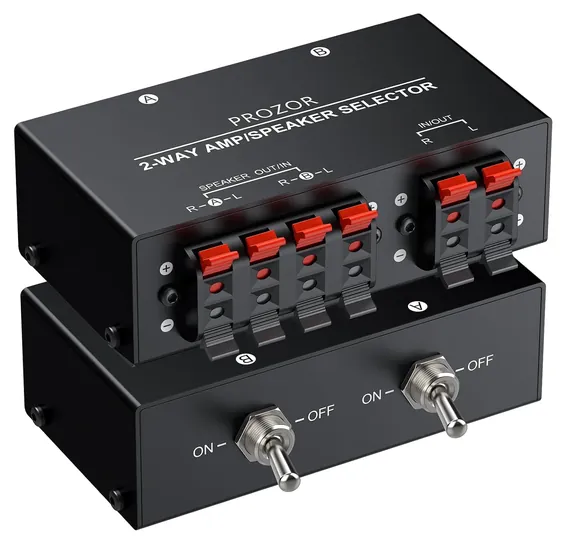
| 7. Prozor 2-Way Switch | 2 | 1 or 2 (two-way) | A/B switches | None described | 150 |
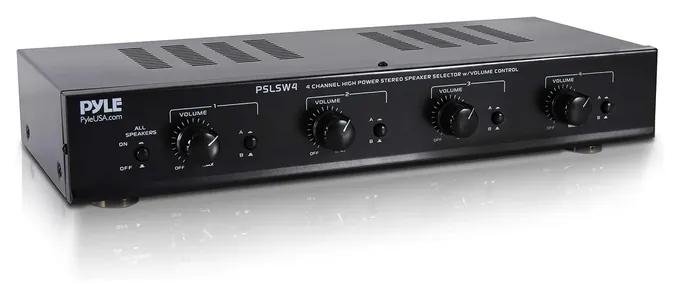
| 8. Pyle PSLSW4 | 4 | 2 | Volume knob, amp A/B | Transformer, per Pyle | 100 |
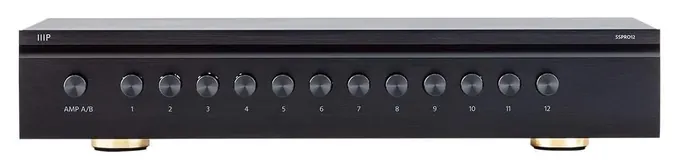
| 9. Monoprice SS-Pro 12 | 12 | 2 | Push button | Transformers, rear dial | 300 peak |
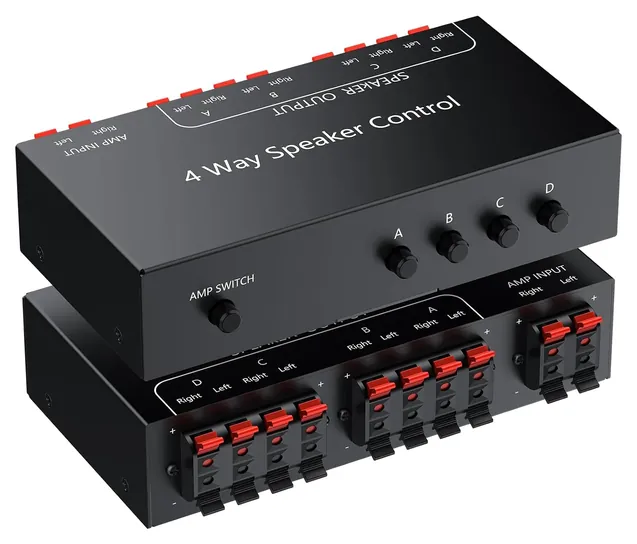
| 10. Prozor AS005 | 4 | 1 | Button + master switch | None described | 150 |
Power figures are the makers' own ratings; nobody publishes lab tests of these boxes, and where two sources disagree both are shown. "None described" means the maker lists no protection circuit. Monoprice's 8230 description doesn't say how many amps it takes. We found no Prozor manual, so its rows come from its own listing text.
Sources
- Monoprice SSVC-4.1 quick install guide (PDF) 8230 description, Target copy SS-Pro 12 product page
- OSD Audio SSVC6D User manual, online copy Product page and specs
- Pyle PSS4 user guide (PDF) PSS4 store page and answers PVCS2 wiring sheet (PDF) PVCS2 store page PSLSW4 user manual (PDF)
- Douk Audio VU3 Pro Product page
- Prozor 2-zone switch listing, Desertcart copy 4-zone selector listing, Desertcart copy
- Crutchfield: OSD SSVC6D details
From the manual
- The guide limits amps to 50 watts a channel, but Pyle's store answers say to disregard that: the rating is 100. p. 3; Pyle store Q&A
- Turn the amp down before changing buttons, and never press a button whose terminals have no speakers attached. p. 5
- Connect only one of a receiver's A or B outputs, and never chain one selector into another. pp. 3, 5
- Pyle's three-year extended warranty covers eligible products registered within 30 days of purchase. Pyle store page
From the manual
- Pyle recommends 8-ohm speakers; with pairs A and B both on, the amp sees 4 ohms. p. 1
- If you add in-wall volume controls, Pyle says to use the autotransformer type. p. 1
From the manual
- Each room has a knob that turns down to off and an A/B button for a second amp, wired to the B amp terminals. pp. 2-4
- Pyle lists transformer protection, but its chart shows the load at 2.4 ohms with all four rooms on. pp. 2, 5
- Rated for amps of 100 watts a channel or less and wire up to 14 gauge; go heavier past 80 feet. pp. 2, 5
Editor's Notes
November 5, 2026, by Ezvid Wiki Editors:
We read the manuals for the Monoprice SSVC-4.1, OSD Audio SSVC6D and three Pyle boxes, then added a spec table, a section on why the SSVC-4.1 leads, and setup notes from those manuals. We corrected the SSVC6D's protection setting, which uses jumpers inside the case rather than a rear switch, and the PSLSW4's description, whose manual shows a button for choosing between two amps and lists transformer protection. The guide now says the top pick's protection is resistor-based.
October 23, 2026, by Ezvid Wiki Editors:
The Monoprice SSVC-4.1 takes the top spot because it does the two things most readers need at once: it guards the amplifier when several rooms play, and it gives each room its own volume knob. The old list had mostly gone dark. The AVX 1624, AVX 1602, OSD Audio ATM-7, TEC 7220 and Keen Eye Black Box are no longer sold, and we couldn't find the Specialty AV TEC-905B. The Nobsound Little Bear is gone too, and it was a switch for line-level sources rather than speakers anyway. The Niles SSVC-6 is still around, but its price has climbed and stock is thin, so it moves to special honors.
The Pyle PVCS2 and Pyle PSLSW4 stay. New are the OSD Audio SSVC6D for two sources, the Monoprice 108230 and Monoprice SS-Pro 12 for big houses, the low-cost Pyle PSS4 and Prozor AS005, and two boxes for switching amps, the Prozor 2-Way Switch and the Douk Audio VU3 Pro.
Our evidence was the makers' power and impedance ratings, the plain math of speakers wired in parallel, and hobbyist forum threads on switching between amps. Nobody seems to lab-test these boxes, so treat the power ratings as the makers' claims.
Earlier notes
January 1, 2021, by Brendon Hannaford:
For this update we removed two options due to availability concerns and replaced them with budget models in order to further expand the price range of our list. The Pyle PSLSW4 is for those who want a lot of features but don't necessarily care about an audiophile-grade construction. The fact that you can hook up two amps and send their outputs to different sets of speakers simultaneously makes it a decently advanced device, and its individual volume controls are similarly surprising for its price. The Keen Eye Black Box is a surface-mountable selection that's great for compact DIY setups, as it can be attached to just about anything with the 4 included screws. While its small size may be beneficial for some, it's worth noting that its terminals are quite close together and might be difficult to work with for some users.
April 23, 2019, by Christopher Thomas:
Depending on your use case, you can spend as little or as much as you'd like on a quality speaker selector. The AVX 1624 is one of the most useful for the a wide range of users thanks to its multi-room capabilities, moderate price, and impedance protection. If you don't need volume control, their 1602 is worth a look, because it happens to be incredibly inexpensive. The Pyle is worth a look for fixed 2-speaker installations and makes a great addition to rooms that are already outfitted with flush in-wall audio components. If you're looking for rock-solid reliability and high-volume performance, consider the TEC 7220, Russound, or Niles, all of which have great power handling and dependable electronics inside. Specialty AV also makes a couple audiophile-grade options that seem simple, but do perform very well. Meanwhile, the NobSound is an especially affordable unit that comes in two varieties. One of them incorporates a Bluetooth 4.0 receiver for wireless input, while the other is one of the few consumer-grade models with XLR inputs, which makes it a good choice for those using audiophile-level unbalanced amplifiers. Finally, if you're looking for the most in-depth control over your system, it's hard to beat the OSD ATM-7. While it's a little bit costly, it's the only one we found with reliable remote control, and its 2 sources and 7 output channels can be switched to act as 7 sources and 2 output channels, making it just about the most versatile of the bunch.
Special Honors
Russound Russound makes the SS-4.2 and SS-6.2 selectors for four and six pairs, plus dual-source PRO models for up to 12 pairs. The company focuses on whole-home audio, so its selectors sit alongside amplifiers, keypads and in-wall speakers from the same maker. russound.com
Niles SSVC-6 Niles has made multi-room switching gear for decades, and its SSVC-6 handles six pairs with a volume knob for each and selectable impedance protection. It costs far more than the boxes above and stock is scarce, but it's worth a look for a custom install. Niles also sells in-wall volume controls. nilesaudio.com
How Many Rooms, And Who Sets The Volume
That lets the whole house switch between, say, a living-room receiver and a streaming amp with one button.
Count the pairs of speakers you want to run, then add one for the room you'll wire next year. Four-zone boxes are the most common. Eight- and 12-zone boxes such as the Monoprice SS-Pro 12 suit big houses and small businesses.
Next, decide where volume gets set. A plain switch box only turns rooms on and off, so every room plays at the level set on the receiver. A selector with a knob per zone lets the kitchen stay quiet while the patio plays loud. If your box has no knobs, you can add a volume control in the wall of any room that needs one. Specialty dealers such as Outdoor Speaker Depot sell selectors and in-wall controls side by side, which makes it easier to plan both.
A few boxes take two sources. That lets the whole house switch between, say, a living-room receiver and a streaming amp with one button. If you only own one amp, you don't need it.
Protecting Your Amp: Impedance In Plain Terms
This is the part most buyers miss. Speakers are rated by impedance, usually 8 ohms, sometimes 4 or 6. Your amplifier is rated for a minimum impedance it can drive safely. When a selector turns on several pairs, they're wired in parallel, and the load the amp sees drops. Two 8-ohm pairs look like 4 ohms. Four of them look like 2 ohms, which can make many home receivers overheat or shut down. Andrew Welker, an electrical engineer and loudspeaker designer at Axiom Audio, made the same point about a receiver's own A and B switch in a March 2021 Tech Talk: two pairs of 4-ohm speakers "would present a 2-ohm load," which he called "problematic for many, many amplifiers and receivers."
Selectors deal with this in three ways. Some do nothing, and you're expected to play only a pair or two at a time. Some have a protection button you press when several pairs play. Others hold the load above a floor on their own, either with resistors or with transformers and autoformers, which waste less power as heat. Monoprice's SSVC-4.1 is the resistor kind and keeps the amp at 5 ohms or more with four 4-ohm pairs on. Some transformer boxes must be told how many pairs you'll use, through a dial on the back or jumpers inside the case, so set that before the first loud session.
If you plan to play three or more rooms at once, buy a box with impedance protection, or pair a plain box with impedance-matching volume controls in the walls. Check your amp's manual for its minimum rating before you start.
Two Amps, Wall Plates And Wiring
Some boxes run the other way: two amplifiers into one pair of speakers, so you can switch between a vintage receiver and a newer amp. Never let both amps connect to the same speakers at once. A good switch breaks the first connection before it makes the second, a point hobbyists stress in an Audio Science Review thread on amp switching. Boxes with simple toggles leave that up to you, so flip one off before you flip the other on. Relay boxes such as those from Douk Audio add meters and remotes for side-by-side listening.
Sound quality is rarely a problem, since a switch is just a contact. The bigger risk is switching while the amp is driving the speakers hard: members of an Audioholics forum thread warn that it can blow the amp. Turn the volume down before you switch rooms.
If cable runs inside walls, use speaker wire rated for in-wall use and check local code, or hire an installer. These boxes are for ordinary home speakers. Commercial 70-volt systems, the kind in stores and offices, need their own switches.
How we researched this
We compared 23 speaker selectors and switch boxes, including every pick from the earlier list. We read Monoprice's SSVC-4.1 quick install guide, OSD Audio's SSVC6D manual and Pyle's guides for the PSS4, PVCS2 and PSLSW4, plus Monoprice's product descriptions for the 8230 and SS-Pro 12 and Douk's page for the VU3 Pro; Prozor publishes no manual, so its figures come from its own listings. An Axiom Audio engineer's explanation of parallel speaker loads and two hobbyist forum threads on amp switching shaped the buyer's guide. The CPSC recall database lists no selector or switch box from these brands (Monoprice's two recalls were Ethernet cables and an outdoor cooker), and the one Pyle recall we found at Health Canada, from 2011, covered amplifiers and mixers, not selectors.
Sources (7)
- Monoprice: speaker selectors and volume controllers
- Douk Audio: speaker switchers
- Audio Science Review: amplifier/speaker selector thread
- Audioholics Forums: affordable A/B speaker switch
- U.S. Consumer Product Safety Commission: recalls
- Axiom Audio: How many speakers can you play at once? (Andrew Welker, Tech Talk)
- Health Canada: Pyle and Pyramid home audio equipment recall (2011)
Frequently asked questions
Does a speaker selector make my speakers louder?
No. It's passive and adds no power. It splits one amplifier's output among rooms, so each pair can get less power when several play at once.
Do I need impedance protection?
If you'll play three or more pairs at once, yes. Each pair added in parallel lowers the load on the amp, and a protected selector keeps that load in a range the amp can handle.
Can I connect two amplifiers to one pair of speakers?
Only through a switch made for it, with one amp connected at a time. Tying two amp outputs together can damage both.
Does a selector hurt sound quality?
Very little. The switch is a simple contact. Resistor-type protection and volume circuits turn some power into heat, but at normal levels the bigger risk is switching rooms with the volume up.
Can I use one with a commercial 70-volt system?
No. Home selectors are made for 4- to 8-ohm speakers. Seventy-volt systems in stores and offices need switches built for them.