The 10 Best Remote Control Outlet Switches
Updated by · How we research

Plug-in remote outlets, wall-switch kits and outdoor sets compared on load rating, range and safety marks. The BN-Link ES1513-5-2 leads for whole-room control. When users buy our independently chosen editorial selections, we may earn commissions to help fund the Wiki.
Most plug-in remote outlets are rated for about 1,200 watts: plenty for lamps, fans and string lights, but not for a typical space heater. Each pairs a receiver that plugs into the wall with a remote that switches it, with no Wi-Fi, app or wiring. Renters, holiday decorators and anyone with a lamp behind the couch benefit most.


Editor's Notes
October 26, 2026, by Ezvid Wiki Editors:
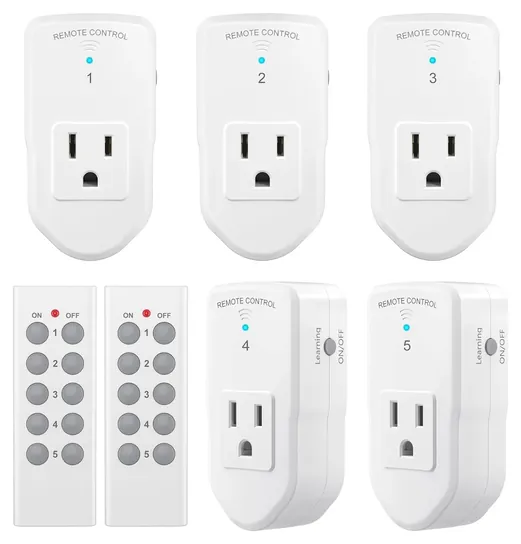
The BN-Link ES1513-5-2 is the new first choice, since one box covers a whole room: five receivers, two remotes and nothing to set up. This page covers plug-in radio remote outlets, the kind with a receiver in the wall socket and a remote in your hand, and it now includes outdoor sets and wall-plate switches too.
Half the old list had to go. The Woods 59746WD and the Etekcity Kit have disappeared from sale, the Woods 59748WD is out of stock under a new brand, and the Dewenwils Heavy Duty link now leads to a timer with no remote. We dropped the Toveenen Ultra Long Range because it claims more power than a standard household plug can carry, the BN-Link Mini over reports of units dying after a few months, and the J-Tech Digital 3rd Generation for a thin record.
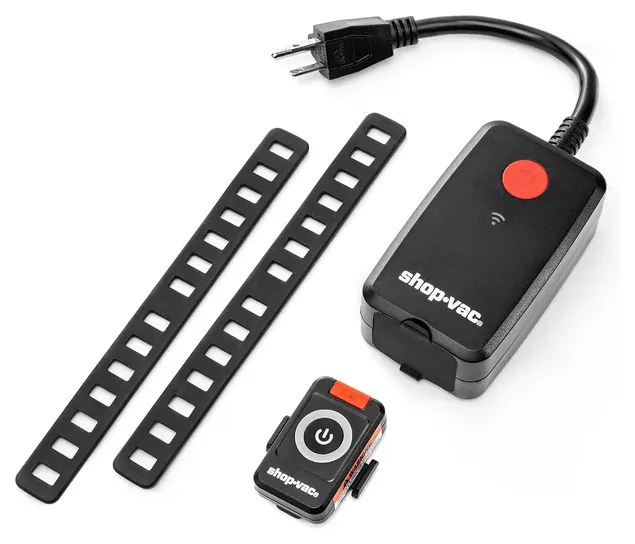
The Etekcity Zap 1FX and the Dewenwils Remote Wall Switch stay, and the GE mySelectSmart returns as the MySelectSmart 36523, the current version from Jasco. New are an outdoor Dewenwils set, a long-range LoraTap, a stairway switch from Suraielec and a Shop-Vac outlet for vacuums.
The deciding evidence was the fine print on each receiver: how many watts it takes for lights versus motors, and whether it carries an ETL or UL safety listing or only a radio license. We also checked every brand against CPSC recall records and weighed owner reports on range, batteries and receivers that fail early.
Earlier notes
March 23, 2021, by Will Rhoda:
It was a fairly smooth round of updates, with almost all of our choices from last year still managing to pull their weight. One exception was the Goronya Wireless, which we removed after noticing that it wasn’t presently available.
We also gave some thought to replacing the Etekcity Zap 1FX with its next-generation model – the Etekcity ESO15-TB, which is only slightly more expensive and sheds the simple remote control included with the 1FX in favor of Wi-Fi connectivity – but ultimately decided that, while we like the looks of this new option, it just wasn’t what we were looking for on this specific list, which is focused on units that can be controlled remotely without a Wi-Fi connection or the additional purchase of a hub. Following this same logic, we also removed the Insteon Dual Socket, which was a hardwired model that offered app control via Wi-Fi, but didn’t include a designated remote control.
Our new picks this time around are the BN-Link Mini — which comes in a pack of five with a pair of remotes, each offering separate control of all five outlets; and the Toveenen Ultra Long Range — which offers 10 times the range of many of its competitors, and is operable from distances of up to 1,000 feet.
As app-controlled options become more and more prevalent, we still see the value of maintaining this list – for the benefit of technophobes, users who abstain from smartphones, and those equipping properties without Wi-Fi access – but for users who are specifically interested in app control, don’t despair, we still have you covered. For weather-resistant options, head over to our list of remote control outdoor outlets, which includes several options with app connectivity (including the ESO15-TB, at the time of this writing). For plug-and-play options that work well with Wi-Fi inside the home, check out our list smart plugs.
February 10, 2020, by Kaivaan Kermani:
We had a reasonable variety of options here from before the update, including single-plug options like the GE mySelectSmart, and the recently-updated Dewenwils Wall; multiplugs, like the Woods Photoelectric and Woods Outdoor, both of which have 3 outlets, but with the latter being waterproof, and also, the Etekcity Zap 1FX, and Dewenwils Heavy Duty which I’ve updated, and; sets with multiple outlets like the J-Tech Digital 3rd Generation, which has 5 outlets, and which I’ve updated from the 2nd gen. model, and the Etekcity Kit, which is very similar to the Etekcity Compact that I had removed.
The sets can be used on different sockets around your home and are your most versatile option. They’re also fairly well-priced and I would them over other options. I’ve removed a couple of the single-plug options like the Eve Energy and replaced it with the Goronya Wireless, which has 5 outlets and is a particularly nice choice for the elderly and disabled. Instead of the learning button being placed on the more traditional position on the right of the outlet, it’s on top, which is a nice accessibility feature. Also, the remote can last for ages on its batteries.
I’ve also replaced another single-plug option for something a little different that wasn’t on the list before – Insteon Dual Socket. This model easily replaces your traditional wall socket, and quite frankly, I really like it. It would have been my first pick, save for the fact that it’s a little more expensive and inconvenient to install, and the remote has to be bought separately, so I can’t recommend it to practically-minded people on a budget; however, it’s still my favorite personal choice, and I would still get this smart plug installed around my house.
In terms of remote accessibility, you’ve got a few options, and the best ones involve purchasing the Insteon Hub to operate it via a smartphone, or get one of the mini remotes- of which I believe they have 3 different models. They have quite a few more control options actually, including a keypad, which is what I think makes this outlet better than similar models that often only offer smartphone control via the company’s own hub that you have to purchase separately. I hope, for the sake of convenience, that Insteon starts selling the Dual Socket in a bundle package with their remote – if that happens, then I will surely move the model up the list.
Match The Load, Not The Headline Watts
The common white indoor units are rated 10 amps, or about 1,200 watts.
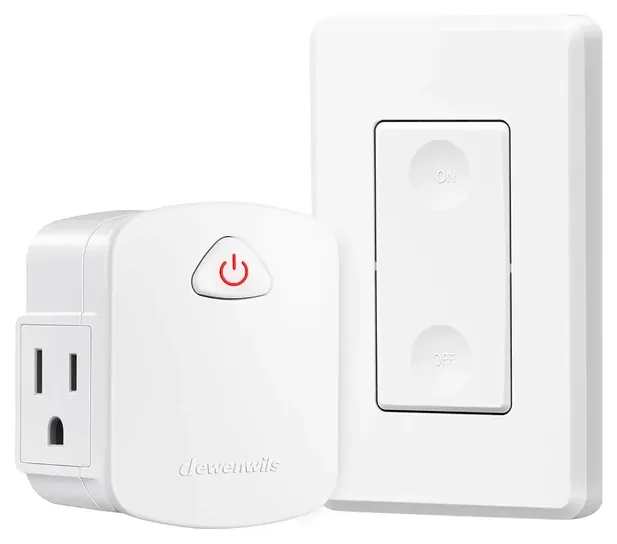
Every receiver has a rating printed on it, and it's the first thing to check. The common white indoor units are rated 10 amps, or about 1,200 watts. That covers lamps, fans, routers and nearly any string of LED lights. Heavier units, like the Dewenwils IT101 and the Dewenwils Remote Wall Switch, are rated 15 amps, or 1,875 watts, which is the most a standard household plug is built for.
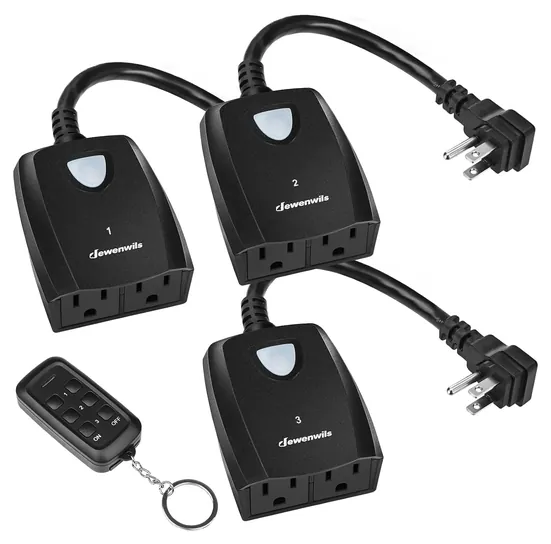
The headline number is for simple resistive loads. Motors and old incandescent bulbs pull a surge when they start, so makers give them a lower limit. The Dewenwils HRS103F2 outdoor set takes 1,875 watts of lights but only 1,000 watts of incandescent bulbs and a half-horsepower motor, and the MySelectSmart 36523 allows just 360 watts of incandescent bulbs. BN-Link says plainly that its kit isn't for shop vacuums; the Shop-Vac Remote Outlet exists for that job.
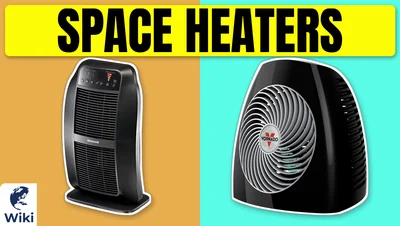
Space heaters are the trap. Most draw about 1,500 watts, more than a 10-amp receiver allows, and fire safety advice is to plug a heater straight into the wall, not into an extension cord or an adapter (Wikipedia: Space heater). A remote also means the heater can turn on when no one is in the room. Keep heaters, hot plates and irons off remote outlets, and don't plug a loaded power strip into one.
Range, Radio Bands And Remotes
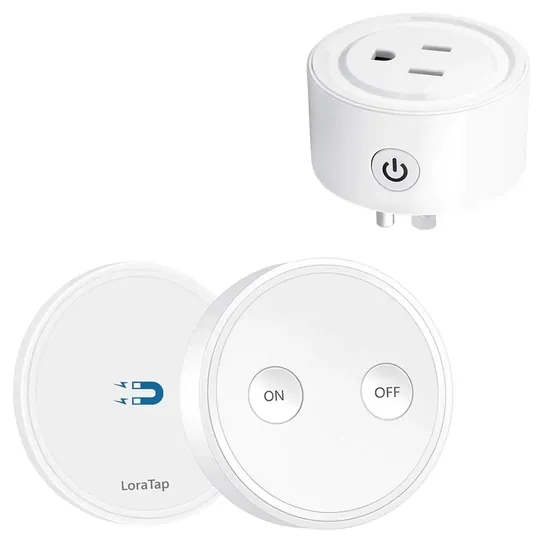
The 100-foot range on most boxes is an open-air figure. Walls, floors, brick and metal cut it, and some owners of outdoor sets get well under half that from inside the house. Dewenwils lists the 433 MHz band for its kits, while the LoraTap SP111SC uses 915 MHz, which LoraTap says gets through walls and ceilings better and reaches up to 656 feet outdoors. The two bands don't talk to each other, and most makers only pair remotes and receivers of the same model, so pick one family and stick with it (Dewenwils remote outlets).
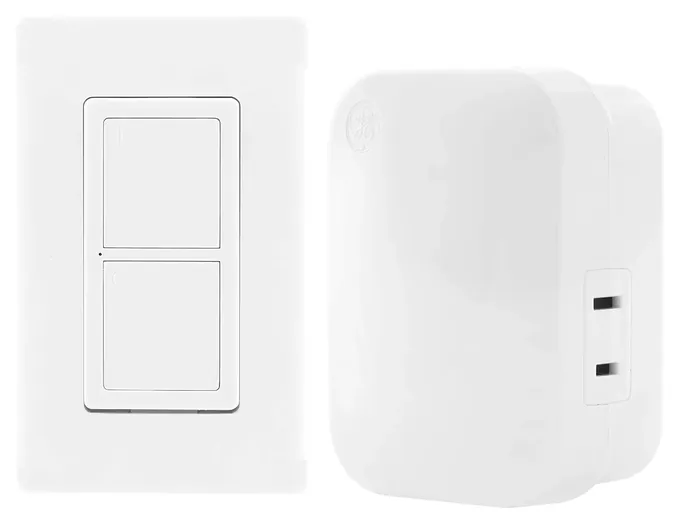
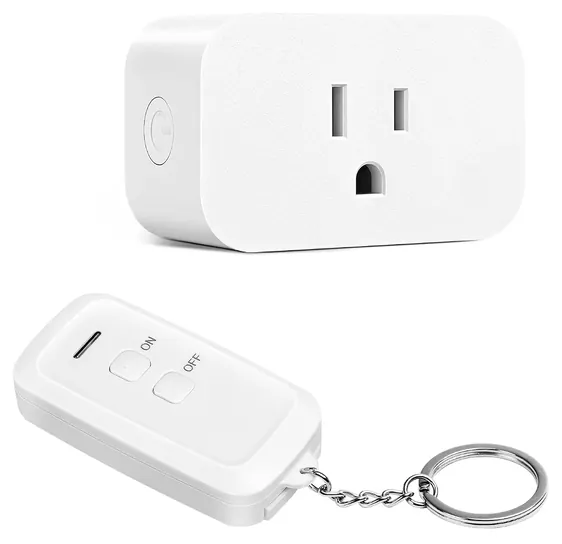
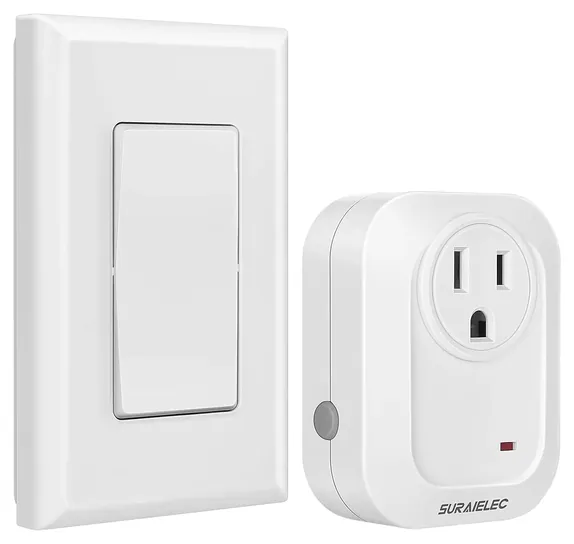
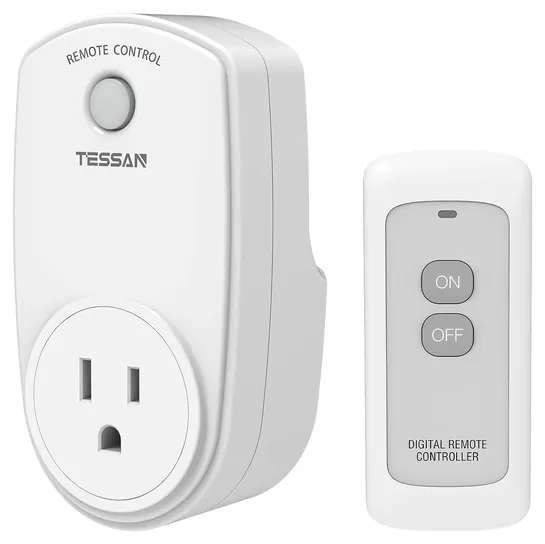
Remote styles matter more than they look. A key fob is easy to lose, a numbered multi-button remote runs several outlets, a magnetic disc lives on the fridge, and a wall-plate remote, like the Dewenwils Remote Wall Switch or the Suraielec URSW11A, gives a room without a switch one by the door. The Suraielec sends a new code with each press, so two kits in one building don't interfere.
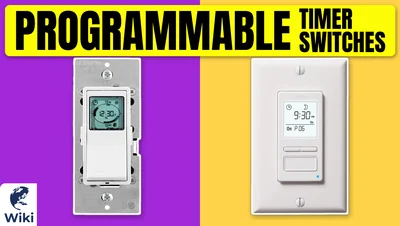
Remotes run on a coin cell or a small 12-volt battery, so keep a spare. Most receivers stay off after a power cut, which is safer but means a lamp won't come back on by itself. If you want lights on a schedule rather than a button, a programmable timer switch does that, and a Wi-Fi smart plug adds phone control and schedules at the cost of an app and a working router (Wikipedia: Smart plug).
Safety Listings, Outdoor Use And Recalls
Look for an ETL or UL mark. Those come from testing labs that check the electrical side for fire and shock risk. An FCC mark only covers the radio, so a receiver with just FCC and RoHS logos has not been shown to meet the same electrical standard. Among these picks, the Dewenwils HRS103F2, the Dewenwils Remote Wall Switch and the Etekcity Zap 1FX state ETL listings, and BN-Link names ETL for its kit.
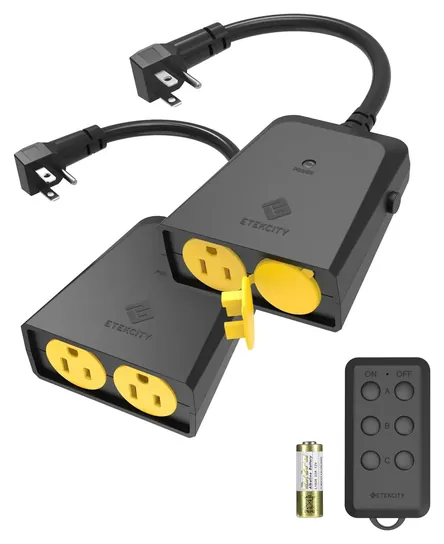
Outdoors, use only a receiver made for it, with a sealed shell and covers over the sockets. Dewenwils tells owners to mount its outdoor receivers upright, at least 2 feet off the ground. Splash ratings like the Shop-Vac's IP54 mean rain and spray, not puddles or snowbanks.
Cheap wireless switches have caught fire before. The CPSC recalled Idea Village wireless light switches in 2010 (CPSC recall) and Woodstock International dust-collector remote switches with undersized wiring in 2009 (CPSC recall). A search of the CPSC recall database found no recalls for any brand on this list (SaferProducts.gov).
How we researched this
We compared 25 remote outlets, wall-switch kits and outdoor sets, read the makers' electrical ratings, safety listings and instructions for the 10 finalists, looked for patterns in owner feedback on range, batteries and early failures, and checked every brand against CPSC recall records. We found no independent lab tests of this category, so the ranking rests on documented ratings and safety listings.
Frequently asked questions
Do remote control outlets need Wi-Fi or an app?
No. The receiver and remote talk over their own radio link and come paired from the factory. You plug in the receiver, plug the lamp into it and press the button.
Can a remote outlet run a space heater?
Generally no. Most indoor receivers are rated about 1,200 watts, and a typical heater draws about 1,500. Heaters should go straight into a wall outlet.
How far away does the remote work?
Most makers claim about 100 feet in open air. Walls, floors and metal cut that, so expect less from another room or from inside the house to the yard. The LoraTap SP111SC claims up to 656 feet outdoors.
Does the outlet turn back on after a power outage?
Usually not. BN-Link, Tessan and Dewenwils say their receivers stay off after a power cut, so press the remote again once the power returns.
Can I add a wireless light switch without wiring?
Yes. Kits like the Dewenwils Remote Wall Switch and the Suraielec URSW11A pair a plug-in receiver with a switch plate that mounts on the wall with screws or tape. It controls whatever is plugged into the receiver, not a ceiling light wired into the wall.
Should I get a smart plug instead?
A Wi-Fi smart plug adds schedules and phone control but needs an app and a working router. A radio remote outlet does one thing, on and off from a button, and keeps working when the internet is down.