The 9 Best Rack Mount Battery Backups
Updated by · How we research

1U or 2U, line-interactive or online: nine rack UPS units compared on watts, sine wave, depth, runtime and monitoring. The CyberPower CP1500PFCRM2U ranks first. When users buy our independently chosen editorial selections, we may earn commissions to help fund the Wiki.
Watts, not volt-amperes, are what you size a UPS by. A rackmount UPS bolts into a standard 19-inch rack and keeps servers, storage and switches in home labs, small offices and network closets running through brief outages, then shuts them down safely. Modern active-PFC power supplies need a pure sine wave on battery.
At a Glance


From the manual
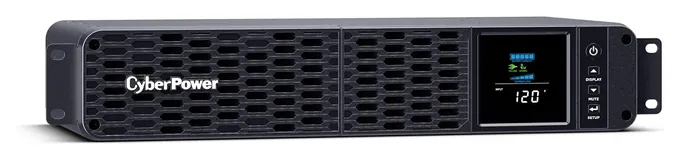
- Charge it at least eight hours before relying on it; it won't power on the first time unless it's plugged into AC power. p. 1
- The warranty bars extension cords, outlet strips and surge strips, so plug it straight into a grounded wall outlet. p. 1
- CyberPower suggests keeping the load under 80 percent of the rating, which works out to about 800 watts. p. 1
- The box holds four screws for fastening it to the rack, but no rails or shelf, so plan support for a full-depth rack. p. 1
Why the CyberPower CP1500PFCRM2U is our top pick
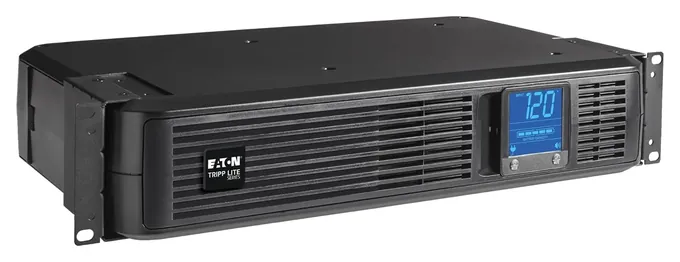
It gives a shallow rack true sine-wave power on battery, the kind active-PFC server and PC supplies expect, while our runner-up, the Tripp Lite SMART1500LCD, switches to a stepped PWM sine wave when the power fails.1,3 Both are 2U and about 10.5 inches deep, so either fits a short wall cabinet,1,3 but our pick also delivers 1,000 watts to the runner-up's 900.1,3
The longer-term differences favor our pick too. Its expansion slot takes optional network or cloud monitoring cards, its three-year warranty covers the batteries, and the manual shows them coming out through the front panel.1,2 The runner-up's spec sheet says network management isn't supported, and units without a battery door need a repair technician for a new battery.3
The runner-up does win on runtime: its maker lists 11.8 minutes at half load, against 10.2 for our pick.3,1 For routers and switches that only need a few spare minutes, it's the budget answer. For servers and storage boxes with modern power supplies, the sine wave and the card slot decide it.
| CyberPower CP1500PFCRM2U | Tripp Lite SMART1500LCD | |
|---|---|---|
| Wave on battery | Pure sine | PWM sine (stepped) |
| Output | 1,000 W | 900 W |
| Network card slot | Yes, optional cards | Not supported |
| Battery swap | User, through the front | Battery door on newer units |
| Runtime, half load | 10.2 min | 11.8 min |
Sources
- CyberPower CP1500PFCRM2U 1Spec page 2User manual (PDF), p. 1
- Eaton Tripp Lite SMART1500LCD 3Spec sheet (PDF), pp. 2, 3, 3, 5, 4
Compare the specs
Swipe the table sideways to see every column.
| Product | Output (W) | Type, battery wave | Depth (in) | Battery outlets | Runtime, half load (min) | Warranty (years) |
|---|---|---|---|---|---|---|
| 1. CyberPower CP1500PFCRM2U | 1,000 | Line-interactive, sine | 10.5 | 8 | 10.2 | 3, battery incl. |
| 2. Tripp Lite SMART1500LCD | 900 | Line-interactive, PWM sine | 10.5 | 8 | 11.8 | 3 |
| 3. APC Smart-UPS SMC1500-2UC | 900 | Line-interactive, sine | 18.8 | 6 | — | 2 |
| 4. CyberPower CP2000PFCRM2U | 1,200 | Line-interactive, sine | 10.8 | 8 | 9.0 | 3, battery incl. |
| 5. CyberPower OR500LCDRM1U | 300 | Line-interactive, simulated | 9.25 | 4 of 6 | 12 | 3, battery incl. |
| 6. CyberPower OR2200PFCRT2U | 1,540 | Line-interactive, sine | 15.3 | 8 | 15.5 | 3, battery incl. |
| 7. CyberPower OL1500RTXL2U | 1,350 | Online, sine | 16.9 | 8 | 12.5 | 3, battery incl. |
| 8. APC Smart-UPS SRT2200RMXLA | 1,800 | Online, sine | 22 | 7 | — | 3, battery 2 |
| 9. APC Smart-UPS SCL500RM1UC | 400 | Line-interactive, sine | 9.14 | 4 | — | 5 |
Runtimes are the makers' estimates at half the rated load with new, fully charged batteries; APC's documents we could read don't give them. The SMART1500LCD's PWM sine wave and the OR500LCDRM1U's simulated sine wave are both stepped approximations, and both can trouble active-PFC power supplies.
Sources
- CyberPower CP1500PFCRM2U spec page CP2000PFCRM2U spec page OR500LCDRM1U spec page OR2200PFCRT2U spec page OL1500RTXL2U spec page
- Eaton Tripp Lite SMART1500LCD spec sheet (PDF)
- APC SMC1500-2UC product page Smart-UPS C operation manual (PDF) SRT2200RMXLA product page Smart-UPS On-Line SRT operation manual, Spanish (PDF) SCL500RM1UC product page SCL500RM1UC user manual (PDF)
From the manual
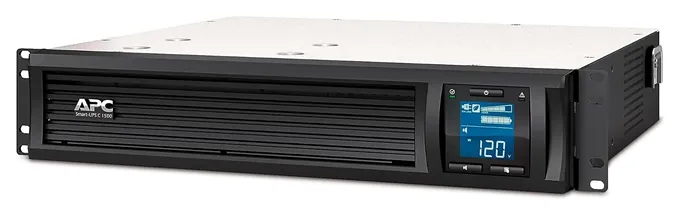
- The warranty is two years and applies only if you register the unit within 10 days of purchase. p. 18
- At about 56 pounds and nearly 19 inches deep, APC suggests pulling the battery before lifting it in and mounting it near the rack's bottom. pp. 7, 8
- It charges to 90 percent in its first three hours, so don't expect full runtime right after setup. p. 8
- PowerChute Serial Shutdown runs only on 64-bit systems, and the USB and serial ports can't be used at the same time. p. 7
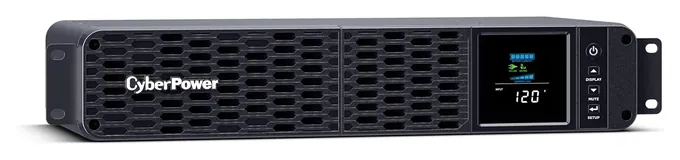
From the manual
- Half its outlets are non-critical: set a battery level in the menu or PowerPanel Business and they shut off to stretch runtime for the rest. p. 1; setup guide, p. 2
- Unlike the CP1500PFCRM2U, it has no widely spaced outlets, so bulky power bricks can block their neighbors. p. 1
- It takes CyberPower's RB1290X2G battery cartridge; after a swap, recharge for 8 to 16 hours before trusting the runtime. pp. 1, 2

From the manual
- Only four of the six outlets have battery backup; the other two are surge-only, so put the modem and router on the backed-up ones. pp. 1, 4
- Charge it for at least eight hours before use, and recharge it every three months if it sits in storage. pp. 3, 4
- A rear slot takes an optional RMCARD for network monitoring; USB monitoring works out of the box. p. 4
- Typical battery life is three to six years, and the replacement cartridge is the RB0670X2. p. 8
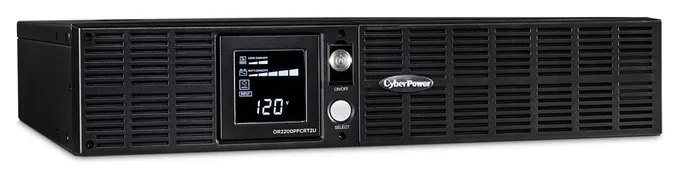
From the manual
- CyberPower asks for at least 18 hours of charging before first use, and again after a battery swap. pp. 2, 6
- CyberPower says to connect it only to a circuit protected at no more than 20 amps, which suits its 20-amp plug. p. 1
- The box has rack brackets and a vertical stand but no rails. p. 2
- Its USB and serial ports can't be used at the same time. p. 3
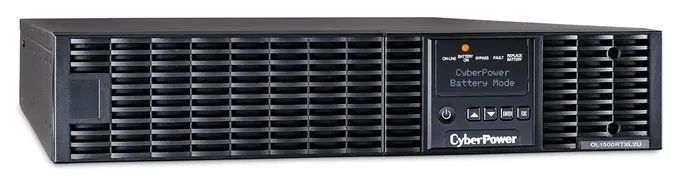
From the manual
- The included four-post rails adjust from 20.5 to 36 inches deep, so a shallow cabinet won't take them. p. 4
- For a two-post rack, CyberPower says to remove the batteries first and have two or three people lift it. p. 6
- It accepts up to 10 extra battery modules; their count is set in the LCD menu, where the default is zero. p. 12
- Setting the output to 110 or 115 volts derates its capacity by 10 percent. p. 12
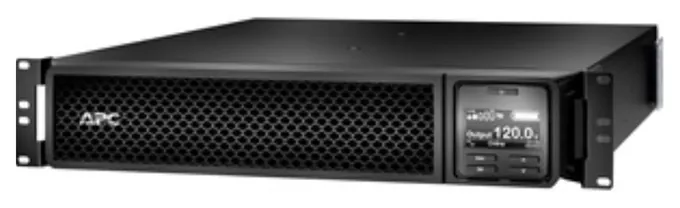
From the manual
- Green mode, off by default, sends utility power straight to the load and allows a gap of up to 10 milliseconds when power fails. pp. 13, 17
- In green mode capacity drops from 2,200 to 1,800 volt-amperes, and the unit needs a 20-amp branch circuit. p. 8
- APC says to replace the battery at least once every five years. p. 7
- Warranty is three years, two on the battery, and applies only if you register within 10 days. p. 32
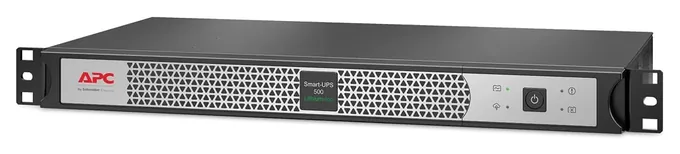
From the manual
- The battery isn't user-replaceable; APC says it typically lasts about 10 years and recommends replacing the whole unit after that. p. 5
- The warranty runs five years if you register within 10 days of purchase. p. 20
- It ships with front brackets for a two-post rack, not rails, and APC says to mount it at the bottom. pp. 6, 8
- Cloud monitoring works only after you set the SmartConnect switch beside the network port to an enabled position. p. 13
Editor's Notes
November 4, 2026, by Ezvid Wiki Editors:
We read the user manuals and spec sheets for all nine picks, added a spec table, a section on why the CyberPower CP1500PFCRM2U leads, and setup and warranty notes from the manuals. We corrected the SCL500RM1UC's warranty, which APC's current manual puts at five years rather than two, and dropped the claims that it and the SMC1500-2UC come with rails. We also noted that older SMART1500LCD units lack a battery door and fixed the SRT2200RMXLA's outlet count.
October 16, 2026, by Ezvid Wiki Editors:
Most readers put a rack UPS in a shallow home or office rack, run gear with modern power supplies and need a few minutes to shut down cleanly. The CyberPower CP1500PFCRM2U suits that job, so it takes the top spot. Much of the early-2021 list had drifted. The CyberPower PR3000 is unavailable, the Vertiv Liebert GXT4 is no longer offered, and the Eaton 5P1500RC was down to a single unit at a steep price. The Tripp Lite SU1500 N listing now sells a different online model. We also dropped the Vertiv Liebert PSI5-5000, which needs a 208-volt circuit most readers don't have, and the Tripp Lite 500VA, because of mixed reliability reports. The old APC Smart-UPS SMT entry gives way to the APC Smart-UPS SMC1500-2UC, which costs about the same and does more.
We also fixed some unit errors in the old text, which mixed up volt-amperes, kilovolt-amperes and watts. Watts are what you size a UPS by.
The Tripp Lite SMART1500LCD is the budget answer, with one caveat about its waveform that the guide explains.
The APC Smart-UPS SRT2200RMXLA and the lithium APC Smart-UPS SCL500RM1UC stay. Everything else is new, including the CyberPower OL1500RTXL2U, a lower-cost online unit, and two bigger CyberPower models for heavier loads.
One honest limit: we found only one independent review in this category, ServeTheHome's look at the CP1500PFCRM2U, and several maker spec pages wouldn't load for us. Most figures here come from makers' listings and spec pages, and we say so where it matters.
Earlier notes
January 7, 2021, by Luke Mitchell:
We largely stuck to our guns in this latest update, believing that our previous choices are still currently the best rack-mountable UPS systems available to buy, although we did add a couple of affordable options to balance our list. While neither of these additions provides the same comprehensive remote management, connectivity options, and power as some of the more expensive, 2-unit models ranked here, they give you peace of mind and protection when running sensitive electrical equipment.
First is the Tripp Lite 500VA, which, while it won't see your system through a lengthy power outage, will certainly regulate your supply during brownouts and give you enough time to safely shut down your equipment and save any data, if necessary. Secondly, we added the APC Smart UPS SCL500R, which has higher-performing lithium-ion batteries and a sequencer to safely power your system on and off, while it also keeps temperatures in check.
March 20, 2019, by Christopher Thomas:
Rack-mountable battery backups take the power of a traditional uninterruptible power supply and put it in a convenient form factor. They're mostly intended for commercial use in media closets and network setups, and if you're in the market for one, you've probably got at least a little professional IT experience. So, we consulted with a couple online resources to see which brands and models are preferred by industry pros. Notably, Eaton apparently makes highly reliable units, and although their brand doesn't reach quite as far in the consumer market, they receive considerable praise from those in the know. For a very well-known option, it's hard to go wrong with anything by APC, and here we've highlighted their newest and most reliable line-interactive as well as on-line versions. CyberPower is another company that's a bit obscure, but makes a handful of high-quality and reasonably priced models. Similarly, Tripp Lite makes some affordable options, and the one listed gets good marks from technicians, and is relatively full-featured. Finally, Vertiv is a renowned power-distribution manufacturer, and particularly their Liebert PSI-5 is among the highest-performing models, though it is considerably expensive.
Special Honors
Network UPS Tools Network UPS Tools, or NUT, is free, open-source software that reads a UPS over USB, serial or the network and tells servers, storage boxes and other computers to shut down before the battery runs out. One UPS can signal several machines. Its hardware compatibility list shows which models and drivers are supported, which is worth a look before buying a unit for Linux or BSD systems. networkupstools.org
Size It By Watts, Then Check Runtime
Runtime grows quickly as the load shrinks, so a lightly loaded closet of networking gear can run much longer.
Every UPS carries two ratings: volt-amperes (VA), the big number in the model name, and watts, the real power it can deliver. You must stay under both, and watts is usually the one that runs out first (Wikipedia: Volt-ampere). A 1,500 VA unit may deliver 900 watts or 1,000 watts depending on the maker. Add up the power draw of everything you'll plug in, using the nameplate or a plug-in meter, and leave some headroom.
Then look at runtime at your load, not at the maximum. Rack units carry small batteries. CyberPower estimates its CP1500PFCRM2U runs about 3.1 minutes at full load and 10.2 minutes at half load, and ServeTheHome describes the batteries as sized for a clean shutdown, not for riding out a long outage (ServeTheHome). Runtime grows quickly as the load shrinks, so a lightly loaded closet of networking gear can run much longer. Most UPS systems are built for 5 to 15 minutes of backup (Wikipedia: Uninterruptible power supply). If you need more, buy a bigger unit or one that accepts external battery modules.
Check the plug, too. Units of about 2,000 VA and up often use a NEMA 5-20 plug, which fits only a 20-amp receptacle with a T-shaped slot, and 208-volt models need a dedicated circuit an electrician would install.
Line-Interactive, Online And The Sine Wave Question
Most affordable rack UPS models are line-interactive. They pass utility power through, correct sags and surges with a transformer without touching the battery, and switch to the inverter when the power fails. Online double-conversion units run the load from the inverter all the time, so there's no transfer gap and the equipment is isolated from the utility line. They cost more, waste more energy as heat and keep their fans running, which makes them noisy in a home office (Wikipedia: Uninterruptible power supply).
Waveform matters as much as topology. Many lower-cost units produce a stepped, simulated sine wave on battery. CyberPower itself pitches its simulated-sine models for equipment without active power factor correction (PFC) and its PFC Sinewave models for active-PFC power supplies. Most modern server, desktop and gaming power supplies use active PFC, and some may shut down when fed a stepped wave. If you're protecting computers or servers, choose a pure sine wave unit. Simulated sine is fine for modems, routers, switches and other small gear with simple adapters.
Fitting The Rack, Batteries And Shutdown Software
Rack gear is measured in units: 1U is 1.75 inches tall and 2U is 3.5 inches, and a standard rack is 19 inches wide with about 17.75 inches between the posts (Wikipedia: 19-inch rack). Depth is the number people miss. Short-depth units of about 9 to 11 inches fit shallow wall cabinets, while big units run 15 to 23 inches and need a four-post rack. A UPS is usually the heaviest thing in a rack, so mount it at the bottom on rails or a shelf rather than hanging it from the front ears alone.
Sealed lead-acid batteries wear out, typically in three to five years, and most units here let you swap them yourself. Two exceptions: older SMART1500LCD units without a battery door need a repair shop (Eaton), and the lithium-ion battery in APC's SCL500RM1UC isn't user-replaceable, though APC says it typically lasts about 10 years (APC manual). Recycle old batteries instead of throwing them away.
A UPS only protects your data if the computer knows when to shut down. Every unit here has a USB port for the maker's software, and network cards or APC's SmartConnect cloud service add remote alerts. For Linux and many storage boxes, the free Network UPS Tools project supports a long list of models. Jeff Geerling, a developer who builds large cloud deployments and runs a server rack in his studio, wrote in February 2025 that his first outage there cut power to his servers "with no safe shutdown," so he set up NUT on a Raspberry Pi to tell each machine when to power off (Jeff Geerling).
How we researched this
We compared 20 rack mount UPS models and accessories and screened 10 in depth. For the nine picks we read CyberPower's user manuals and spec pages for the CP1500PFCRM2U, CP2000PFCRM2U, OR500LCDRM1U, OR2200PFCRT2U and OL1500RTXL2U, Eaton's SMART1500LCD spec sheet, APC's operation manuals for the SMC1500-2UC, SRT2200RMXLA (Spanish edition) and SCL500RM1UC, and ServeTheHome's review of the CP1500PFCRM2U. Searches of CPSC and Health Canada recall notices found none for any of these nine models. The FDA does list a 2024 Philips hospital-equipment recall of APC SCL500RM1U units, the SCL500RM1UC's sibling, made before mid-September 2022, because an internal part could keep the UPS from working.
Sources (21)
- ServeTheHome: CyberPower CP1500PFCRM2U review
- APC: Smart-UPS SMC1500-2UC
- APC: Smart-UPS SRT2200RMXLA
- APC: Smart-UPS SCL500RM1UC
- Wikipedia: Uninterruptible power supply
- Wikipedia: Volt-ampere
- Wikipedia: 19-inch rack
- Network UPS Tools
- CPSC recalls
- CyberPower: CP1500PFCRM2U spec page
- CyberPower: CP1500PFCRM2U user manual (PDF)
- CyberPower: CP1500PFCRM2U/CP2000PFCRM2U user manual (PDF)
- CyberPower: OR500LCDRM1U user manual (PDF)
- CyberPower: OR2200PFCRT2U user manual (PDF)
- CyberPower: OL1500RTXL2U user manual (PDF)
- Eaton: Tripp Lite SMART1500LCD spec sheet (PDF)
- APC: Smart-UPS C SMC1500-2UC operation manual (PDF)
- APC: Smart-UPS On-Line SRT operation manual, Spanish (PDF)
- APC: Smart-UPS SCL500RM1UC user manual (PDF)
- Jeff Geerling: NUT on my Pi, so my servers don't die
- FDA: Philips PIC iX UPS recall Z-1690-2024 (APC SCL500RM1U)
Frequently asked questions
What is a rack mount UPS?
It's an uninterruptible power supply, or battery backup, shaped to bolt into a standard 19-inch equipment rack. Most are 1U (1.75 inches) or 2U (3.5 inches) tall. It keeps servers and network gear running through short outages and gives them time to shut down.
What size rack mount UPS do I need?
Add up the watts your equipment draws, then pick a unit whose watt rating, not just its VA rating, leaves some headroom. Then check the maker's runtime at that load, and measure your rack's depth before you buy.
How long will a rack mount battery backup run?
Usually minutes, not hours. CyberPower estimates about 3 minutes at full load and 10 at half load for its CP1500PFCRM2U. Light loads run much longer. For more time, choose a model that accepts external battery packs.
Do I need a pure sine wave UPS?
For computers and servers with active-PFC power supplies, yes, since some of them misbehave on a stepped, simulated sine wave. Routers, switches and modems with simple adapters are fine on either.
What is the difference between line-interactive and online UPS?
A line-interactive UPS passes utility power through and switches to battery in a few milliseconds when the power fails. An online UPS runs the load from its inverter all the time, so there's no switch-over, but it costs more and its fans run constantly.
How often should UPS batteries be replaced?
Sealed lead-acid batteries typically last three to five years. APC rates the lithium-ion battery in its SCL500RM1UC for about 10 years. Most rack units let you replace the battery yourself.