The 9 Best Psychrometers
Updated by · How we research

Wireless probes, pocket pens, handhelds and a sling psychrometer compared on readings, accuracy and power. The Fieldpiece JL3RH leads for HVAC work. When users buy our independently chosen editorial recommendations, we may earn commissions to help fund the Wiki.
Most digital psychrometers never touch a wet wick. They read humidity with an electronic sensor and calculate wet bulb and dew point from it. That's fast and close enough for most jobs, but the sensor drifts, so check it against a salt test now and then. This list is for HVAC technicians, home inspectors and growers who need those numbers.



Editor's Notes
October 23, 2026, by Ezvid Wiki Editors:
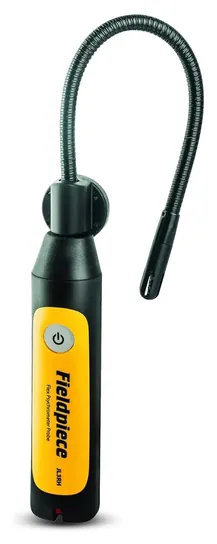
The Fieldpiece JL3RH moves to the top. It gives HVAC techs what they want from a psychrometer, wet bulb, dew point and the heat content of the air right at the unit, with no transmitter or cable, and its manual spells out accuracy, range and a salt-test check. The Fieldpiece SDP2 it replaces relied on an older wireless system.
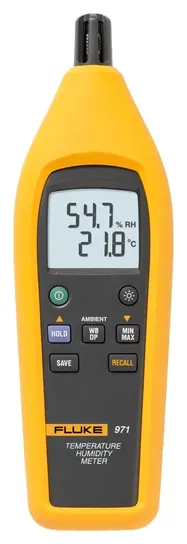
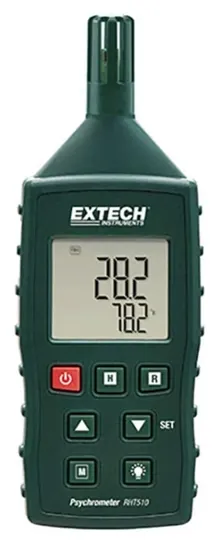
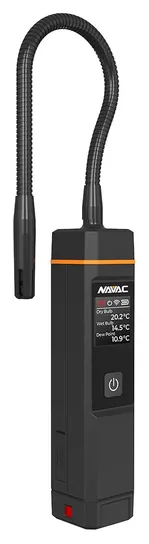
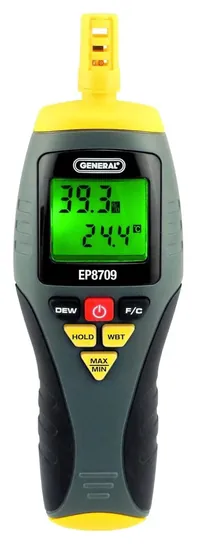
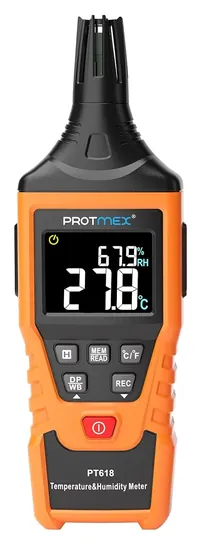
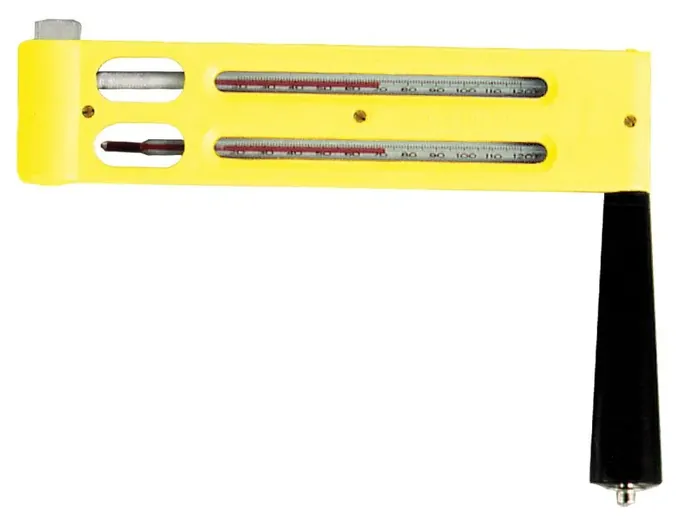
We dropped the UEi DTH35 and the Bacharach sling because of availability concerns, and the Mengshen M350, one of several look-alike generic meters. The Fluke 971, Extech RHT510, Testo 605i, Fieldpiece PRH2 and General Tools EP8709 stay; the last replaces the EP8710 we listed before. New are the rechargeable NAVAC NSH1, the Protmex PT618 for basements and grow rooms, and the Sper Scientific 736700 sling for anyone who wants a reading with no electronics at all.
The deciding evidence was paper: Fieldpiece's operator's manual and spec sheet, Extech's published tolerances, and what each maker will or won't say about accuracy. Two of the cheaper meters give no accuracy figure at all.
Earlier notes
October 1, 2020, by Will Rhoda:
During this round of updates, while the majority of our previous selections maintained their positions, we did decide on eliminating the PDI DP-110 due to availability issues, and also decided on removing the Mengshen M86 and General Tool EP8706, recognizing that our rankings already included superior offerings from these brands, with the Mengshen M350 and General Tools EP8710.
Our new selections this time around were the Fluke 971 — a solid device from one of the biggest names in metering, with memory to store up to 99 measurements; the Testo 605i — which features a flexible probe head, and can be hooked up to the company’s proprietary app with as many as five additional sensors, for complex diagnostic work; and the Fieldpiece JL3RH — which can also be connected with the company’s app, or alternatively paired with one of Fieldpiece’s wireless manifolds: the SM380V or SM480V.
A few things to think about for this category:
Display: Most of our offerings feature backlit LCDs that make it easy to observe your readings at the point of metering. The utility offered by these displays does vary considerably – the infinitesimal screen on the Fieldpiece PRH2, for example, argubally isn’t as convenient as the sizable display on the Extech RHT510 – but for the most part, they’ve got some sort of functional screen.
Two exceptions to this rule are the Fieldpiece JL3RH and Testo 605i. Neither of which have any sort of built-in screen, but both feature 350-foot Bluetooth ranges and the ability to connect multiple meters to the same smartphone app, which does make remote readings and complex diagnostics much more convenient, but it would still be nice to have some sort of display installed on these units. The Fieldpiece wireless manifolds that can be paired with the JL3RH are quite impressive pieces of machinery, presenting another means of observing readings for users who’d rather not be working with their phone in hand all day, but their prices dwarf that of the JL3RH itself, so it’s likely to be a toy that’s only considered by serious professionals and diehard gearheads.
Probes: Basic models in this category have their sensors housed in a single wand that protrudes from the unit, like an antenna. It’s a good design because, not only does it allow for ambient readings, but it also makes it simple to insert the probe into a small hole (that can easily be made with a drill bit, in a pinch) in a plenum, allowing for in-duct measurements.
Some selections – like the Testo 605i and Fieldpiece JL3RH – feature flexible probe wands, which makes it easier to maneuver them in tight spaces. The General Tools EP8710 is available, for a small additional fee, with an external, thermocouple probe that can make life a whole lot easier when you’re trying to work in cramped crawlspaces and cluttered utility rooms. And, the Fieldpiece SDP2 is the most advanced model we ranked, with two detachable leads that each feature wet- and dry-bulb sensors, making it a great choice for quick-and-easy superheat and supercooling calculations.
Transportation and Storage: Given that we’re wading through a category full of delicate instruments, I found that there was a disappointing lack of protective cases offered with most options, but some models do have some provisions that make them easier to store and carry.
By virtue of its small size and convenient clip, the Fieldpiece PRH2 isn’t much harder to transport than a fountain pen, and the UEi Test Instruments DTH35, Fieldpiece SDP2 and Testo 605i all have some provisions to allow for temporary magnetic mounting. The Extech RHT510 comes with a wrist strap and a bracket to mount it onto a separately purchased tripod, and while the soft carrying case for the Fluke 971 is sold separately, it does come with a convenient belt clip and holster.
One exception to the no-case rule is the Fieldpiece SDP2, which comes in a padded, blow-molded case.
February 4, 2019, by Quincy Miller:
The Bacharach 0012-043 might seem a strange addition to this list, given its analog interface. It's not ideal for professional technicians, as doing all those calculations on the slide rule will slow you down, but schoolchildren and hobbyists who enjoy old-fashioned meteorology should appreciate it.
Digital Or Sling: What A Psychrometer Measures
A psychrometer finds humidity by comparing two temperatures.
A psychrometer finds humidity by comparing two temperatures. The dry bulb is ordinary air temperature. The wet bulb is what a thermometer reads when water evaporates off it, so it reads lower in dry air and almost the same in damp air. A sling psychrometer, like the Sper Scientific sling, measures both directly: you wet one wick, whirl the frame, and look up the gap on a table or chart. Engineering ToolBox explains how dry bulb, wet bulb and dew point relate.
Most meters sold as digital psychrometers work the other way. A capacitive sensor reads relative humidity, and the meter calculates wet bulb and dew point. That's quicker and needs no chart. Fieldpiece rates its JL3RH probe at plus or minus 2.5 percent RH between 10 and 90 percent, and its pocket PRH2 at plus or minus 3 percent between 20 and 80 percent. Extech lists plus or minus 4 percent for the RHT510. Several budget meters publish no accuracy figure at all, which is a reason to treat their readings as a rough guide.
If you have a temperature and a dew point but want relative humidity, the National Weather Service has a free humidity calculator.
Probe, Pocket Meter Or Handheld
Pick the shape for the job. For system checks on air conditioners and heat pumps, a probe on a wand or a flexible stem gets the sensor into the airstream of a duct. The JL3RH and NSH1 have bendable probes, and the Testo 605i head folds to a right angle. Wireless probes send readings to a phone app, so you can set one in the return, one in the supply, and watch both from the condenser. Fieldpiece lists a range of 1,000 feet line of sight for the JL3RH; walls and metal cabinets cut that a lot.
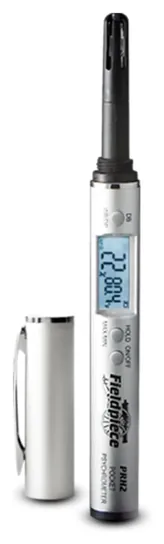
A pocket meter like the PRH2 is the quick-check tool. It has its own screen, slips into a duct hole and needs no phone, but it doesn't save or send anything.
A handheld with a screen and buttons, such as the Fluke 971 or Extech RHT510, suits building checks, warehouses and grow rooms. The RHT510 also takes a Type K thermocouple for pipe and surface temperatures. For home use, the EPA suggests keeping indoor humidity below 60 percent and ideally between 30 and 50 percent to limit mold (EPA mold and moisture guide); any meter on this list can tell you which side of that line you're on.
Keeping A Humidity Sensor Honest
Capacitive sensors drift over time, especially after exposure to condensation, solvents or dust. A salt test is the standard home check: a sealed container with damp table salt settles near 75 percent relative humidity. The JL3RH operator's manual describes this check and tells you to cover the sensor with the slip cover between jobs. The General Tools EP8709 goes a step further and can be adjusted in the field with 33 and 75 percent salt standards, sold separately.
Give any digital meter time to settle. Fieldpiece rates the JL3RH at about 60 seconds to reach 90 percent of a change, and readings taken right after you walk in from outside will wander. Don't breathe on the sensor or touch it, and keep it out of dripping condensate.
A sling psychrometer makes a good reference for checking a digital meter, since it measures the wet bulb directly. Swing it steadily until the wet-bulb reading stops falling, then read it at once. To turn the two temperatures into humidity, use a psychrometric chart or the table sold with many slings.
How we researched this
We compared 15 psychrometers and humidity meters, read Fieldpiece's JL3RH operator's manual and PRH2 spec sheet and Extech's RHT510 spec page, used the other makers' published details where we could reach them, weighed HVAC technician forum discussions and owner feedback, and checked every brand for recalls with the U.S. Consumer Product Safety Commission (none involve these meters). We found no independent lab tests of psychrometers. Updated October 23, 2026 by Ezvid Wiki Editors.
Sources (9)
- Fieldpiece: JL3RH Job Link Flex Psychrometer Probe
- Fieldpiece: JL3RH operator's manual (v25)
- Fieldpiece: PRH2 spec sheet
- Extech: RHT510 Hygro-Thermometer Psychrometer
- Sper Scientific: Sling Psychrometer
- U.S. EPA: A Brief Guide to Mold, Moisture and Your Home
- National Weather Service: Relative Humidity calculator
- Engineering ToolBox: Dry bulb, wet bulb and dew point
- Engineering ToolBox: Psychrometric chart
Frequently asked questions
Is a psychrometer the same as a hygrometer?
Not quite. A hygrometer is any instrument that measures humidity. A psychrometer is a hygrometer that works from a dry-bulb and a wet-bulb temperature. Most digital psychrometers read humidity with an electronic sensor and then calculate wet bulb and dew point, so they do both jobs.
What is the best psychrometer for HVAC work?
For system checks, a probe that reaches into the duct and reports wet bulb, dew point and enthalpy is the most useful. The Fieldpiece JL3RH does that wirelessly. If you'd rather not use a phone, the Fieldpiece PRH2 pocket meter shows four readings on its own screen.
What does wet bulb temperature tell you?
It's the temperature a wet surface reaches as water evaporates from it. The drier the air, the bigger the gap between dry bulb and wet bulb. HVAC technicians use it to check cooling performance and to find the right superheat target on some systems.
How often should I check a digital psychrometer?
A salt test once or twice a year is a reasonable habit, and after any time the sensor got wet or dirty. Damp table salt in a sealed container holds the air near 75 percent relative humidity.
Do I need a phone app to use one?
Only with probes that have no screen, such as the Fieldpiece JL3RH and Testo 605i. The NAVAC NSH1 works with or without its app, and handhelds like the Fluke 971 and Extech RHT510 need no phone at all.