The 6 Best Immersion Heaters
Updated by · How we research

Bucket, mug, tile-saw and pool immersion heaters compared on wattage, outlet load and shutoffs. The Allied Precision 742G is our pick for most buckets. When users buy our independently chosen editorial picks, we may earn commissions to help fund the Wiki.
A 2000-watt immersion heater draws about 17 amps, more than a standard 15-amp household circuit is built to carry, so wattage decides where you can plug one in as much as how fast it works. This page covers portable heaters you lower into a bucket, mug, tile-saw pan or stock tank, not the fixed elements inside a hot-water cylinder.


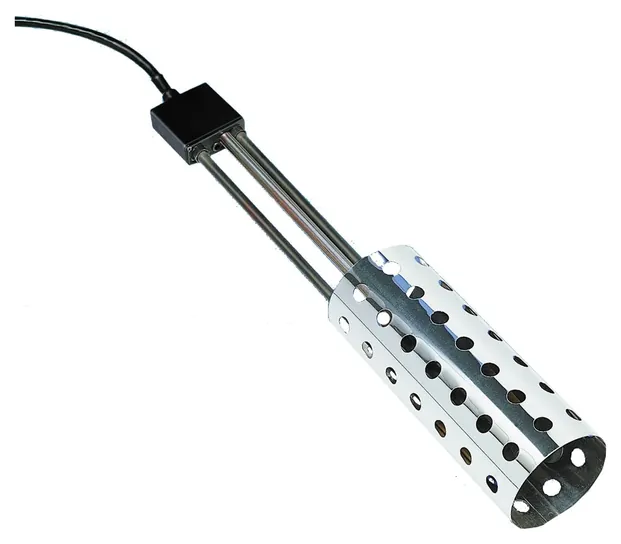
From the manual
- Plug it only into a grounded, GFCI-protected 120-volt outlet, keep the handle and cord dry, and never use it in a hot tub. p. 1
- Fill until the guard is covered, at least 8 inches deep, and unplug it if the water falls below 6 inches. p. 1
- It heats toward boiling and isn't a de-icer, so use a container that can hold boiling water; the sheet recommends metal. p. 1
- Clear lime with a liquid lime remover. Scale thicker than 1/32 inch can burst the element and put current into the water. p. 1
Why the Allied Precision 742G is our top pick
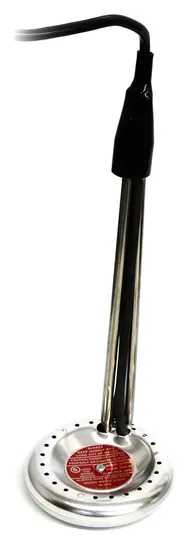
Our pick is the safer bet on an ordinary outlet. At 1000 watts and 120 volts it draws about 8 amps,1 leaving room on a 15-amp circuit, and its maker lists it with UL and CSA.2 Our runner-up, the Yoisie DG-002, runs at 1800 watts on a cord its seller rates for 15 amps, all a 15-amp circuit carries, and its listing names no safety mark.4
The 742G's one-page sheet spells out how it fails safe. A thermostat cycles the element, a separate thermal-overload switch shuts it off for good if that thermostat fails, and when the water runs low it cycles every few minutes instead of running hot.1 Miller's figure of a gallon from 60 to 130 degrees in about 10 minutes1 is what 1000 watts can deliver, so it's believable. That matters: in 2025 and 2026 the CPSC told owners to stop using several brands of perforated tube heaters that can ignite when partly out of water,5,6 one of them sold in a box printed "automatic power-off."5
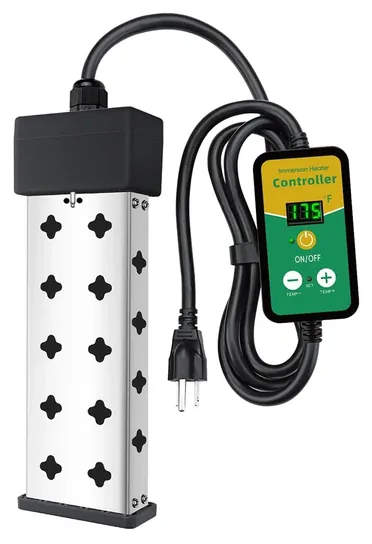
The runner-up wins on control. You set a temperature up to 175 degrees, it restarts after a 15-degree drop, and its seller promises a low-water shutoff with an alarm and a two-year warranty.4 Our pick heats toward boiling with no set point, needs at least 8 inches of water and a GFCI-protected outlet, and comes with a one-year warranty.1,3 For a held temperature, choose the runner-up; for plain hot water on a household circuit, choose the 742G.
| Allied Precision 742G | Yoisie DG-002 | |
|---|---|---|
| Power at 120 V | 1000 W, about 8 A | 1800 W, 15 A cord |
| Safety listing | UL and CSA | None stated |
| Temperature control | Thermostat, toward boiling | Set point up to 175 F |
| Low water | Cycles; overload cutoff | Shutoff and alarm (seller) |
| Warranty | 1 year | 2 years (seller) |
Sources
- Allied Precision 742G 1Instruction sheet, Miller Manufacturing (ManualsLib copy) 2Product page, Miller Manufacturing 3Spec sheet, Gundlach
- Yoisie DG-002 4Seller listing text (Nellis Auction copy)
- CPSC 5HAIYEATBNB immersion water heater warning, January 2025 6Lakkzoom immersion water heater warning, July 2026
Editor's Notes
November 4, 2026, by Ezvid Wiki Editors:
We read Miller Manufacturing's instruction sheet for the Allied Precision 742G and Gundlach's spec sheet for the Electra SafeHete, added a section on why the 742G leads, and corrected the SafeHete's power draw: it's an 1150-watt heater that suits an ordinary outlet. The guide now gives the electrical code's three-hour rule for continuous loads, follows each heater's own container advice instead of a blanket ban on metal buckets, and lists the CPSC's 2025 and 2026 warnings on look-alike tube heaters, none of which names a pick here.
October 23, 2026, by Ezvid Wiki Editors:
The Allied Precision 742G moves to the top. It's a plain 1000-watt bucket heater with a thermostat and a steel guard, and it has sold for years with UL and CSA listings claimed, which counts for a lot in a field crowded with look-alikes. The Electra SafeHete stays for tile-saw pans and other shallow containers.
Eight earlier picks dropped out. We couldn't find the two Pong-Dang heaters, the Yrvhck, the BlazeTech or the Norpro Instant for sale, and the Lewis N. Clark and Mofarso Floating are unavailable. The RoadPro 12V had no price or stock when we checked. New picks add the Yoisie DG-002 with a digital controller, the fast BSEED WH-B, the JIOTAR 300W mug coil and the JUPSDDTH JU-1800, a tank and pool rod with its own ground-fault plug.
Many bucket heaters sold today are one factory design under several brand names, so we kept one of each kind. The most useful evidence turned out to be simple arithmetic: a 2000-watt heater draws more current than a 15-amp circuit is meant to carry, and a bathtub takes well over an hour to warm. Whatever you buy, heat the water, unplug the heater, and only then get in.
Earlier notes
December 24, 2020, by Chris Gillespie:
Providing a versatile method of heating water for anything from a cup of tea to a dip in the hot tub at the weekend, these immersion heaters are available in a range of sizes and heat outputs. [2026 update: heat the water, then unplug the heater and take it out before anyone gets in. The Allied Precision 742G's instructions rule out hot tubs altogether.] In this update, we added several new items to make the ranking as comprehensive as possible.
The BlazeTech Premium and the Pong-Dang KD Heater are both designed to sit on the lip of a bucket and are adept at heating up to five gallons of water in a short period of time, the latter is also equipped with an adjustable thermostat.
For larger amounts of water, for example, an inflatable pool or a small hot tub, the Yrvhck 1600 Watt and the Mofarso floating are the best choices, however, they will still take several hours if the water is cold to start with. Finally, we included the Pong-Dang Fully Submersible, which has a titanium heating rod that can be completely submerged on its flexible stainless-steel hose. It comes with an in-line thermostat, and can also be used for heating chemicals.
November 23, 2018, by Melissa Harr:
Selected both the Lewis N. Clark and Norpro models despite occasional issues with longevity, as often this can be attributed to user error; anyone selecting these models or similar are encouraged to peruse the directions before use. [2026 update: Health Canada posted UL's recall of Norpro immersion heaters, models 559 and CH103 with date codes 1110 to 1409, because the liquid could become energized and the heaters weren't authorized to carry the UL mark.] Added the Allied Precision and Electra models for those who have larger containers of water to heat, as well as the Anova despite hiccups with the Wi-Fi option, as the Bluetooth version seems to function fine.
Watts, Amps And The Outlet You Have
That's also why the better sellers warn against power strips, two heaters in one outlet and thin extension cords.
Divide watts by volts to get amps. A 1000-watt bucket heater on a 120-volt outlet draws about 8 amps, an 1800-watt rod draws 15, and a 2000-watt tube draws nearly 17. Most household outlets sit on 15-amp circuits, so a 2000-watt heater is already over the limit, and even an 1800-watt one will trip a breaker if a space heater shares the line. The electrical code also treats a load that runs for three hours or more as continuous and, as Schneider Electric explains, sizes the circuit so it carries no more than 80 percent of the breaker rating: 12 amps on a 15-amp circuit, 16 on a 20-amp one. A pool or stock-tank rod left on all afternoon is that kind of load, which is why a 2000-watt heater belongs on a 20-amp circuit with nothing else running on it.
That's also why the better sellers warn against power strips, two heaters in one outlet and thin extension cords. A light cord carrying 15 amps for an hour gets hot at the plug. If you must use one, pick a short 12- or 14-gauge cord rated for the load. Wattage sets the speed and stainless steel is the usual sheath for household water, while titanium is for harsh or very hard water (Superb Heating); Powerblanket explains how wattage, sheath and container size fit together. If your only outlet is on a 15-amp circuit, a 1000-watt heater is the safe choice. Kitchen counter outlets in homes wired to code sit on 20-amp circuits, according to a code interpretation from BOAF.
How Long Will It Take?
Physics sets the pace, and no heater beats it. Every watt goes into the water, so the math is simple: 5 gallons of 50-degree tap water needs about 37 minutes at 1000 watts to reach 100 degrees, and about 18 minutes at 2000 watts, before any heat escapes from the bucket. A 40-gallon bathtub raised 30 degrees takes about an hour and a half at 2000 watts. A 1,000-gallon stock tank or kiddie pool raised 10 degrees at 1800 watts takes more than half a day.
Honest ratings match that math. Miller rates the 1000-watt 742G at about 10 minutes to take one gallon from 60 to 130 degrees, which is what the physics allows, so treat a listing that promises a full bucket "in minutes" with care. Covering the container and insulating its sides helps far more than buying a bigger heater. And an immersion heater isn't a winter freeze-protection tool. For a livestock trough, use a purpose-made tank de-icer with a guard and a thermostat that switches on near freezing; the U.S. Consumer Product Safety Commission recalled one brand of trough heaters in 2009 over covers that could crack and expose live parts (CPSC).
Safe Use: Water First, Power Last
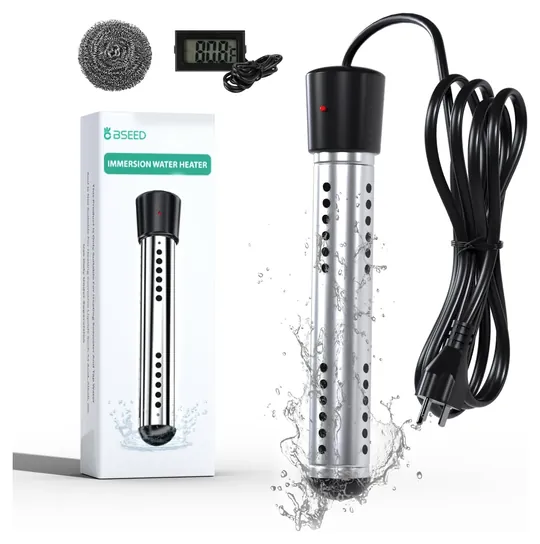
The rules are the same for every heater on this page. Put it in the water before you plug it in, and keep it covered the whole time; a dry element burns out in seconds and can melt a plastic container. Unplug it before you touch the water, lift it out, or let anyone in. None of these heaters is meant to run with a person or animal in the water, and the BSEED's listing says so outright. Plug into a GFCI outlet or a plug-in GFCI adapter every time; the Allied Precision 742G's instructions require one, and the JUPSDDTH JU-1800 has one built into its cord.
Use the container your heater's instructions call for, and keep the cord off liners and out of the water. The BSEED's seller calls for a non-conductive one, such as a plastic tub, and rules out iron, while the 742G's sheet asks for a container that can hold boiling water and recommends metal. Scale builds up on the element in hard water, so clear it with a lime remover now and then; the 742G's sheet warns that heavy scale can make the element burst. A UL mark you can see on the heater's label means more than "UL" in a sales title. In 2022, the CPSC announced a recall of about 5,000 ToolGuards portable heaters sold on Amazon for shock and fire hazards, and an earlier one covered mug heaters that could corrode and shock. Since 2025 it has told owners to stop using three more brands of perforated tube heaters sold online, HAIYEATBNB, Laboomkey and Lakkzoom, because they can catch fire when partly out of water. If you came here for the fixed element in a home hot-water cylinder, that's a plumbing part, covered in guides like Toolstation's.
How we researched this
We compared 18 portable immersion heaters, from mug coils to pool rods, and worked out current draw and heating times from each pick's wattage. For the two long-sold picks we read Miller Manufacturing's instruction sheet and product page for the Allied Precision 742G and Gundlach's spec sheet for the Electra SafeHete 2150SS, which shares its 1150-watt element with the taller 3150SS. We found no manual or maker site for the Yoisie, BSEED, JIOTAR or JUPSDDTH, so those entries rest on their sellers' listing text. Our November 4, 2026 search of CPSC and Health Canada notices found none naming any of the six, but it did turn up CPSC warnings from 2025 and 2026 on three other brands of tube heaters sold online that can ignite when out of water.
Sources (16)
- Superb Heating: which is the best immersion heater
- Powerblanket: choosing the right immersion heating element
- CPSC: ToolGuards portable water immersion heaters recall (2022)
- CPSC: Ritchie immersion heaters recall (2009)
- CPSC: World Kitchen immersion heaters recall
- Toolstation: immersion heater buying guide
- Miller Manufacturing: Allied Precision 742G instruction sheet (ManualsLib copy)
- Miller Manufacturing: 1000-watt bucket heater (742G) product page
- Gundlach: 2150SS water heater spec sheet
- CPSC: HAIYEATBNB immersion water heater warning (2025)
- CPSC: Laboomkey immersion water heater warning (2025)
- CPSC: Lakkzoom immersion water heater warning (2026)
- Health Canada: Norpro immersion heater recall (expanded 2016)
- Schneider Electric: 80% vs. 100%-rated circuit breakers
- BOAF interpretation: NEC 210.11(C)(1) kitchen circuits
- TileThis: Electra SafeHete 2150SS and 3150SS bucket heaters
Frequently asked questions
Can I heat a bathtub or hot tub with someone in it?
No. Heat the water, unplug the heater, take it out, and then get in. The 742G's instructions say to unplug it before taking it out of the water, and the BSEED's listing says to keep people and animals out of the water while it runs.
How long does it take to heat 5 gallons of water?
Raising 5 gallons from 50 to 100 degrees takes at least about 37 minutes at 1000 watts and about 18 minutes at 2000 watts. Real times run longer because the bucket loses heat.
Can I use an immersion heater in a plastic bucket?
It depends on the heater, so follow its own sheet. Miller says the 742G won't damage a plastic pail, though its instructions ask for a container that can hold boiling water and recommend metal. The BSEED's seller calls for a non-conductive container and rules out iron. Whatever the bucket, the water must cover the element.
Can I plug an immersion heater into an extension cord?
Best not. If you must, use a short, heavy 12- or 14-gauge cord rated for the load, and never a power strip. A 2000-watt heater needs a 20-amp circuit to itself.
Will an immersion heater keep a stock tank from freezing?
Not safely for weeks at a time. Use a stock-tank de-icer made for continuous outdoor use, with a guard and a thermostat that turns on near freezing.
Is this the same as the immersion heater in a hot-water cylinder?
No. A cylinder immersion heater is a fixed element screwed into a home water tank and is fitted by a plumber or electrician. This page covers portable heaters you drop into a container.