The 8 Best Faraday Bags For Phones
Updated by · How we research

Eight Faraday bags and sleeves for phones compared on seal, shielding and fit. The Mission Darkness Non-Window leads for its double-roll seal and modest price. When users buy our independently chosen editorial recommendations, we may earn commissions to help fund the Wiki.
A Faraday bag only works when it's sealed: a federal forensics guide warns that seams, thin fabric and a loose closure let signals slip through, and that a phone hunting for a tower drains its battery fast. Call your phone once it's sealed to check. These picks suit privacy-minded travelers, drivers guarding key fobs and anyone who wants a phone offline.


From the manual
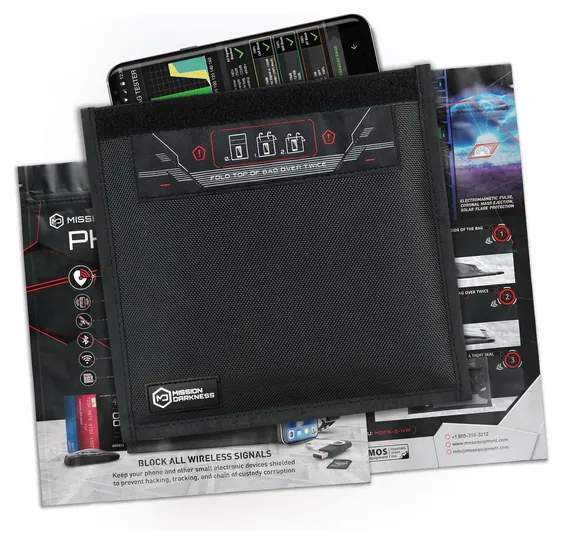
- Roll the top down twice and press the strip shut full width; a cable, strap or fabric corner caught in the fold leaks. Sealing the bag
- It can't charge a phone from outside; a battery pack has to ride inside the sealed bag. Q&A
- The maker says this phone bag is currently made in China; the country is printed near the bottom of the box's back. Q&A
Mission Darkness Non-Window maker page: specs, sealing and Q&A
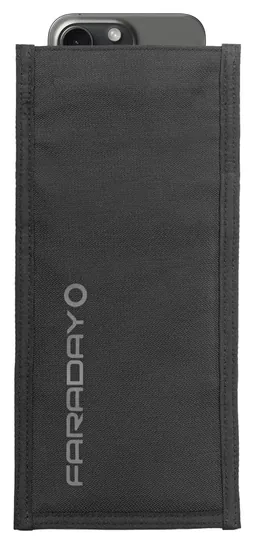
Compare the specs
Swipe the table sideways to see every column.
| Product | Inside size (in) | Closure | Maker's shielding data |
|---|---|---|---|
| 1. Mission Darkness Non-Window | 8.5 x 5 | Double roll, hook-and-loop | Certified, no dB published |
| 2. Faraday Defense Jacket Pro | 8 x 4.5 | Magnetic double fold | >85 dB, 0.4-40 GHz |
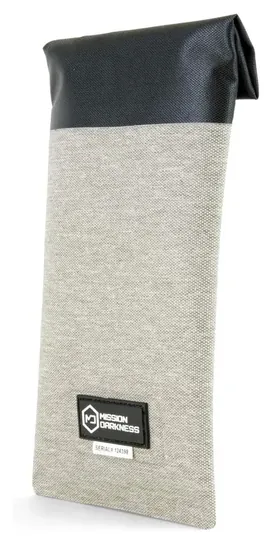
| 3. Mission Darkness Dry Shield | 7.5 x 4 | Double roll, magnets | Certified, no dB published |
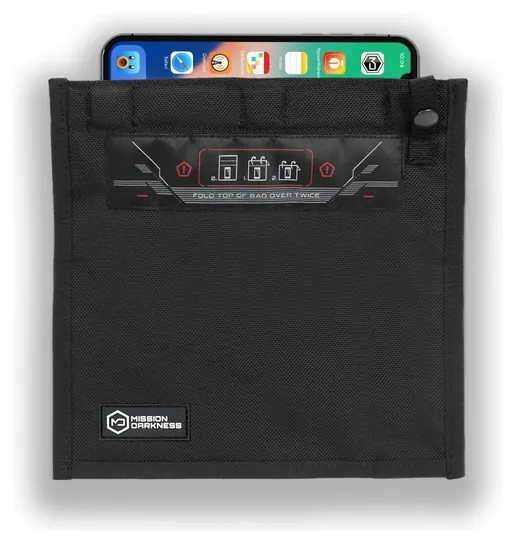
| 4. Mission Darkness NeoLok | 9 x 6.5 | Double roll, magnets, strap | Certified, no dB published |
| 5. Simket Two-Pack | — | — | — |
| 6. Mission Darkness Mojave | 7 x 4.5 (sleeve) | Hook-and-loop fold, zip case | Certified, no dB published |
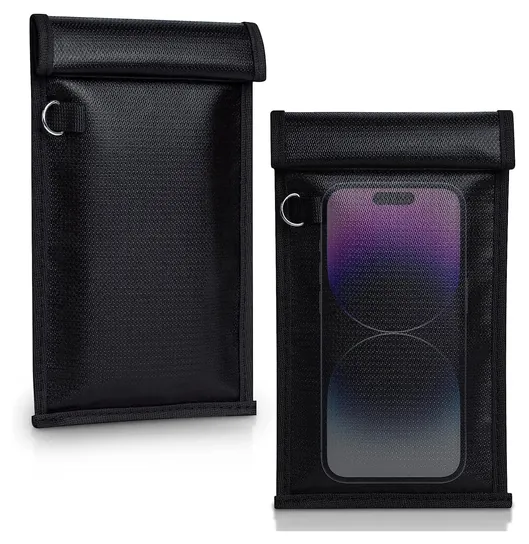
| 7. SLNT Locking Sleeve | 6.7 x 4.5 | Magnetic flap, lock ring | 79.8-94.9 dB, 1-40 GHz |
| 8. DefenderShield ConcealShield | — | Hook-and-loop flap | About 72 dB at 0.4-6 GHz |
Inside sizes are length by width, each maker's usable interior with the bag closed; the Mojave's is its shielded sleeve, and the Jacket Pro's is the vertical phone size. Simket has no maker site and DefenderShield gives only outside sizes, so those cells are blank. Shielding figures are the makers' own: SLNT's and DefenderShield's come from lab tests of flat fabric samples, not finished bags, and Mission Darkness sends its reports on request.
Sources
- Mission Darkness Non-Window spec page Dry Shield spec page NeoLok spec page Mojave spec page
- Faraday Defense Jacket Pro vertical bag specs at distributor LBA One Source
- SLNT Locking bag spec page Phone sleeve page with fabric lab results
- DefenderShield ConcealShield product page Ultra Armor shielding test report, 2025 (PDF)
From the manual
- Long contact with water or a puncture degrades the shielding liner, so never seal a wet phone or sharp objects inside. Usage notes
- Anything crossing the opening, such as a charging cable, lets signals pass. Usage notes
- The usable space is about 7.5 by 4 inches and half an inch deep, so a phone in a bulky case may not fit. Dimensions & Fit
Mission Darkness Dry Shield maker page: dimensions and usage notes
From the manual
- The snap strap is meant for transport; with it undone, the magnetic roll opens one-handed, even while wearing gloves. Description
- Magnets sewn into the bag let it stick to metal surfaces. Features
From the manual
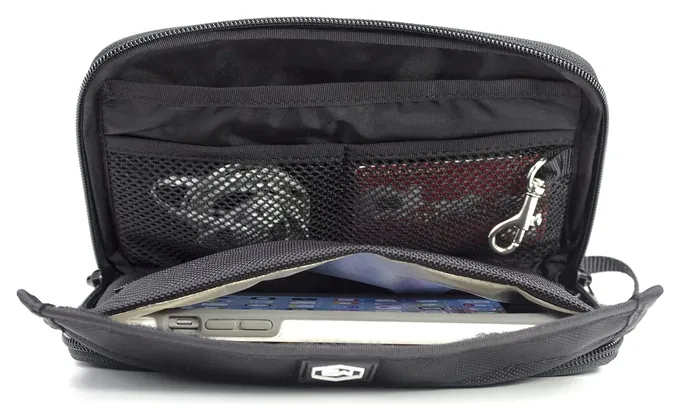
- The sleeve closes by folding its pocket over and pressing a hook-and-loop strip. Features
- Water or a puncture can ruin the shielding, so don't carry wet devices or loose sharp items in it. Usage warning
- The maker lists the Mojave as made in the USA. Features
From the manual
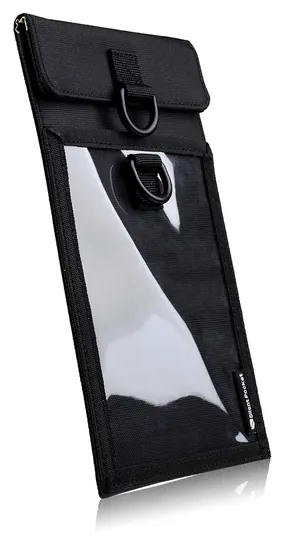
- It comes in one medium size, and SLNT advises leaving room around the device; a phone case counts toward the fit. sizing guide
- The phone must sit fully below the magnetic flap, or the flap can't close and seal. sizing guide
- SLNT says it's engineered to meet OSHA compliance standards for shielding key fobs during remote-start vehicle servicing. Key features
- The clear front pocket does not block signals. Key features
From the manual
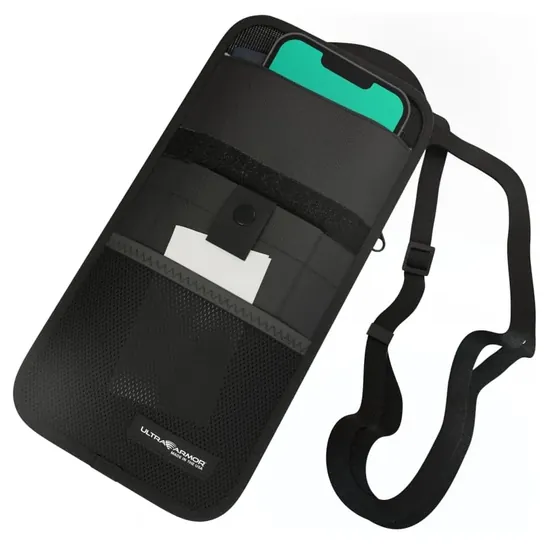
- Nothing may stick out past the opening; fold the flap over and press along its full length, corners included. How to Use
- An incomplete seal may only dampen signals, the maker warns; a call to the sealed phone should go straight to voicemail. How to Use
- Don't submerge it, machine wash it or sharply fold the shielding; brush lint off the hook-and-loop strip if it stops gripping. Care Instructions
- Only the Crossbody version has the back pocket and the detachable strap; the Standard is a strapless pouch, so check which one you're buying. Specifications
DefenderShield ConcealShield maker page: how to use, care and specs
Editor's Notes
November 5, 2026, by Ezvid Wiki Editors:
We rechecked this page's claims against the makers' pages, NIST's forensics guide and two independent bag checks. The Mission Darkness Non-Window stays on top, but its maker says this bag is currently made in China, so we removed the line saying it's assembled in the U.S., along with a call-test claim no source showed for this size. We also corrected the Jacket Pro and ConcealShield entries, since both makers publish shielding figures, and added a spec table and each maker's sealing and care advice.
October 23, 2026, by Ezvid Wiki Editors:
The Mission Darkness Non-Window now leads this list. Its double-roll seal runs the full width of the bag, and it costs little for a bag from a maker that names its test standards. The Mission Darkness Dry Shield, Mission Darkness Mojave, SLNT Locking Sleeve and DefenderShield ConcealShield stay. The Faraday Defense Jacket Pro, Mission Darkness NeoLok and Simket Two-Pack are new.
We dropped the EDEC OffGrid window bag, the Onever Pouch, the NeoLok with Battery and the Silent Pocket Carryall because they've gone off the market, and the Armadillo Pro-Tec because we found nothing beyond its sales page to back it.
The most useful evidence here came from two prepper sites that sealed phones in several of these bags and then tried to call, pair or connect to them, and from NIST's guide to handling seized phones, which explains why bags leak and drain batteries. We read each maker's shielding claims and found no recalls for these brands.
Earlier notes
December 12, 2020, by Melissa Harr:
Anyone who has even a passing knowledge of Faraday bags shouldn't be too surprised to see that multiple models from Mission Darkness have made the cut; this company produces reliable gear for protecting your critical devices, from smartphones to laptops. Because it offers shielding as well as protection against water, we've added the Mission Darkness Dry Shield Sleeve as the choice to beat at this time. [2026 update: the Mission Darkness Non-Window now leads this list, and the Dry Shield ranks third.] It's easier to close securely than many, and the price isn't too steep. The Armadillo Pro-Tec remains on the list as a similar alternative, although one that's less expensive — and perhaps not made to quality standards that are quite as high.
Both of the aforementioned are relatively small and slim. For something larger, look to the Mission Darkness Non-Window, Mission Darkness Mojave, or DefenderShield Anti-Tracking. The DefenderShield model even has a handy crossbody strap, making this a good choice for travel. The Silent Pocket Carryall also has a carrying strap, one designed for the wrist, that makes this model look quite a bit like a wristlet purse.
Finally, a quick word about using a Faraday phone bag properly. In order for these pouches to work, they need to be sealed securely according to all manufacturer specifications. For instance, some, like the Onever Pouch, have a liner inside, and the phone must be placed fully within this liner in order for the pouch to function. Sometimes this placement is not intuitive, so you'll want to carefully read the item's directions. You should also occasionally inspect whichever one you choose, since rips, loose stitching, and other issues caused by daily use can render the bag ineffective.
February 5, 2019, by Karen Bennett:
These models were all selected since they’re well equipped to keep your phone insulated and safe from the wealth of personal and financial information that it may store. Included are 2 Mission Darkness models, both known for their dependability, as well as 2 practical choices equipped with straps. In all, the selections featured here are in a variety of shapes and at different price points. Interestingly, this type of product got its name from 19th century scientist Michael Faraday, who invented a conductive mesh enclosure to block electrical fields. [2026 update: his own enclosure was a room lined with metal foil, not mesh.]
Special Honors
GoDark Faraday Bag for Phones GoDark's phone bag isn't among our eight picks, but it's worth knowing, and it's sold by other dealers as well as on GoDark's own site. It pairs a roll-top closure and strap with welded, water-resistant seams, a foam layer and a felt liner that keeps the phone off the shielding fabric. GoDark says its fabric beat 100 decibels in independent lab tests and passed a military EMP shielding test. It takes a phone up to about 6.75 by 3.25 inches, without a case. godarkbags.com
How A Phone Bag Leaks, And How To Check Yours
A powered-on phone that can't find a network keeps raising its radio power to search, so the battery drains faster than usual, NIST notes.
A Faraday bag is a pouch lined with metal-plated fabric that stops radio waves from reaching the phone inside: cellular, Wi-Fi, Bluetooth, GPS and NFC. It isn't all or nothing. The NIST guide to mobile device forensics says shielding containers may weaken a signal without fully stopping it, especially near a cell tower. It cites a Purdue field test in which many shielding products let some traffic through, text messages most often, for three reasons: thin material, gaps at the seams and the shield itself acting as an antenna.
Most real-world failures come down to the closure. A roll-top that isn't rolled all the way, or a flap left half open, leaks. Check yours the way reviewers at TruePrepper and Cat Outdoors did: seal the phone, then call it from another phone, try to pair a Bluetooth device and look for it on Wi-Fi. If anything connects, reseal it and try again before trusting the bag. Don't go by a video that keeps playing: Mission Darkness notes that a buffered stream can run for a moment after the signal is cut.
A powered-on phone that can't find a network keeps raising its radio power to search, so the battery drains faster than usual, NIST notes. For storage or long trips, power it off first.
Roll-Top, Magnetic Flap Or Travel Case
Closures trade speed for seal. Roll-top envelopes, like the Mission Darkness Non-Window, fold the opening over twice and then fasten it, which closes the gap that leaks most. They're slower to open. Magnetic double rolls, used on the Dry Shield, close faster and still roll. A magnetic fold, as on the Jacket Pro, is quickest of all, and TruePrepper points out that it can't be misaligned the way a hook-and-loop strip can.
Check the inside size against your phone in its case, not the bare phone. Inside sizes on this list run from about 6.7 by 4.5 inches on the SLNT to 9 by 6.5 inches on the NeoLok, and the Dry Shield is the narrowest at 4 inches. The Mojave hides a shielded sleeve of about 4.5 by 7 inches inside a zippered organizer, and only that sleeve blocks signals. SLNT advises sizing up, since a phone that fills a bag to its edges can keep the flap from sealing.
Carry style matters too. Slim sleeves fit a jacket pocket, roll-top envelopes ride in a bag, and crossbody pouches stay on your body. Joshua Lee, an Arizona police sergeant with almost two decades in law enforcement, named the Non-Window his best overall bag in a 2024 column after months of field use with Mission Darkness gear, while warning that it's hard to carry on your person. Heavier bags, he writes, suit a car or a search-warrant kit.
What Shielding Claims Mean, And What They Don't
"Military grade" on a box means nothing by itself. MIL-STD-188-125 and IEEE 299 are test methods, and makers usually test the fabric, not the finished bag. Mission Darkness says its fabric was tested to both and offers the reports on request. SLNT publishes lab results for one layer of its fabric, about 80 to 95 decibels across 1 to 40 GHz, and DefenderShield posts a 2025 lab report on its shielding material. Budget brands often name no test at all, which is why a call test at home matters.
A plain RFID-blocking wallet or card sleeve is not the same thing. It stops short-range card readers, not a phone's cellular radio. Airplane mode isn't a substitute either: it's a software setting, and NIST notes it doesn't always stop services such as GPS.
Care keeps the shielding working. Keep wet devices and sharp objects out, and don't fold the shielding sharply, which DefenderShield says can damage it. Check now and then for tears or worn seams: Mission Darkness warns that even minor damage can let signals in. Owning a Faraday bag is legal in the U.S., but a sealed phone can't call 911, so don't bag the only phone you'd use in an emergency.
How we researched this
We compared 15 phone bags and sleeves and kept these 8. None of them ships with a real manual, so we read the makers' spec and usage pages instead: Mission Darkness's pages for the Non-Window, Dry Shield, NeoLok and Mojave, SLNT's Locking bag page and sizing guide, the Jacket Pro spec sheet from Faraday Defense's distributor, and DefenderShield's ConcealShield page with its 2025 lab report on the shielding material. NIST's mobile forensics guide explained how bags leak, TruePrepper's and Cat Outdoors' call and pairing checks covered the Jacket Pro and the Simket pouches, and searches of CPSC and Health Canada recall notices found none for these brands. Updated November 5, 2026 by Ezvid Wiki Editors.
Sources (17)
- Mission Darkness: Non-Window Faraday Bag for Phones
- Mission Darkness: NeoLok Non-Window Faraday Bag
- Mission Darkness: Dry Shield Faraday Phone Sleeve
- Mission Darkness: Mojave Faraday Phone Bag
- LBA One Source: Faraday Defense Jacket Pro Vertical Phone Bag specs
- SLNT: Locking Faraday Bag
- SLNT: Faraday Sleeves for Phones (fabric lab results)
- SLNT: Sizing guide
- SLNT: Are Faraday bags legal?
- DefenderShield: ConcealShield Faraday Travel Bag
- DefenderShield: Ultra Armor shielding test report (2025, PDF)
- GoDark: Faraday Bags for Phones
- TruePrepper: Best Faraday Bags
- Cat Outdoors: Best Faraday Bags
- FireRescue1: Joshua Lee, Shielding your tech: Why you need a Faraday bag
- NIST SP 800-101 Rev. 1: Guidelines on Mobile Device Forensics
- U.S. Consumer Product Safety Commission recalls
Frequently asked questions
Do Faraday bags actually work for phones?
Good ones do when they're sealed properly. Independent checks found well-made bags cut off calls, Wi-Fi and Bluetooth. NIST warns that any container may only weaken a signal, so test yours by calling the phone once it's sealed.
Can a phone be tracked inside a Faraday bag?
Not while the bag is fully sealed and working, because the phone can't reach towers, Wi-Fi or GPS. Once you open it, the phone reconnects and can report its location again.
Does a Faraday bag drain the phone's battery?
It can. A phone that can't find a network keeps searching at higher power, so the battery runs down faster. Turn the phone off if it will stay in the bag for long.
Is a Faraday bag the same as airplane mode?
No. Airplane mode is a software setting, and NIST notes it doesn't always stop services such as GPS. A sealed bag blocks the signals physically, but only while it stays closed.
Will a Faraday bag fit my phone in its case?
Check the inside size, not the outside. Roll-top envelopes and the larger magnetic bags take big phones in rugged cases, while slim sleeves often need a thin case.
Are Faraday bags legal?
Yes. No federal law bars shielding your own phone; the federal ban covers signal jammers, which broadcast interference to every phone nearby. Remember that a sealed phone can't call 911.